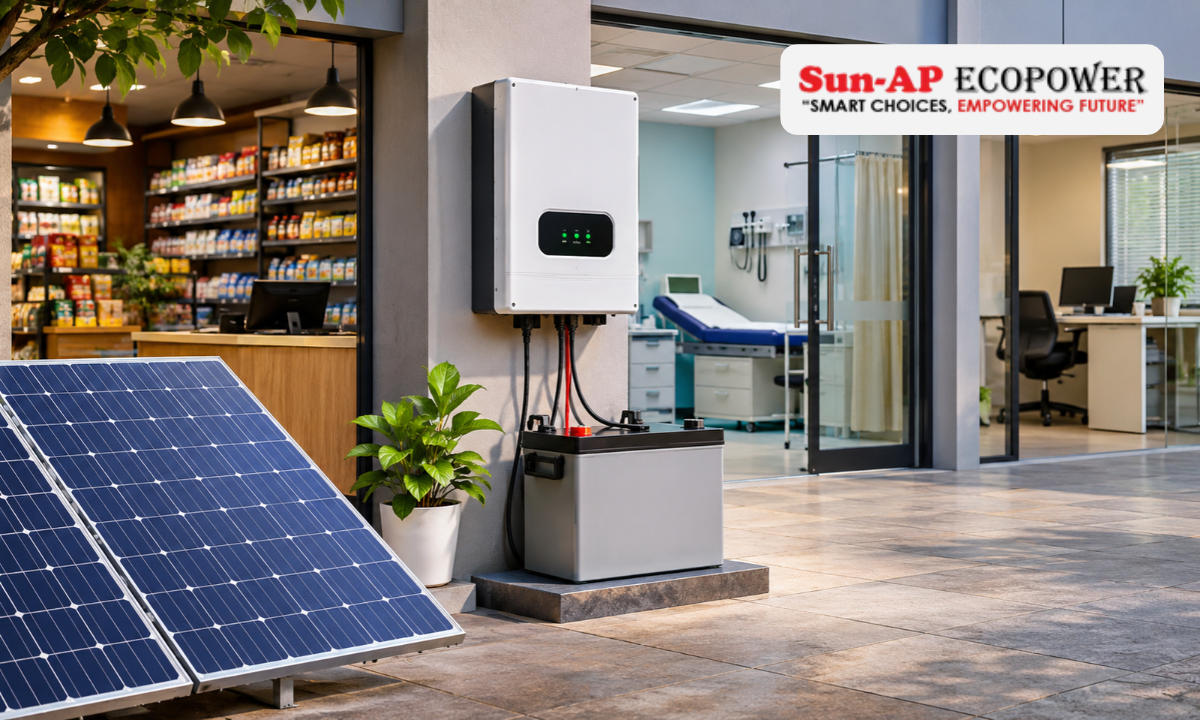
A power cut costs a shop its sales and a clinic its patients. A solar inverter with battery keeps essential loads running and lets you use your own solar power after sunset. This guide is written for businesses; homeowners can read our explainer on how a hybrid solar system works during power cuts.
Why Businesses Need Battery Backup with Solar
A standard on-grid system shuts down when the grid fails, as a safety measure. Commercial solar battery backup lets critical loads such as billing counters, lighting, refrigeration and medical devices keep running. Our post on commercial solar systems explains the grid-tied side of the story.
What to Back Up: Critical and Non-Critical Loads
- Critical: billing system, lights, fans, network equipment, refrigeration.
- Non-critical: air conditioners and heavy motors, which need a much larger battery.
Backing up only critical loads keeps battery size and cost manageable. A solar inverter for shop installation usually starts with this list.
How Hybrid Solar Inverters Handle Backup
Hybrid solar inverters combine solar conversion, battery charging and grid interaction in one unit. The single phase Feston hybrid models on our shop list switching to backup in about 10 ms, which helps keep computers and billing machines running through a cut.
Choosing a Three Phase Hybrid Inverter
Many shops, clinics and small offices have three phase supply. The three phase hybrid inverter range on our shop includes a Feston 10kW model that lists 97.6% efficiency, 210A charge capacity and AC coupling support for existing solar systems.
Lithium Battery Backup: What to Check
Lithium battery backup suits business use because it offers deep usable capacity and long life. The Feston 5.12kWh, 48V 100Ah pack on our shop lists 6000 cycles at 90% depth of discharge, can be paralleled up to 16 units, and is sold only together with an inverter. Confirm that the inverter and the battery management system communicate correctly.
Installation and Safety Checks
Ask your installer to place the battery in a dry, ventilated spot and to use proper isolators and earthing. A separate backed-up distribution board for critical loads keeps the rest of the premises off the battery. Keep a written load list so the system can be checked or expanded later.
Comparison: On-Grid vs Hybrid for a Small Business
| Feature | On-grid | Hybrid with battery |
|---|---|---|
| Works in a power cut | No | Yes, for critical loads |
| Daytime bill savings | Yes | Yes |
| Solar use after sunset | No | Yes, from the battery |
| Upfront cost | Lower | Higher |
Where to Get Sizing Help
Share your load list and backup hours with our team, and browse the hybrid solar inverters shop. To read more about the Feston range, see our Feston inverters guide.
Can a solar inverter with battery run an air conditioner?
It can, but air conditioners draw high power, especially at start-up, so you need a larger inverter and battery bank. For most small sites we recommend backing up critical loads first, such as lights, fans, computers, billing machines and refrigeration, and adding the air conditioner only if the budget and battery size allow. Share your air conditioner rating and our team will check what is realistic.
Is a hybrid system worth it for a small shop?
It depends on how often power goes out and how much it costs you when it does. If outages are frequent or you work after sunset, a hybrid solar inverter with battery can keep the shop running and still cut daytime grid use. If outages are rare, a standard on-grid system may be enough. Share your usage and we will advise.
What is the difference between on-grid, off-grid and hybrid inverters?
An on-grid inverter feeds solar power into the grid and usually does not run without grid supply. An off-grid inverter works with batteries and does not depend on the grid. A hybrid inverter combines both, using solar, battery and grid together. Backup during outages needs an off-grid or hybrid type with a battery.
How do I decide how big the battery should be?
Start by listing the loads you want to keep running and how long you need them. Multiply each load’s power by its running hours to get the energy you must store, then add a margin. Battery size also depends on the type of battery and how deeply it can be discharged. Send us your list and our team will size it with you.
Should I choose a lithium battery or a lead-acid battery?
Both are used in backup systems. Lithium batteries are generally lighter, take less space and suit frequent daily cycling, which helps in small shops and clinics. Lead-acid batteries usually cost less up front. We supply lithium batteries, including LFP, and other battery options on our batteries page.
Is a solar inverter with battery suitable for clinics?
It is often used to keep essential equipment running during outages, but clinics need extra care. Identify life-critical and sensitive equipment first, and confirm its power needs and switch-over requirements with the equipment maker or your electrician. Share your equipment list and our team will help you plan the backup.
What should I ask a dealer before buying a hybrid inverter?
Ask about warranty terms, battery compatibility, service support, expansion options and how backup works during an outage. Our guide on questions to ask dealers before buying a solar hybrid inverter lists what to check. Also read about solar inverter warranty before you decide.
Can I add batteries or solar panels to my system later?
Often yes, but it depends on the inverter and battery model. Some systems allow added battery capacity, and some limit the solar input. Tell us your future plans at the start so we can choose a model that leaves room to grow.
Plan your backup around the loads that matter most. Send us your list and we will recommend a suitable setup. For a wider view of inverter types and trade-offs, read our guide on solar inverters with a battery.