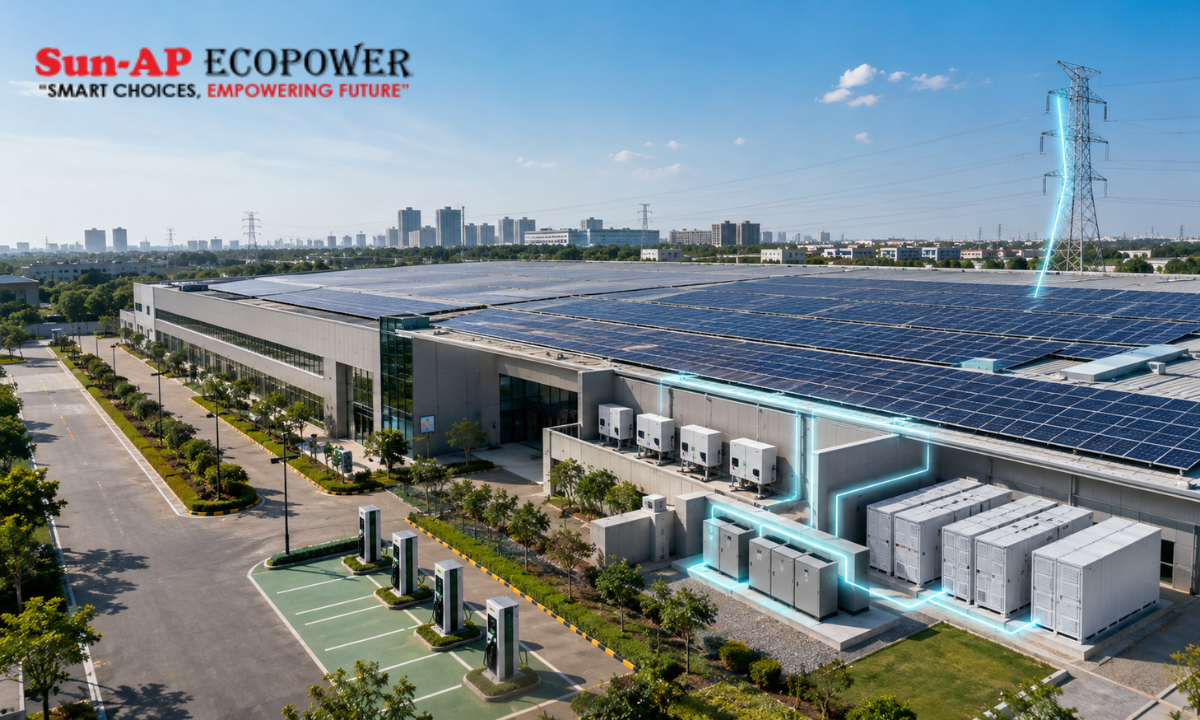
For modern industrial facilities and corporate enterprises across India, energy procurement is no longer a fixed operational expense, but a strategic lever for balance sheet optimization. Transitioning to commercial solar systems allows companies to lock in predictable energy costs for the next two decades, effectively insulating their operations from volatile utility tariff hikes.
However, shifting to high-yielding captive power generation requires sourcing top-tier photovoltaic assets from certified solar panel distributors in India who understand the strict engineering and safety demands of large-scale rooftop and ground-mounted arrays.
Historically, corporate participation in renewable energy was driven primarily by environmental corporate social responsibility (CSR) mandates or green branding initiatives. Today, the narrative has shifted entirely to hard-core asset economics. As state distribution companies (DISCOMs) continue to increase cross-subsidy surcharges and peak-hours commercial tariffs, businesses are finding that unchecked grid reliance introduces structural vulnerability into their cash flow projections.
The Concept of Grid Parity: Commercial enterprises achieve grid parity the exact moment the Levelized Cost of Energy (LCOE) of a rooftop solar asset drops below the base tariff charged by the local utility provider. In India, where commercial and industrial grid tariffs routinely fluctuate between ₹8 and ₹12 per kilowatt-hour, a properly engineered captive solar array delivers power at a fixed lifecycle cost of under ₹3 per unit. This disparity creates an immediate, highly profitable fiscal hedge.
Deploying a multi-kilowatt or megawatt-scale solar array requires a sophisticated understanding of how industrial power distribution works. A commercial plant does not operate like a simple residential backup unit; it functions as a synchronized, localized power station that integrates directly with your facility’s Low Tension (LT) or High Tension (HT) panels.
This guide is engineered to provide corporate stakeholders, facilities managers, and chief financial officers with an authoritative breakdown of the underlying technology, the financial shields available under Indian tax codes, and the realistic capital expenditure (CAPEX) models required to plan a transition to energy independence.
Legal Disclaimer
The financial models, capital expenditure approximations, tax interpretations, and engineering comparisons detailed within this guide are provided strictly for educational and general informational context. This content does not constitute a formal offer, binding commercial quote, or certified engineering site plan. Because localized utility tariffs, state-specific net-metering regulations, and specific corporate tax positions are subject to ongoing statutory updates, you must secure a dedicated site-specific feasibility study and independent financial audit before executing any commercial hardware procurement or formal engineering installations.
How Commercial Solar Systems Work?
To make an informed capital investment, a corporate board must look past the basic consumer explanation of solar power. A commercial-scale installation does not function like a simple residential setup. When deploying solar power for commercial applications, you are constructing a synchronized, localized power plant that operates in perfect harmony with the utility grid and your facility’s heavy machinery.
The movement of solar energy from an industrial rooftop to a factory floor requires an integrated sequence of electrical engineering steps designed to ensure power quality, voltage stability, and absolute safety.
The Four Stages of Industrial Electron Routing
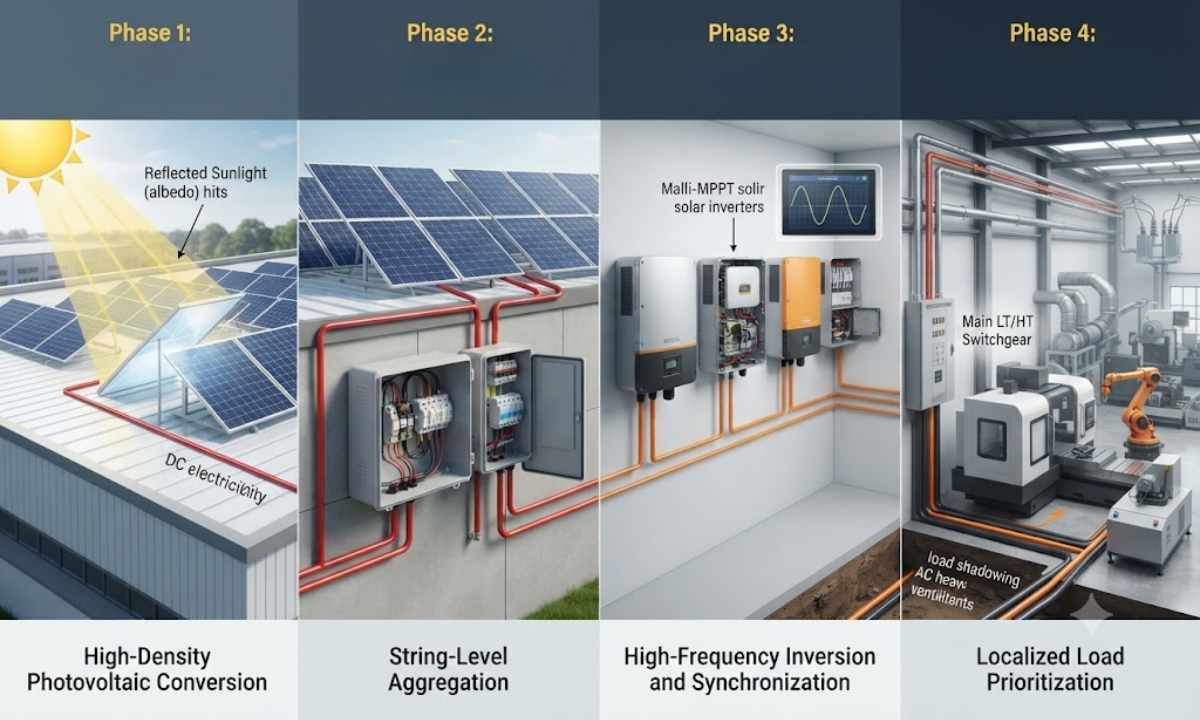
Phase 1: High-Density Photovoltaic Conversion:
The process begins on the roof or ground-mount structure, where high-efficiency modules absorb photons. In modern commercial architecture, standard panels have been replaced by N-Type TOPCon and Bifacial modules.
Bifacial modules capture direct sunlight on the front face while simultaneously absorbing reflected light (albedo) from the roof surface on the reverse side. This atomic reaction displaces electrons, generating high-voltage Direct Current (DC).
Phase 2: String-Level Aggregation:
Because industrial systems use thousands of cells, individual panels are wired together in series to create “strings” that maximize voltage.
These strings are routed into outdoor DC combiner boxes equipped with surge protection devices (SPDs) and fast-acting fuses. This aggregation increases total power density before sending the raw electricity to the conversion core.
Phase 3: High-Frequency Inversion and Synchronisation:
Raw DC power cannot run an industrial facility. The power flows into sophisticated multi-MPPT (Maximum Power Point Tracking) inverters. These units convert the variable DC into clean alternating current (AC).
Crucially, the inverter must match the exact sine wave, phase sequence, and frequency of the utility grid. If your local utility grid runs at 50Hz, the inverter’s microprocessors dynamically measure the grid’s wave topology thousands of times per second to inject solar energy into your system with zero phase displacement.
Phase 4: Localized Load Prioritization:
The converted AC power enters your facility’s main Low-Tension (LT) or High-Tension (HT) distribution panels. Through a principle known as “load shadowing,” electrical currents naturally follow the path of least resistance.
As your on-site solar array generates power closer to your machinery than the distant utility substation, your factory machines consume solar electrons first. The utility grid only steps in to provide a seamless top-up if your machines require more power than the panels are generating at that moment.
Inverter Topologies: String vs. Central Architectures
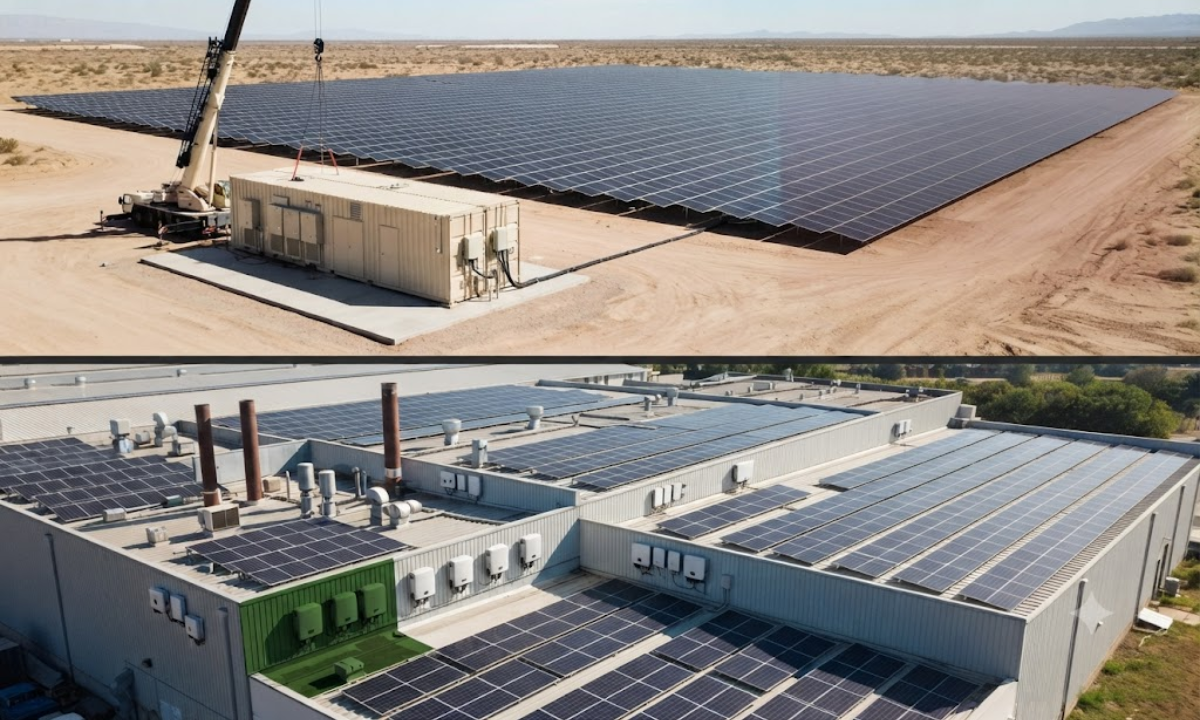
A critical decision when planning solar energy commercial use is selecting how to distribute your conversion hardware. Sourcing the wrong inverter architecture introduces single points of failure that can cause complete operational downtime.
| Engineering Metric | Central Inverter Architecture | Multi-String Inverter Architecture |
|---|---|---|
| System Footprint | One or two massive, containerized units are located at ground level. | Multiple decentralized units are mounted directly on the roof or walls. |
| MPPT Granularity | 1 to 2 global MPPT channels for the entire solar array. | Up to 10+ independent MPPT channels per unit, isolating shaded zones. |
| Systemic Risk | High. A single internal component failure shuts down 100% of the plant. | Low. If one unit encounters an error, the remaining 90% of the plant keeps running. |
| O&M Velocity | Requires specialized factory engineers and heavy cranes for component repair. | Can be hot-swapped by on-site facility technicians within hours. |
| Yield Optimization | Ideal for completely flat, unshaded ground-mounted megawatt blocks. | Essential for complex industrial roofs with varying angles, chimneys, and vents. |
The Power Quality Imperative: Industrial machinery such as CNC machines, automated assembly lines, and heavy HVAC chilling plants is highly sensitive to power quality.
Poorly engineered solar integrations can introduce harmonic distortion into your internal grid, which overheats corporate transformers and triggers premature equipment failure.
High-spec commercial installations utilize inverters with integrated active power regulation and harmonic filters, ensuring that the solar electrons entering your facility are cleaner and more stable than the power supplied by the utility grid.
Benefits of Commercial Solar Systems
When evaluating the benefits of commercial solar systems, chief financial officers must transition from viewing solar as an environmental line item to treating it as an aggressive capital optimization tool.
For a profitable corporate entity, deploying commercial solar panels serves as a dual-layered fiscal engine that drops multi-million-rupee savings straight to the bottom line through immediate tax shields and structural utility bill reductions.
The primary financial mechanisms operating within India’s current corporate energy framework unlock significant balance sheet advantages:
1. The Yield Spread Economy (LCOE vs. Grid Tariffs)
The immediate business case for solar is driven entirely by the operational spread between what it costs to purchase grid energy and what it costs to generate power captively on your own roof.
- The Grid Real-World Outflow: State utility providers across major industrial zones continue to escalate commercial tariffs to subsidize other sectors. Rates for high-tension and low-tension commercial connections routinely sit between ₹8 and ₹14 per unit.
- The Solar Lock-In Factor: A high-spec captive asset delivers a Levelized Cost of Energy (LCOE) fixed between ₹2.20 and ₹2.80 per unit across a 25-year operational lifecycle. By producing your own power, you instantly capture a recurring dividend of up to ₹9 per kilowatt-hour saved, completely insulating your production cost from future regulatory tariff hikes.
2. The Capital Weapon: Section 32 Accelerated Depreciation (AD)
Unlike the residential market, which depends on direct capital subsidies, the corporate solar ecosystem is incentivized through highly aggressive corporate tax relief. Under Section 32 of the Income Tax Act, solar power assets are categorized as high-rate renewable devices, allowing for accelerated write-offs:
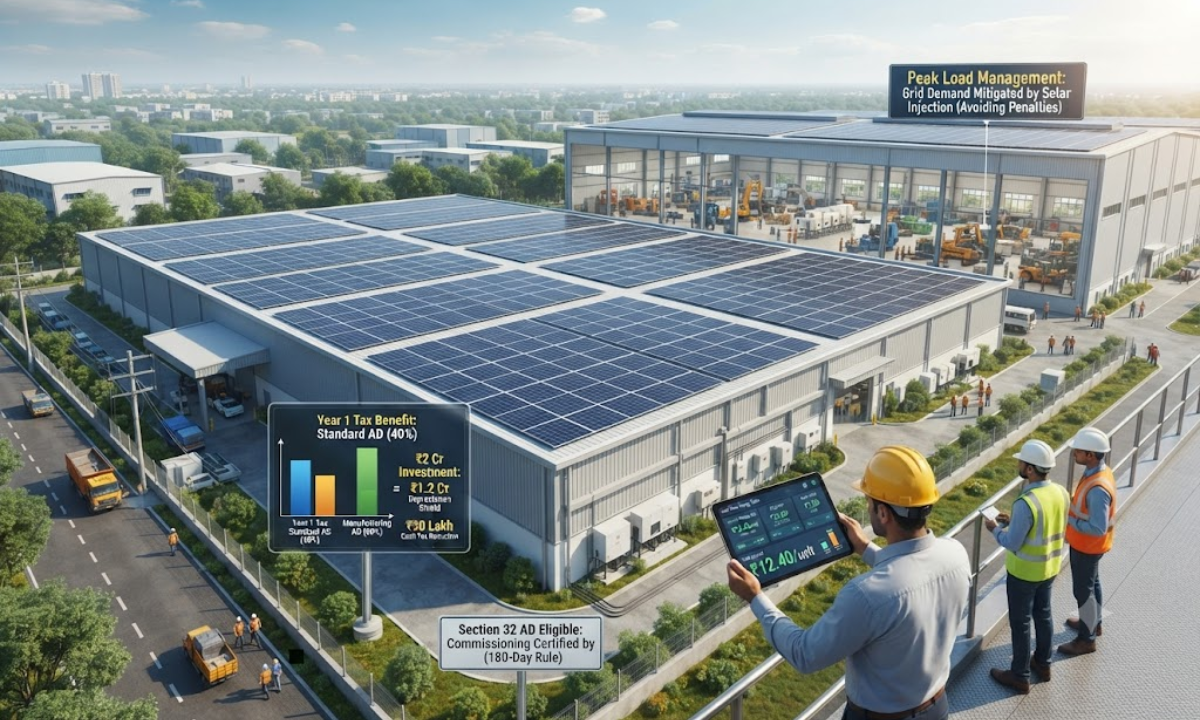
- Standard Commercial Entities (Offices, Warehouses, Hotels): Eligible for a 40% Written Down Value (WDV) depreciation deduction in the very first year of commissioning.
- Manufacturing Units & Industrial Plants: Under Section 32(1)(iia), manufacturing businesses can claim an additional 20% depreciation on top of the standard block. This permits an unprecedented 60% total tax write-off in Year 1.
The Immediate Cash Shield: If an industrial manufacturing plant capitalizes a ₹2 Crore solar installation, a first-year depreciation block of 60% reduces its taxable business income by ₹1.2 crore.
For an enterprise operating in the standard 25% corporate tax bracket, this legal mechanism triggers a flat ₹30 Lakh reduction in actual cash tax outflow before a single unit of electricity is even generated.
3. The 180-Day Rule and Regulatory Alignment
To capitalize on these front-loaded corporate tax shields, project managers must carefully align construction milestones with tax timelines.
Under the Income Tax code, the solar plant must be “put to use” for more than 180 days in the current financial year to claim the full depreciation block. This means your system must receive its official commissioning certificate before October 3rd. If commissioned on or after October 4th, your Year-1 benefit is legally halved to 20% (or 30% for manufacturing assets).
Furthermore, the tax department tightly links asset utilization to statutory energy approvals. Following strict Ministry of New and Renewable Energy (MNRE) guidelines, all commercial installations must exclusively deploy solar modules listed under the Approved List of Models and Manufacturers (ALMM).
Sourcing non-compliant imported panels causes the local DISCOM to flatly deny net-metering synchronization. Without that official grid synchronization log, the asset cannot be legally classified as “put to use,” instantly liquidating your eligibility to claim the Accelerated Depreciation tax shield for that fiscal year.
4. Comprehensive Demand-Charge Mitigation
Most commercial electricity billing is broken down into two components: active energy consumption fees and Contract Demand Charges (the baseline penalty charged by the DISCOM to guarantee your peak structural capacity). When heavy inductive machinery starts up simultaneously, a facility’s instantaneous power draw can spike past its sanctioned limit, triggering massive financial penalties.
Modern commercial solar infrastructure actively flattens these load curves. By injecting real-time generation during peak daylight production cycles, the solar plant acts as a structural buffer, lowering your property’s net demand draw from the utility grid and protecting your treasury from peak contract-demand penalties.
The 2026 CAPEX Blueprint: Asset Costs & Payback Velocities
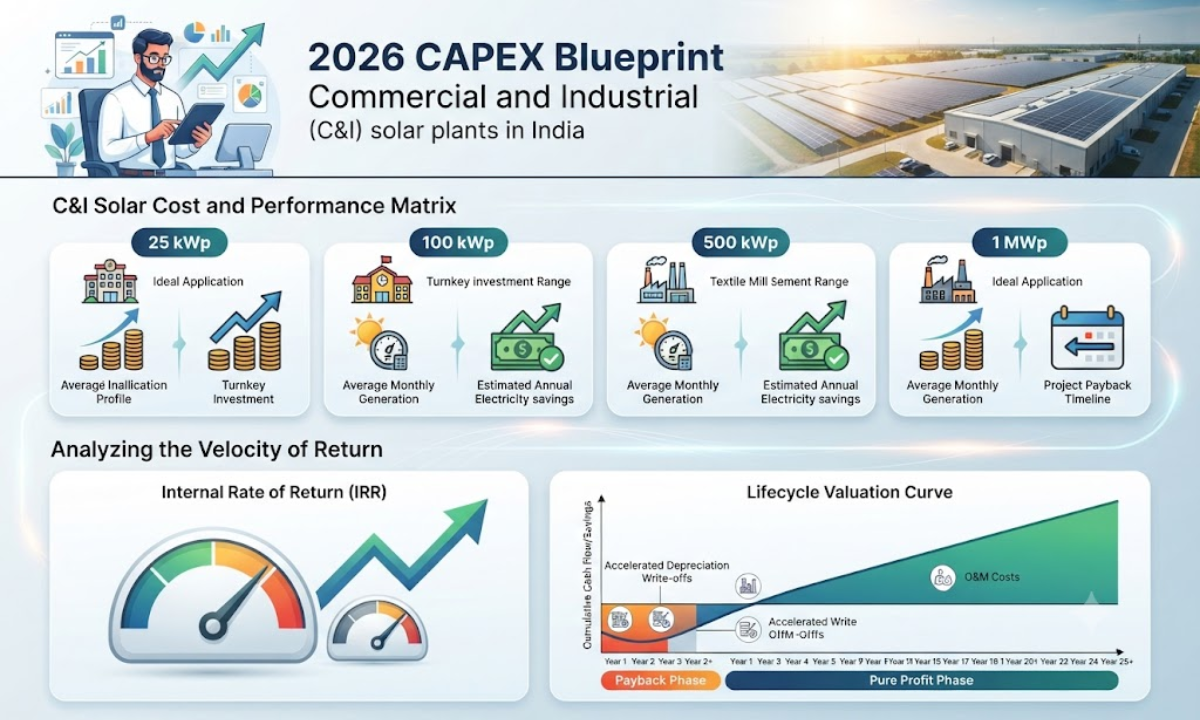
Deploying a captive solar power plant is a foundational capital allocation decision that requires a clear look at up-front expenditure against long-term asset performance.
As commercial and industrial (C&I) solar arrays benefit heavily from economies of scale, the per-kilowatt deployment cost drops sharply as the total system capacity increases.
A turnkey commercial solar installation in India covers a complex architecture of structural, civil, and electrical engineering layers:
- Tier-1 PV Modules: Deploying high-efficiency, ALMM-listed N-Type TOPCon or Bifacial panels to secure maximum generation per square foot.
- Industrial-Grade Conversion Equipment: Sourcing premium Solar inverters online or through authorized distribution networks to ensure active grid synchronization and power factor management.
- High-Wind Resistant Mounting Systems: Deploying Hot-Dip Galvanized (HDG) steel or anodized aluminum structures engineered to survive severe regional wind loads up to 180 km/h.
- Balance of System (BOS) & Grid Integration: Turnkey localized execution covering UV-stabilized XLPE DC cabling, independent earthing networks, surge protection devices, and local DISCOM net-metering approvals.
C&I Solar Cost and Performance Matrix (2026 Benchmarks)
| System Capacity | Ideal Application Profile | Turnkey Investment Range (2026) | Avg. Monthly Generation | Est. Annual Electricity Savings | Project Payback Timeline |
|---|---|---|---|---|---|
| 25 kWp | Boutique Hotels, Small Offices, Rural Fuel Stations | ₹11 Lakh – ₹13.5 Lakh | 3,000 kWh / Units | ₹2.8 Lakh – ₹3.6 Lakh | 3.5 – 4.2 Years |
| 100 kWp | Cold Storage, Schools, and Auto Ancillary Units | ₹38 Lakh – ₹45 Lakh | 12,000 kWh / Units | ₹11 Lakh – ₹13.8 Lakh | 2.8 – 3.5 Years |
| 500 kWp | Textile Mills, Packaging Units, IT Parks | ₹1.8 Crore – ₹2.1 Crore | 60,000 kWh / Units | ₹57 Lakh – ₹68 Lakh | 2.6 – 3.2 Years |
| 1 MWp | Heavy Chemical Units, Cement Plants, Foundries | ₹3.4 Crore – ₹3.9 Crore | 1,20,000 kWh / Units | ₹1.1 Crore – ₹1.4 Crore | 2.5 – 3.0 Years |
Analyzing the Velocity of Return (IRR and Asset Lifecycle)
When a corporate entity reviews these financial baselines, the true metric of success is the Internal Rate of Return (IRR).
While traditional corporate investments or fixed-income reserves yield anywhere from 7% to 12% returns, an engineered commercial solar asset delivers an unleveraged IRR ranging between 25% and 35%.
The Lifecycle Valuation Curve
- The Payback Phase (Years 1 to 3): The facility uses its cumulative electricity savings paired with Year-1 accelerated depreciation tax write-offs to completely amortize the initial capital expenditure.
- The Pure Profit Phase (Years 4 to 25): Once the payback milestone is crossed, the cost of generating power drops to near zero (covering only minimal operational and maintenance overheads). For the remaining 21+ years of the panel’s warranted performance lifecycle, every single kilowatt-hour generated translates directly into operational profit and enhanced cash-flow margin.
The O&M Preservation Rule: Maximizing these payback timelines requires zero tolerance for operational downtime. A single blown string fuse or thermal breakdown in a central inverter can wipe out weeks of peak generation, stretching your payback targets.
Commercial asset managers must ensure their systems are configured with remote, string-level cloud monitoring systems, enabling facility engineers to isolate and rectify localized faults before they compromise the entire plant’s yield.
Eliminating Systemic Failure and Overcoming the Real-World Stress Factors of the Indian Grid
A solar power plant is only as reliable as its weakest link. When high-end residential energy systems encounter operational downtime, the fault is rarely caused by a simple mechanical defect in the inverter itself.
Instead, the system collapsed because it was deployed as a generic product rather than an engineered solution tailored to withstand the volatile environmental and electrical stresses of the Indian grid.
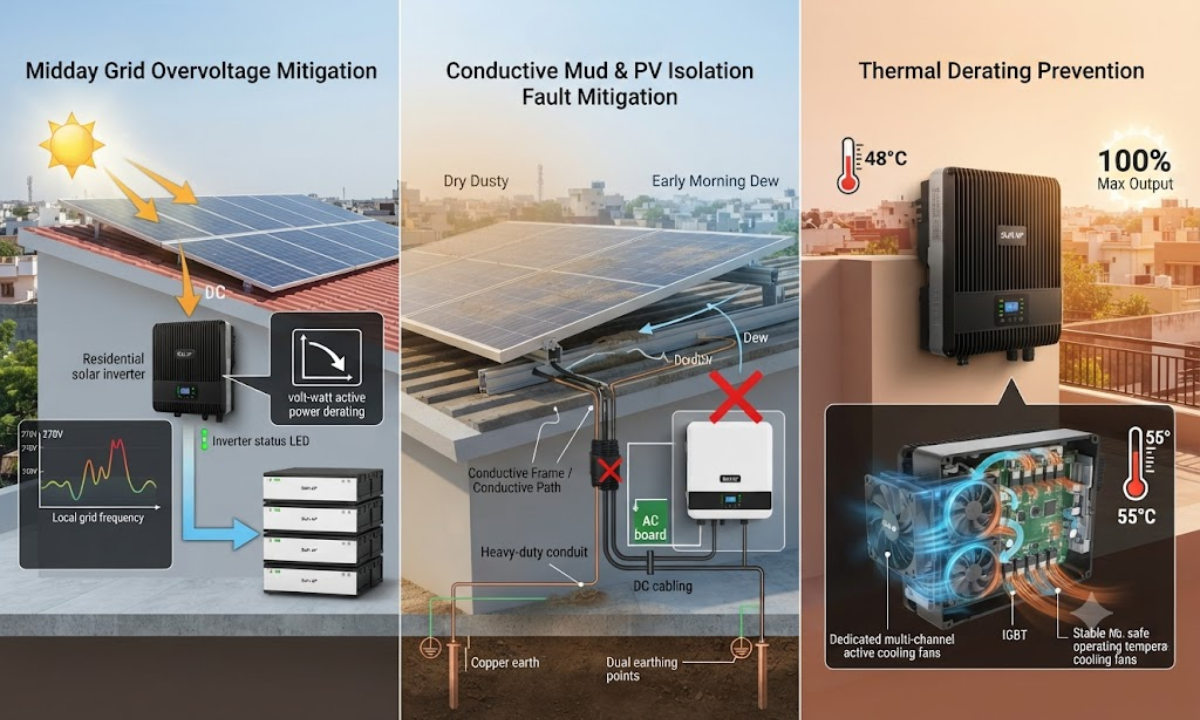
The three most destructive operational vectors encountered on local networks require proactive technical mitigation:
1. Midday Grid Overvoltage Trips (The Feedback Loop)
In regions with dense residential solar penetration, utility lines experience an unmapped phenomenon known as midday voltage rise. Around 1:00 PM, when regional solar production peaks and household baseloads are low, hundreds of residential systems simultaneously pump excess power back into local distribution transformers.
As the local distribution network (DISCOM) infrastructure is often outdated, the line voltage climbs sharply, frequently breaching 270V.
To prevent this sudden, un-notified generation gap, premium hybrid systems must be dynamically programmed with wide grid-tolerance parameters or configured to execute volt-watt active power derating.
Instead of shutting down completely, the inverter recognizes the grid overvoltage trend, throttles its export limits, and routes the excess solar capacity directly into charging your lithium battery storage bank.
2. The Conductive Mud Phenomenon (PV Isolation Faults)
In India, dry weather conditions create thick layers of particulate dust across solar panels and mounting structures. When this dust is exposed to early morning dew or light seasonal rain, it forms a highly conductive “mud track” between the aluminum module frames, DC cables, and the roof structure.
This creates a minute pathway for electricity to leak to the ground, triggering a PV Isolation Error or Ground Fault Error.
- The Protective Trap: To prevent fatal electrical shock or DC arcing, high-frequency inverters instantly freeze operations and lock the system behind a red fault light.
- The Mitigation Protocol: Eliminating isolation breakdowns requires strict adherence to advanced balance-of-system (BOS) standards:
- Deploying exclusively UV-stabilized XLPE DC cabling enclosed in heavy-duty conduit routing to eliminate physical cable degradation.
- Implementing independent, dedicated dual-earthing networks (separate lines for the inverter body, AC distribution board, and DC array structure) using chemical copper-bonded electrodes to maintain a ground resistance value strictly less than 1 Ohm.
3. Thermal Derating (The Balcony and Rooftop Trap)
Solar inverters are massive power-electronic computing nodes. During peak summer months, ambient temperatures on rooftops or unventilated service balconies easily hit 45°C to 50°C. At these extremes, the internal switching transistors (IGBTs) can scale rapidly toward 75°C+.
To shield internal circuits from melting down, mid-tier inverters deploy an aggressive protective mechanism known as Thermal Derating. The system purposefully drops its generation output by 30% to 50%.
You may have bought a 5kW system, but under peak afternoon heat, it throttles itself down to a 3kW machine.
| Environmental Stress | Standard Product Reaction | Sun AP Engineered Solution |
|---|---|---|
| High Ambient Heat (45°C+) | Sudden output throttling (thermal derating). | Advanced multi-channel fan convection, oversized aluminum heat-sink blocks, and optimal physical clearance configurations. |
| Voltage Fluctuations | Frequent system resets and offline dropouts. | Extended operating voltage parameters and real-time firmware phase stabilization. |
| Monsoon Humidity | Internal moisture ingress leading to board shorts. | Strict NEMA 4X / IP65 industrial weatherproof enclosures designed for aggressive outdoor deployment. |
Why Choose Sun AP Ecopower?
Transitioning your property to a hybrid solar infrastructure requires moving past generic retail procurement and embracing precise corporate and electrical engineering. At Sun AP Ecopower, operating out of our centralized distribution facility in JP Nagar, Bangalore, we do not view ourselves as simple equipment traders.
When EPC contractors, institutional installers, and discerning estate owners source their systems through Sun AP Ecopower, they unlock distinct structural advantages:
- Unbiased Multi-Brand Tier-1 Access: We are officially authorized distributors for the world’s leading clean-tech manufacturers, including Feston, Deye, Enphase, SolarEdge, Fimer ABB, and Panasonic. Because we are not bound to a single brand, we design custom, multi-source setups perfectly balanced for your specific load profiles and architectural demands.
- Pre-Dispatch Technical Calibration: We do not drop-ship blind boxes. Every hybrid inverter that exits our warehouse undergoes a rigorous pre-dispatch testing protocol at our engineering desk. We pre-flash specialized grid profiles to handle localized utility overvoltage spikes and verify flawless closed-loop CAN/RS485 communication with your LFP storage cells before the hardware arrives on-site.
- Flawless DISCOM & Regulatory Clearance: Navigating net-metering synchronization without structural delays requires compliant hardware. Our entire components matrix strictly complies with the latest BEE mandatory efficiency standards, Central Electricity Authority (CEA) technical guidelines, and local utility mandates (such as BESCOM and CESC approval parameters), guaranteeing immediate, hassle-free grid approval.
- B2B Procurement Efficiency: As a high-volume, pure-play solar distributor, we provide a unified procurement point for complete project lifecycles. From Tier-1 solar modules and smart bi-directional energy meters to custom LT distribution panels and UV-stabilized balance-of-system (BOS) components, we provide full institutional warranty backing and clear, GST-compliant transactional reporting.
We act as elite value-added technical partners, stocking, optimizing, and calibrating the finest global energy assets to ensure your project delivers uncompromised resilience under the harshest real-world grid conditions.
Conclusion
An advanced hybrid solar configuration is a significant capital investment designed to function as an independent, intelligent utility clearinghouse for your property for decades. Relying on cheap component pairings or generic online listings to manage multi-kilowatt, high-voltage throughput introduces severe points of failure that can compromise your storage lifespan, stall expensive household appliances, and cause persistent system downtime.
True energy autonomy demands a configuration engineered for real-world grid fluctuations, thermal stresses, and immediate sub-20ms transfer responses. By anchoring your home with a robust hybrid inverter topology, you insulate your estate from the rising costs of localized utility distribution and build an unassailable shield of continuous power.
Do not risk your electrical infrastructure with uncalibrated components. Connect with our senior engineering consultants at the Sun AP Ecopower Private Limited office on 2nd Cross, Dollars Colony, JP Nagar 4th Phase, Bangalore.
Let our technical desk audit your home’s baseline electrical load profiles and engineer the uncompromised, high-yield hybrid energy ecosystem your property deserves.