There is a massive misconception among property owners in India regarding solar energy: most assume that installing any standard rooftop solar array guarantees uninterrupted electricity during a blackout. The frustrating reality hits during the first major grid failure, when traditional on-grid systems automatically shut down to protect utility workers.
To achieve true energy independence and maintain continuous operations, you must understand how a hybrid solar system works. Powered by next-generation Hybrid Solar Inverters, these advanced setups act as an intelligent, self-sustaining microgrid that bridges the gap between clean generation and uninterrupted utility backup.
In an era where commercial facilities, manufacturing units, and premium residences cannot afford even a few minutes of downtime, relying on legacy diesel generators is no longer viable. Modern power management demands smart orchestration.
Seamlessly integrating the photovoltaic array, the utility grid, and high-capacity lithium storage, a hybrid architecture ensures that your facility transitions from grid-dependent to self-sustained in the blink of an eye.
Let’s look past the surface-level explanations and dive into the exact engineering mechanics of how these advanced systems operate the moment the utility grid goes dark.
The Three Pillars of a Hybrid Setup (The Hardware Layer)
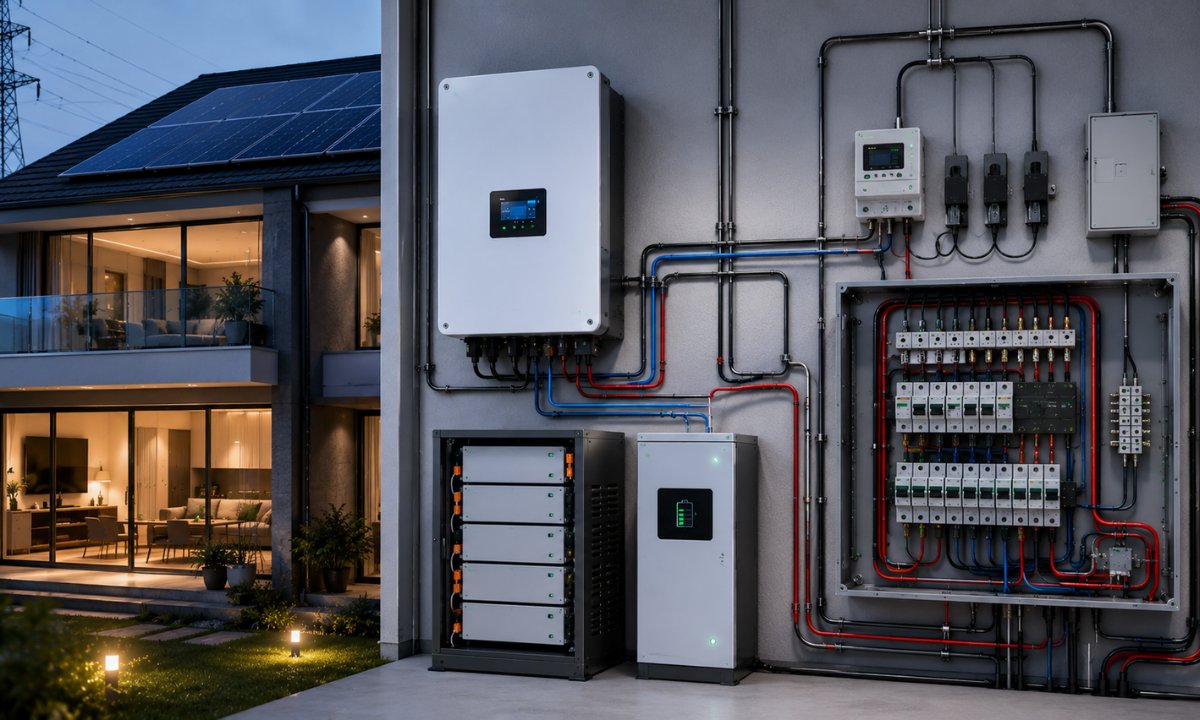
Before we can understand how a system reacts to a grid failure, we must establish the physical architecture that makes it possible. A traditional on-grid setup is relatively simple. It pushes raw solar DC power into an inverter, which converts it to AC and feeds it directly into your main electrical panel.
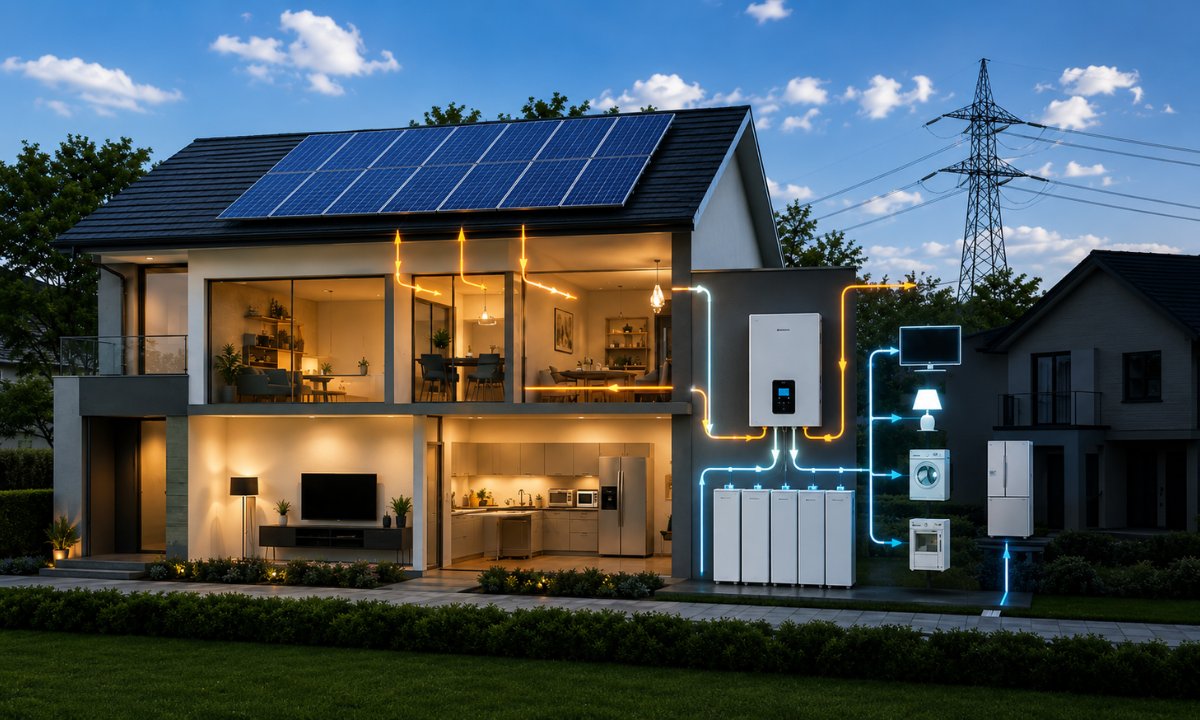
A modern hybrid solar panel system, however, requires a far more sophisticated hardware topology. It does not just produce power; it actively manages it. To do this, the system relies on three distinct pillars of hardware:
1. The Core Brain: The Hybrid Inverter
Unlike standard inverters that only convert DC to AC, a high-end hybrid inverter (such as those engineered by Deye, FIMER, or Enphase) acts as a bidirectional energy router. It features multiple electrical buses (ports) dedicated to specific tasks:
- The Grid Port: Synchronizes with the public utility grid for exporting surplus energy or importing shortfalls.
- The Battery Port: A specialized low-voltage or high-voltage DC bus that strictly manages the charging and discharging of the storage bank.
- The Load Port (Backup): A dedicated “islanded” port connected directly to your critical appliances, completely bypassing the utility grid.
2. The Power Reservoir: The Lithium Energy Storage System (ESS)
You cannot have a hybrid system without a robust solar energy storage system. While older setups relied on bulky, inefficient lead-acid batteries, the 2026 standard dictates high-voltage Lithium Iron Phosphate (LiFePO4) battery racks.
These modern storage banks communicate directly with the hybrid inverter’s internal Battery Management System (BMS), allowing for split-second discharge rates capable of handling heavy surge loads (like starting a compressor or industrial motor) the moment the grid drops.
3. The Sensory Network: CT Sensors and Smart Meters
To make split-second decisions, the inverter must know exactly what is happening at the grid connection point. Current Transformer (CT) sensors and bi-directional smart meters are installed directly at the utility meter box. They monitor the exact flow of electrical current 24/7.
As one of the premier Solar product dealers in India, Sun-AP Ecopower ensures that our EPC partners have access to this complete ecosystem. When you pair a Tier-1 hybrid inverter with compatible lithium storage and precision metering, you create an integrated microgrid.
But what exactly happens when those CT sensors detect that the public grid has violently dropped to zero volts?
The Microsecond Shift (What Happens Instant the Grid Fails?)
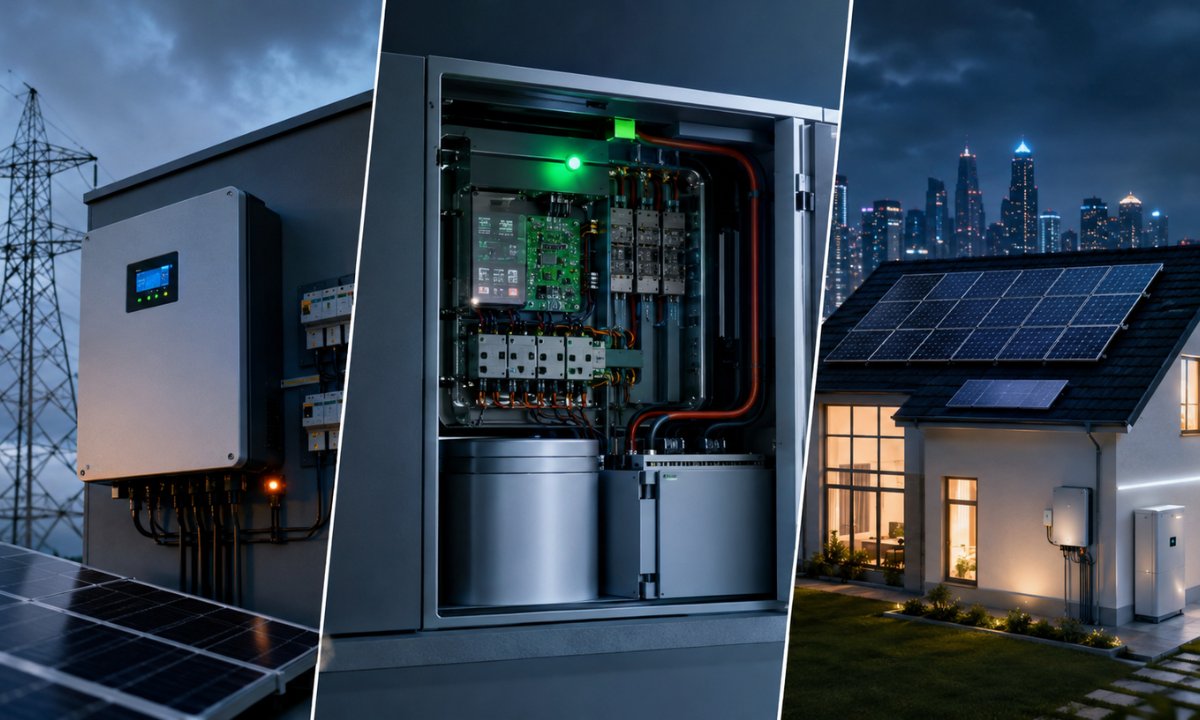
To appreciate the engineering brilliance of a hybrid system, you have to look at a timeline measured not in minutes or seconds, but in milliseconds. In a conventional setup, a power outage triggers a complete blackout. In a hybrid architecture, a power failure initiates a highly coordinated, lightning-fast sequence of micro-operations.
Here is exactly what happens behind the scenes the moment the public utility grid drops to zero volts.
Step 1: Detection and the Anti-Islanding Mandate (0 to 10 ms)
The absolute priority of any inverter during a solar power outage scenario is safety.
When the utility grid goes down, utility engineers immediately rush to fix the lines. If your solar panels continue pushing electricity back out into the street lines, you could fatally electrocute those workers. This dangerous phenomenon is known as islanding.
To prevent this, international electrical standards mandate Anti-Islanding Protection. The moment the grid fails, the smart sensors at your electrical panel detect the drop in voltage and frequency. Within less than 10 ms, the inverter instantly stops exporting power outward, effectively severing its connection to the public utility.
Step 2: The Microsecond Disconnect (10 to 20 ms)
Once safety isolation is established, the hybrid inverter’s working core switches from Grid-Tied Mode to Island Mode. An internal component called the Automatic Transfer Switch (ATS) opens up.
This acting gatekeeper creates a localized wall between your property and the outside world. Your property is now officially its own independent power plant, a self-contained microgrid.
Step 3: Battery Activation and Phase Synchronization (<20 ms)
With the utility grid isolated, the inverter switches its internal AC busbar over to draw from the lithium battery storage system. The inverter changes its role from a passive synchronization device into an independent voltage source, instantly generating its own stable AC sine wave to power your facility.
Hybrid System Execution Phases
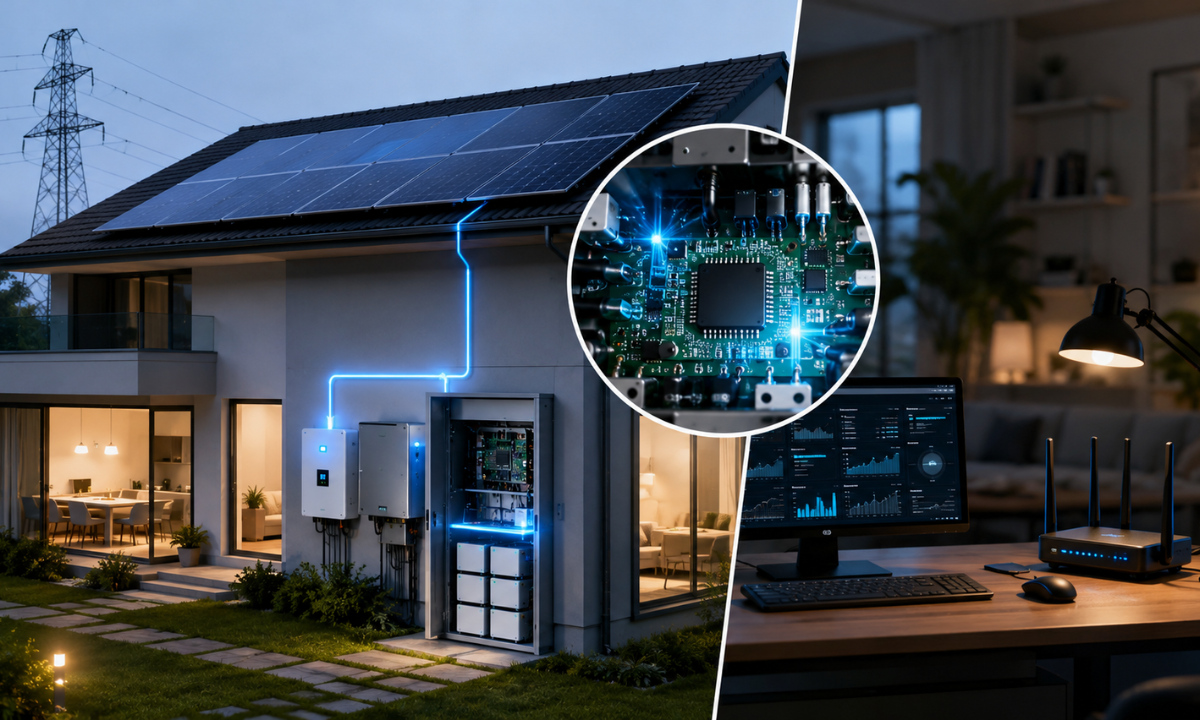
To visualize how seamlessly this transition occurs compared to legacy backup options, consider the execution phase breakdown below:
| Feature / Phase | Standard On-Grid System | Legacy Diesel Generator (DG) | Tier-1 Hybrid Solar System |
|---|---|---|---|
| Detection Speed | Instantaneous (<10 ms) | Human observation or AMF panel (5 to 15 ms) | Instantaneous (<10 ms) |
| Safety Isolation | Shuts down completely | Manual switch or mechanical interlock | Automatic microsecond internal isolation |
| Transition Time | Permanent blackout until grid returns | 10 seconds to 2 minutes (startup lag) | <20 ms (Seamless UPS grade transition) |
| Operational Impact | Total operational halt, data loss | Equipment resets, voltage spikes, server crashes | Zero flickering, continuous server & machinery uptime |
As Tier-1 hybrid systems execute this transition in under 20 ms, your appliances, computers, and Wi-Fi routers do not even register that a power cut occurred. There is no rebooting, no flickering lights, and zero data loss.
Intelligent Load Management: Critical vs. Non-Critical Circuits
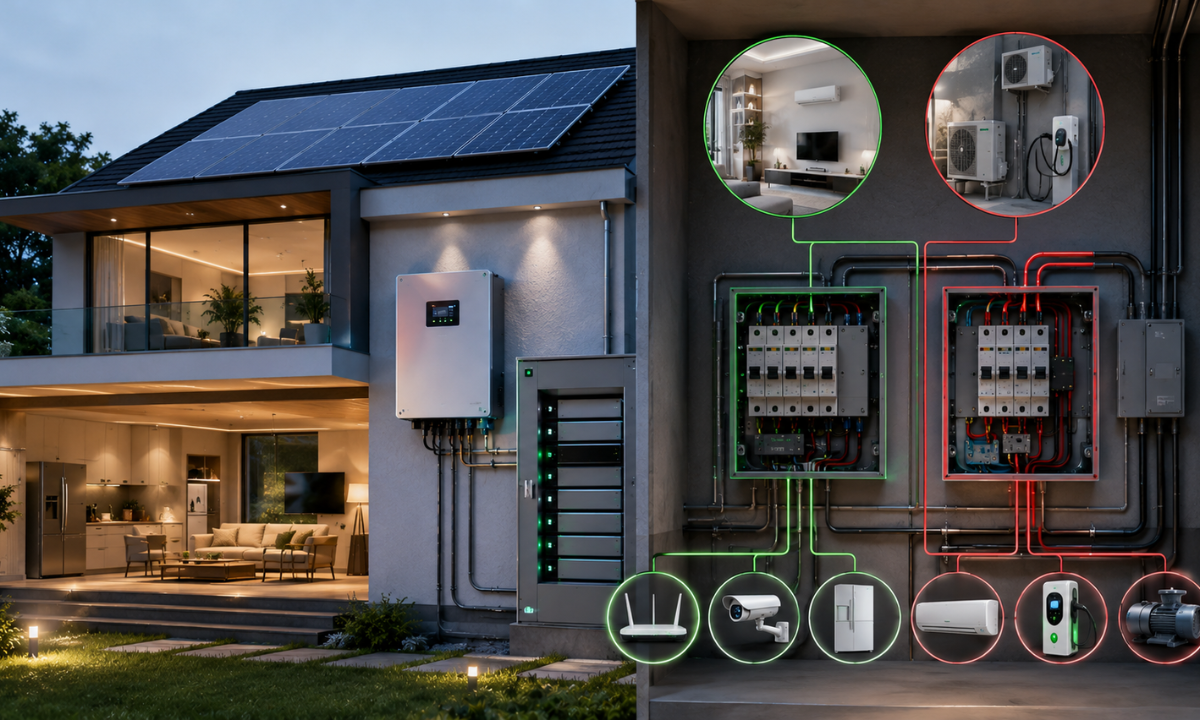
A common mistake made when planning a solar backup system for home or commercial facilities is assuming that a backup system must power the entire property uniformly.
If a power outage occurs during a peak summer afternoon, attempting to run heavy inductive loads such as multiple central air conditioning units, electric vehicle chargers, or industrial pumping systems strictly off a battery bank will quickly deplete your energy reservoir.
To solve this, advanced hybrid installations utilize a strategy known as Intelligent Load Management. When a Tier-1 hybrid inverter is installed, the property’s main electrical distribution board is physically split into two distinct sub-panels:
1. The Critical Load Panel (Essential Circuits)
This panel is wired directly to the backup/island port of the hybrid inverter. The moment a power cut hits, the inverter routes battery and solar power to these circuits in under 20 ms. This panel typically powers:
- Wi-Fi routers, network switches, and server racks
- Security systems, CCTV, and automated gates
- Refrigeration and medical equipment
- Essential lighting and overhead fans
2. The Non-Critical Load Panel (High-Consumption Circuits)
This panel remains connected directly to the primary grid line. The moment a power cut occurs, these circuits are intentionally dropped by the system to safeguard the battery storage. These include:
- Centralized HVAC systems and heavy geysers
- EV charging docks (unless configured with smart throttling)
- Luxury outdoor lighting or swimming pool filtration pumps
The Smart Bypass Feature: Advanced hybrid inverters from brands like Deye feature a programmable Smart Load output. If a power outage happens during a bright, sunny day, and your lithium battery bank is already 100% full, the inverter will automatically turn back on the non-critical load panel.
It uses the excess, real-time generation from your rooftop panels to run your heavy appliances for free, without drawing a single watt from your battery reservoir.
Segregating loads this way, a modern solar power backup for the home provides the perfect balance between absolute operational resilience and long-term battery conservation. It ensures your core operations never experience a second of downtime, while intelligently managing your thermal and mechanical loads until the primary grid recovers.
Day vs. Night Scenarios During an Extended Blackout
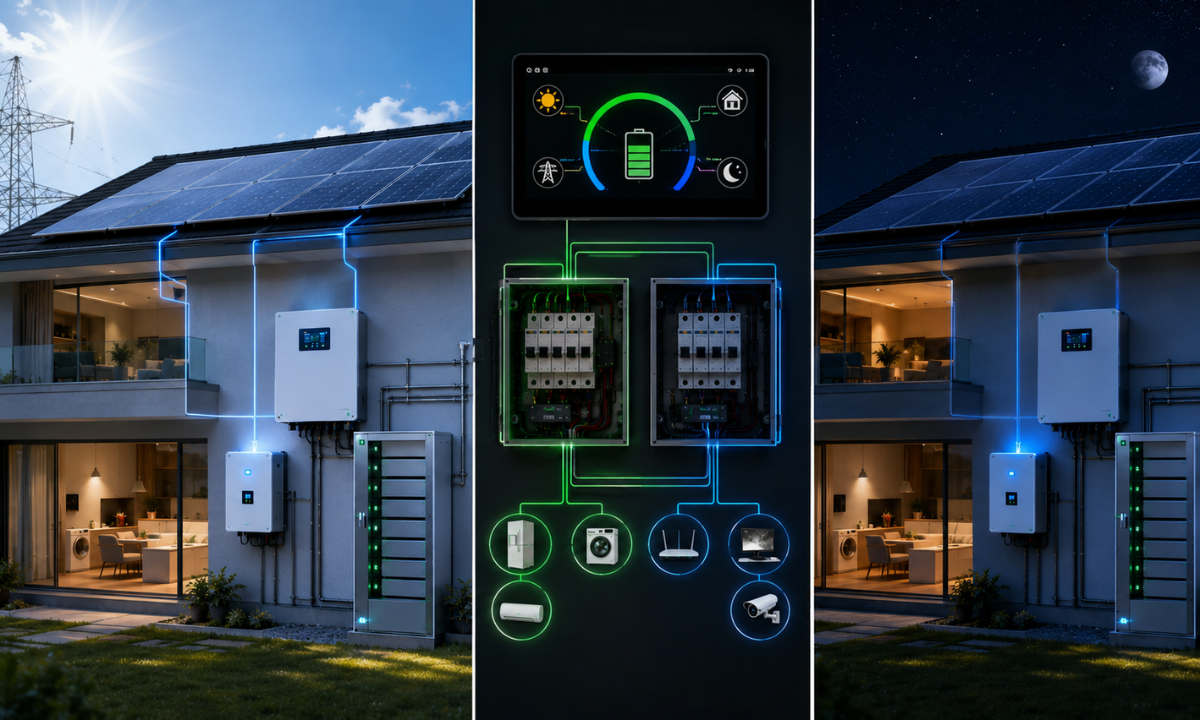
One of the most persistent questions solar installers face from clients is: “If the grid stays down for three consecutive days, will my system keep running indefinitely?” The answer depends entirely on how the hybrid inverter balances real-time generation against battery depletion across a 24-hour cycle. Unlike basic backup systems, a true hybrid solar energy storage system behaves radically differently depending on whether the sun is shining or the stars are out.
Understanding this daily rhythm helps engineers and property owners optimize their consumption patterns during prolonged utility outages.
| THE 24-HOUR HYBRID RESILIENCY CYCLE | |
| Daytime Outage | Nighttime Outage |
| Panels run critical loads Excess solar charges batteries” Smart Load” runs heavy appliances | Panels are inactive Batteries handle 100% of the load System throttles to maximize runtime |
The Daytime Outage: Dynamic Solar Prioritization
During a daytime power cut, your roof is actively generating power. A smart hybrid inverter handles this generation using a strict internal hierarchy:
- Load Fulfilment: First, it directs raw solar DC power through the inverter to run whatever appliances are currently turned on in your critical load panel.
- Battery Replenishment: If your panels are producing 5 kW of power but your essential loads are only drawing 2 kW, the inverter routes the remaining 3 kW into the battery backup solar system.
- Smart Load Routing: If the batteries reach 100% capacity and excess solar power is still available, the inverter activates the non-critical circuits (like water pumps or air conditioning), ensuring no clean energy goes to waste even though the grid is dead.
The Nighttime Outage: The Storage Drain
When the sun sets, the photovoltaic array goes dormant, and the architecture shifts entirely.
- The Transition: The inverter instantly switches to draw exclusively from the lithium battery bank. Because there is zero real-time generation to buffer the consumption, the lifespan of your backup depends completely on your battery bank’s depth of discharge (DoD) and your load profile.
- The Intelligence: Premium hybrid systems utilize smart software to throttle or alert the user if the night-time consumption is too aggressive, preserving core network servers, security systems, and essential lighting until the sun rises the following morning to restart the charging cycle.
Pairing high-efficiency panels with smart hybrid inverters, a facility can survive extended multi-day grid failures, effectively running on a closed-loop, self-sustaining solar cycle.
Why Choose Sun-AP Ecopower for Your Hybrid Solar Infrastructure?
Deploying a multi-kilowatt hybrid solar architecture requires absolute precision. Because these systems handle high-voltage bidirectional currents, microsecond grid-isolation switching, and sensitive lithium battery management, cutting corners on component quality or engineering design is not an option.
As one of the most trusted Solar product dealers in India, Sun-AP Ecopower serves as the technical backbone for elite solar EPC installers, commercial enterprises, and premium property owners across the country.
- Authorized Tier-1 Technology Portfolio: We do not supply generic or unbranded equipment. Sun-AP Ecopower is an officially authorized distributor for the world’s leading clean energy innovators, including Enphase (USA), Deye, FIMER-ABB, and Panasonic. Every component carries genuine manufacturer warranties and full engineering compliance.
- Pre-Engineered System Compatibility: One of the greatest challenges in hybrid deployments is ensuring that the battery’s BMS communicates flawlessly with the inverter’s operating system. Our technical team ensures that your entire hardware stack, from panels and smart meters to lithium battery storage modules, is pre-tested and fully synchronized for optimal efficiency.
Solar projects face strict timelines. We support our pan-India network of partners with extensive inventory availability, highly competitive tier pricing, on-time logistics, and responsive post-installation technical guidance to troubleshoot complex field configurations.
Conclusion
A power cut shouldn’t mean a complete operational shutdown or a reliance on loud, polluting diesel generators. By choosing a sophisticated hybrid solar panel system, you transition from a passive consumer of electricity to an active orchestrator of a self-sustaining microgrid. The seamless shift from grid power to lithium storage guarantees that your critical infrastructure remains online, uninterrupted, and completely cost-effective.
Do not leave your facility’s energy resilience to chance. Equip your property with the absolute benchmark in smart-grid technology.
Ready to design an elite hybrid energy system? Connect with the engineering experts at Sun-AP Ecopower today to explore our authorized product range, secure optimized project pricing, and take complete control of your energy future.