When evaluating a commercial or residential solar installation, buyers are often reassured by the 25-year performance guarantees attached to solar panels. However, the heart of the system, the solar inverter, operates under a completely different operational reality.
As the active power processing unit converting direct current (DC) into alternating current (AC), it endures continuous thermal stress, high voltage inputs, and daily grid fluctuations. Before you Buy Solar inverter stock for an upcoming EPC project or commercial facility, understanding how manufacturer warranty terms protect your asset is essential to managing long-term operational risk.
While photovoltaic modules have no moving parts, inverters rely on complex power electronics, capacitors, and printed circuit boards (PCBs) that experience mechanical and thermal wear over time. This fundamental difference creates a distinct “warranty gap” in solar project planning:
- Solar Panel Warranties: Typically 10 to 12 years for product manufacturing, and 25 years for power output performance.
- Inverter Warranties: Standard factory coverage ranges from 5 to 10 years, with options for paid extensions up to 15 or 20 years depending on the architecture and manufacturer.
Closing this gap requires looking beyond the headline warranty duration.
Commercial project developers, system integrators, and engineering, procurement, and construction (EPC) contractors must examine what a warranty actually covers, such as internal component replacement versus site labor and verify that equipment is sourced through authorized distribution channels to ensure claims are honored without delay.
Warranty Realities Across Inverter Architectures
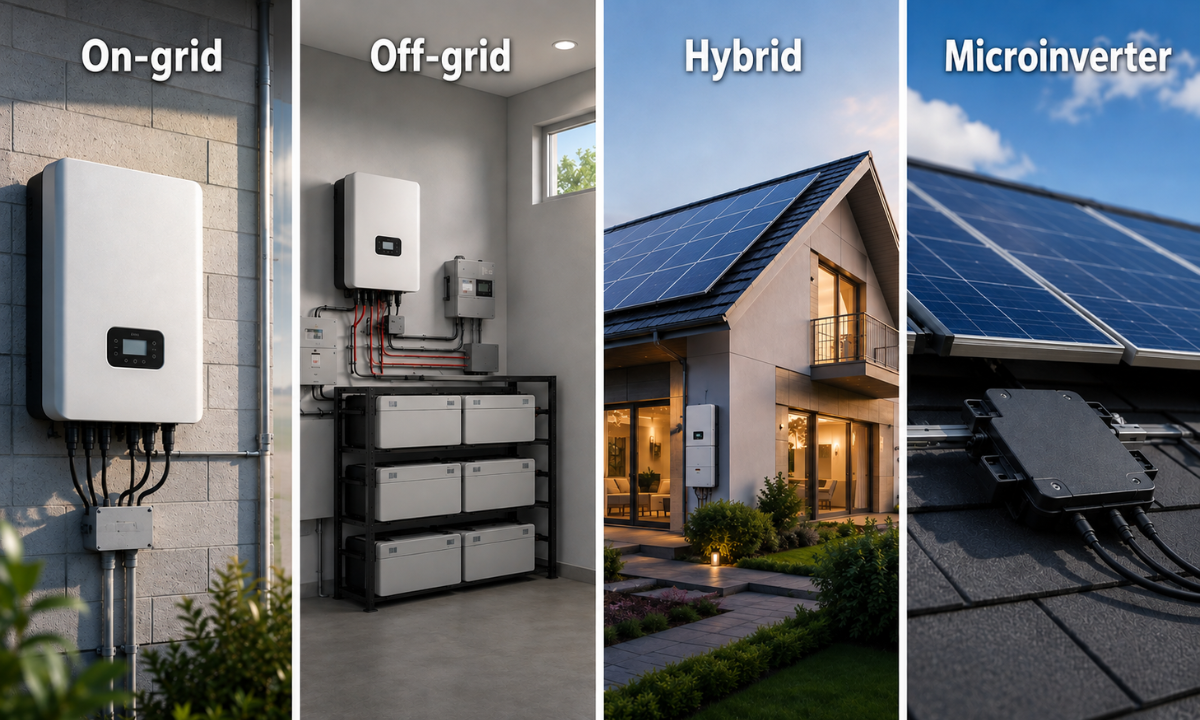
Inverter warranties vary significantly depending on the underlying technical architecture of the unit. As different system designs handle distinct electrical loads, thermal profiles, and switching frequencies, manufacturers structure their baseline coverage terms accordingly. Evaluating these differences allows buyers to match equipment selection with project risk profiles.
Baseline Terms Across System Designs
Understanding the standard warranty coverage across major product categories helps commercial developers plan for mid-life servicing and capital expenditure:
- On-grid solar inverter: Standard string architectures typically carry a 5 to 10-year factory warranty. Designed for high-voltage DC string inputs and grid-synchronized AC output, these units feature robust thermal management systems, though continuous exposure to high ambient temperatures in rooftop environments remains the leading cause of early component wear.
- Off-grid solar inverter: Built for standalone systems disconnected from the utility grid, these units frequently carry 2 to 5-year warranties. As off-grid units manage heavy inductive motor loads, frequent surge currents, and continuous battery charging cycles, their power electronics operate under higher mechanical and electrical stress profiles.
- Hybrid solar inverter: Combining grid synchronization with multi-directional battery storage management, these units usually offer 5 to 10-year coverage. Managing three distinct energy flows- solar generation, battery storage charging/discharging, and grid export requires complex firmware and power switching components, making comprehensive factory support critical.
- Microinverters: Installed directly behind individual photovoltaic modules on the roof, microinverters benefit from lower per-unit thermal dissipation and power conversion stress, allowing manufacturers to offer baseline warranties ranging from 12 to 25 years.
While microinverters feature longer coverage windows, central and string architectures remain the standard for commercial and industrial (C&I) projects due to lower upfront capital costs per kilowatt.
Balancing these baseline terms against long-term maintenance budgets ensures that system integrators select equipment that aligns with their clients’ financial expectations.
How Operational Stress Impacts Component Coverage?
A warranty document reflects the manufacturer’s confidence in how their power conversion hardware handles environmental and operational stress.
Inverters operating in high-humidity regions, dusty industrial environments, or areas with frequent grid voltage surges experience accelerated component degradation.
When selecting equipment, EPC contractors should examine whether the warranty covers specific high-wear components, such as internal cooling fans, display boards, and power capacitors, or if those sub-assemblies carry shorter, limited warranty terms. Verifying these details during procurement prevents unexpected out-of-pocket costs when routine maintenance is required down the line.
Understanding Inverter Lifespan vs. Warranty Terms
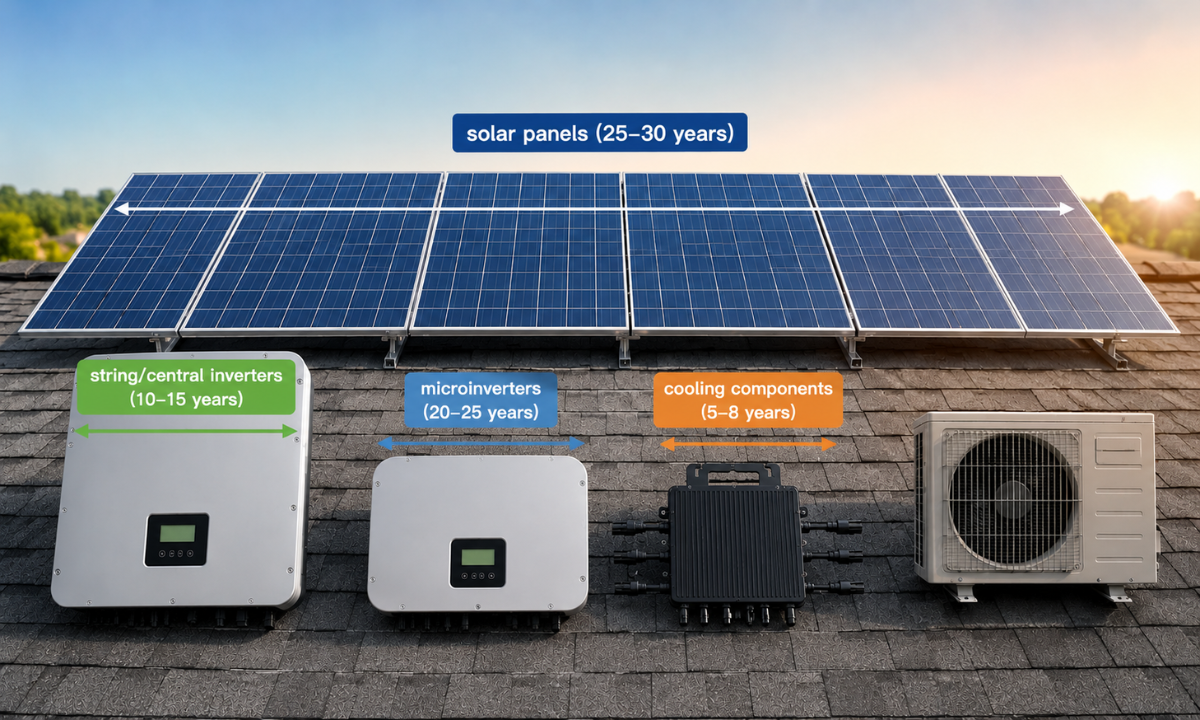
Solar PV modules are passive solid-state devices with an expected service life of 25 to 30 years. In contrast, a solar inverter contains active power electronics, electrolytic capacitors, high-frequency switches, and mechanical cooling components that operate continuously under high thermal and electrical loads.
Consequently, the realistic inverter lifespan typically ranges from 10 to 15 years, meaning most commercial and residential solar systems will require at least one major component refresh or full unit replacement during the project’s lifetime.
Component Lifespan vs. Warranty Breakdown
To accurately model long-term operation and maintenance (O&M) budgets, project developers must differentiate between standard product coverage and real-world component longevity across the solar array:
| System Component | Expected Lifespan | Baseline Factory Warranty | Key Operational Wear Factors |
|---|---|---|---|
| Solar Photovoltaic Modules | 25 to 30 Years | 10–12 Yr Product / 25 Yr Output | UV degradation, thermal expansion, moisture ingress |
| String & Central Inverters | 10 to 15 Years | 5 to 10 Years | Thermal cycling, capacitor drying, grid voltage spikes |
| Microinverters | 20 to 25 Years | 12 to 25 Years | Roof ambient heat, casing seal degradation |
| Cooling Fans & Relays | 5 to 8 Years | Often 2 to 5 Years (Limited) | Dust accumulation, mechanical bearing wear |
Factoring these mechanical realities into initial project planning allows EPCs and facility owners to treat inverter replacement as a scheduled mid-life system maintenance event rather than an unexpected operational failure.
Key Environmental Factors Influencing Inverter Lifespan
While power electronics naturally age over time, specific environmental conditions and installation practices significantly impact how long an inverter operates before requiring service:
- Ambient Temperature & Mounting Placement: Mounting inverters in direct sunlight or enclosed, unventilated spaces accelerates internal heat buildup, causing thermal throttling and degrading internal capacitors.
- Grid Voltage Instability & Surges: Frequent grid voltage fluctuations, phase imbalances, and lightning-induced transients force internal metal oxide varistors (MOVs) and protective relays to absorb continuous electrical stress.
- Dust, Humidity, and Ingress Protection: Fine particulate matter blocking cooling heat sinks or moisture entering unsealed cable glands leads to short circuits and internal component corrosion.
- Daily Thermal Cycling: Repeated daily expansion and contraction caused by switching from zero-power overnight states to peak daytime output strains internal solder joints and printed circuit boards.
Designing installations with dedicated shading canopies, selecting proper IP65/IP66 rated enclosures, and ensuring unobstructed airflow around heat sinks directly extends equipment operating life and minimizes premature field failures.
Leveraging Warranties for Mid-Life Risk Mitigation
As a standard 5-year inverter warranty expires before the unit reaches the middle of its expected operating window, purchasing extended warranty coverage acts as an effective financial hedge for commercial project owners:
- Financial Predictability: Extending warranty coverage to 10, 15, or 20 years locks in long-term maintenance costs at a known upfront price, eliminating unpredictable out-of-pocket repair expenses.
- Replacement Assurance: Guarantees access to functional replacement units or updated circuit boards even if the specific inverter model is discontinued during the system’s operational lifetime.
- Higher Portfolio Valuation: Commercial and industrial (C&I) solar assets backed by active, transferable manufacturer warranties command higher valuations during refinancing or asset sales.
Aligning warranty coverage windows with project debt repayment schedules ensures that system performance remains protected during the financial payback phase of the solar investment.
What Standard Warranties Cover (and What Voids Them)
Reading the fine print of an inverter warranty disclosure reveals a clear boundary between factory manufacturing defects and field operational risks.
Standard warranties protect the buyer against internal hardware failures resulting from defective materials or assembly line errors, but they do not cover site-related environmental damage, grid anomalies, or improper handling.
What Is Covered vs. What Is Excluded
Understanding the operational boundary between covered factory defects and out-of-pocket field costs prevents unexpected expenses during an equipment claim:
| Category | Covered by Standard Warranty | Excluded from Standard Warranty |
|---|---|---|
| Hardware & Sub-assemblies | Defective IGBT modules, main control boards, internal capacitors, and display units | External DC/AC disconnect switches, external wiring, and damaged enclosures due to impacts |
| Software & Firmware | Factory firmware glitches, communication card failures, and internal logic errors | Third-party monitoring software integration issues and site network connectivity failures |
| Labor & Logistics | Factory repair labor and replacement unit dispatch from the regional warehouse | Technician site visit fees, installation removal labor, local crane rental, and return freight costs |
| Environmental Events | Normal indoor/outdoor operation within rated IP enclosure limits | Lightning strikes, grid surges beyond MOV protection ratings, flooding, and pest infestations |
As standard factory coverage focuses strictly on equipment hardware rather than site labor or logistics, commercial installers often bundle extended service agreements with their client contracts to cover the physical labor required for swapping units on-site.
Common Actions That Void Manufacturer Warranties
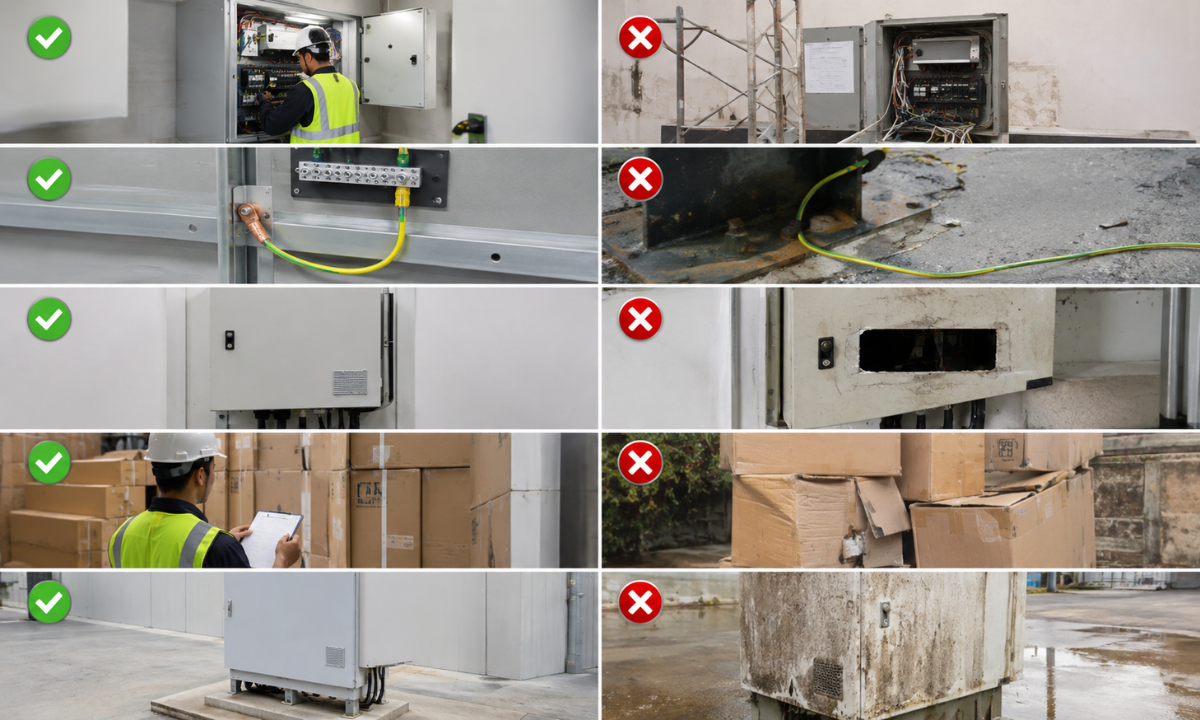
Even a valid manufacturing defect claim will be rejected if the installation violates the manufacturer’s mandatory deployment guidelines. Manufacturers routinely inspect returned units at regional service centers to verify whether failure was caused by internal defect or site misuse:
- Procurement Through Unauthorized Channels: Purchasing units from uncertified grey-market importers or non-authorized dealers voids factory support entirely, leaving buyers without serial number registration or RMA recourse.
- Non-Certified Installation Practices: Deploying equipment without adhering to regional electrical codes, using improper cable sizing, or failing to install mandatory AC/DC surge protection devices (SPDs).
- Inadequate System Earthing: Poor or missing ground connections allow transient grid voltages to bypass internal protection circuits, burning out sensitive control boards.
- Unauthorized Enclosure Modification: Opening sealed inverter compartments, drilling unauthorized conduit entry holes, or breaking factory tamper-evident seals voids the IP ingress rating and invalidates the warranty.
- Environmental Ingress Beyond Enclosure Ratings: Installing an IP65-rated indoor unit in exposed outdoor locations subject to direct high-pressure washdowns or extreme dust accumulation.
Working strictly with authorized master distributors ensures that every unit is registered with full factory serial tracking from the day of dispatch, establishing a verified chain of custody that protects your warranty rights.
Preserving Warranty Rights with Detailed Maintenance Logs
When submitting a Return Merchandise Authorization (RMA) claim, manufacturers require proof that the system was installed and operated within design limits.
Establishing a routine inverter service schedule and maintaining an updated maintenance log provides the physical evidence needed to validate factory claims quickly.
A thorough service log should record annual thermal imaging checks of electrical terminals, fan inspection records, grid voltage logs, and copies of initial commissioning reports. Providing this documentation alongside error code exports during an RMA request eliminates disputes over operational misuse and speeds up replacement unit approval.
Standard vs. Extended Warranties: A B2B Evaluation Matrix

For commercial and industrial (C&I) solar developers, engineering, procurement, and construction (EPC) contractors, and asset managers, evaluating warranty tiers is a strategic capital allocation decision.
While panels carry predictable linear performance guarantees for 25 years, inverters represent the primary operational risk point in a solar array. Performing a rigorous warranty comparison helps project planners determine whether paying an upfront premium for extended factory coverage delivers a higher net present value (NPV) than budgeting for out-of-pocket mid-life hardware replacements.
B2B Inverter Warranty Evaluation Matrix
The following decision matrix contrasts standard factory coverage, extended manufacturer coverage, and un-warranted out-of-pocket component replacement across key financial and operational criteria:
| Evaluation Parameter | Standard Factory Warranty | Extended Manufacturer Warranty | Out-of-Pocket Replacement |
|---|---|---|---|
| Typical Coverage Term | 5 to 10 Years (Included as baseline) | 12 to 20/25 Years (Paid extension at purchase) | Post-warranty failure window (Years 8–15) |
| Upfront Financial Impact | ₹0 (Bundled into baseline equipment price) | 10% to 18% of initial inverter cost | ₹0 upfront; 100% equipment cost at failure |
| Return Merchandise (RMA) Priority | Standard regional warehouse processing | Prioritized commercial dispatch & dedicated support | Full procurement cycle & lead-time vulnerability |
| System Downtime & Yield Loss | Moderate (Standard factory RMA turnarounds) | Low (Fast-track swap options available) | High (Unpredictable lead times & price hikes) |
| Asset Resale & Debt Financing | Satisfies basic bankability requirements | Enhances long-term C&I power purchase agreements | Increases financial risk profile for lenders |
To select the most cost-effective warranty strategy, commercial developers should analyze how these options impact total cost of ownership (TCO) across three core operational dimensions:
- Cash Flow vs. Risk Transfer: Purchasing an extended warranty at the time of equipment commissioning converts unpredictable future maintenance liabilities into a fixed, predictable capital expenditure. This protects project internal rates of return (IRR), especially for third-party solar power purchase agreements (PPAs).
- Mitigating Discontinuation Risks: Solar inverter technologies evolve rapidly. If a specific string inverter model is discontinued by the manufacturer after 8 years, an active extended warranty obligates the manufacturer to provide an equivalent replacement or compatible retrofitting kit, whereas out-of-pocket buyers must absorb the engineering costs of redesigning string connections.
- Service-Level Agreement (SLA) Alignment: Extended warranty packages for high-capacity commercial inverters frequently include remote diagnostic monitoring, firmware priority patches, and guaranteed dispatch response times, significantly shortening revenue-destroying plant downtime.
Ultimately, for mission-critical commercial installations, extending the inverter warranty from 5 to 15 or 20 years aligns the power conversion layer with the 25-year financial life of the PV module array, locking in operational stability for the entire investment lifecycle.
The Authorized Wholesaler Advantage: Streamlining Warranty and Support
burden for busy EPC contractors and project developers.
When an inverter experiences an unexpected field failure, every day of unresolved downtime represents lost generation revenue and strained client relationships. Sourcing equipment through an authorized Solar panel distributor in India, such as Sun-AP Ecopower, bridges the gap between factory bureaucracy and on-site operational realities, ensuring fast-track warranty resolution and reliable post-purchase backing.
Key B2B Benefits of Sourcing Through Authorized Channels
Working with an authorized master distributor establishes a verified supply chain that protects your investment from the day of equipment dispatch:
- Automated Serial Number Registration: Every unit leaving the warehouse is registered with its official factory serial number tied directly to your invoice. This verified chain of custody ensures immediate warranty recognition by manufacturers without requiring tedious proof-of-purchase disputes during field claims.
- Accelerated RMA Turnaround: Independent contractors attempting direct manufacturer RMA claims often face 30 to 60-day processing windows. Authorized wholesalers leverage direct factory escalation channels and regional buffer stock to expedite replacement approvals and unit dispatches.
- Guaranteed Genuine Factory Stock: Sourcing directly through authorized channels eliminates the risk of acquiring refurbished, uncalibrated, or grey-market units that lack valid factory coverage or localized DISCOM grid compliance.
- Dedicated Engineering Assistance: Experienced technical teams provide dedicated product support to help installers perform initial fault diagnostics, review error codes, and export operational logs required by factory service centers for instant claim verification.
Establishing a direct procurement relationship with a certified master distributor transforms warranty management from a reactive headache into a streamlined, predictable business process.
Reducing Project Downtime with Pre-Dispatch and Local Diagnostics
Beyond handling formal return paperwork, authorized distribution partners provide valuable front-line technical defense.
Before an inverter is even flagged for a factory return, dedicated technical support teams assist on-site engineers with remote troubleshooting to determine whether the issue stems from an actual internal component failure or an easily rectifiable external factor, such as a loose communication wire, tripped AC breaker, or grid voltage imbalance.
If a hardware return proves unavoidable, having an authorized channel partner manages the logistics of dispatching replacement power boards or swap-out units directly from regional warehouses across South and West India.
This proactive logistical framework minimizes plant downtime, preserves overall solar yield, and keeps your commercial projects operating at peak efficiency.
Conclusion
A solar inverter warranty is far more than a simple piece of sales paperwork; it is a foundational risk management tool for commercial project developers, EPC contractors, and system integrators.
While PV modules deliver reliable power generation for 25 years, the power conversion equipment bears the continuous electrical and thermal stress of daily operation. Aligning your procurement strategy with realistic equipment lifespans and verified warranty terms ensures that your solar assets remain profitable, bankable, and protected against costly operational downtime.
Pre-Procurement Warranty Verification Checklist
Before issuing purchase orders for your next commercial or residential project, review these essential verification steps to safeguard your investment:
- Verify Authorized Channel Status: Ensure your supplier is an authorized master distributor with direct manufacturer backing, guaranteeing full serial number registration and valid factory claims.
- Review Coverage Boundaries: Confirm exactly which components are covered under the standard warranty term, paying close attention to sub-assemblies like internal cooling fans, display boards, and surge protection modules.
- Evaluate Extension Economics: Calculate the long-term ROI of purchasing extended manufacturer coverage (up to 15 or 20 years) to protect overall project internal rates of return (IRR) and minimize unbudgeted mid-life replacement costs.
- Clarify Labor and Logistics Terms: Understand whether the manufacturer or distributor covers return freight and replacement unit dispatch fees, or if site removal labor must be factored into your operational service agreements.
- Establish Mandatory Maintenance Logs: Ensure installation crews follow certified deployment standards and maintain regular service records to prevent accidental warranty voidance during future field claims.
Implementing these precautionary checks before equipment installation eliminates administrative friction during future claims and protects your firm’s professional reputation.
Partner with Sun-AP Ecopower for Genuine Equipment
As an authorized master distributor and B2B wholesaler, Sun-AP Ecopower provides direct access to industry-leading solar inverter manufacturers, including FIMER, SolarEdge, Enphase, Sungrow, and Deye. Sourcing through our established distribution network guarantees genuine factory-backed inventory, competitive tier-one pricing, DISCOM compliance, and dedicated technical support throughout the lifetime of your project.
Whether you are scaling regional residential installations or executing multi-megawatt commercial and industrial projects, our team is equipped to deliver complete balance-of-system solutions tailored to your operational requirements.
Get in Touch for Wholesale Procurement
Connect with our B2B technical desk today to request bulk price quotes, verify inverter stock availability, or discuss customized extended warranty options for your upcoming projects.
- B2B Inquiry Desk: +91 98453 50616
- Email Support: sales@sunapecopower.com
- Official Website: sunapecopower.com
Head Office: Sun-AP Ecopower Pvt. Ltd., Bengaluru, Karnataka, India.