Every summer, electricity bills in Indian homes spike, and the air conditioner is almost always the biggest reason. A standard 1.5-ton split AC running 8 hours a day can add Rs 2,000 to Rs 4,000 to your monthly bill on its own. Add an unreliable grid supply on top of that, and it is easy to understand why more homeowners are looking for a smarter, more independent solution.
The question we hear most often at Sun AP Ecopower, one of India’s trusted solar product dealers, is this: can lithium batteries actually run an air conditioner?
Yes, they can. But getting it right requires understanding your load, choosing the correct battery capacity, and pairing it with the right inverter. This guide covers all of it.
What Makes Lithium Batteries Suitable for Running an AC
Not every battery chemistry can handle the demands of an air conditioner. An AC is one of the heaviest loads in any home, not just because of its continuous running wattage, but because of the high startup surge it draws in the first few seconds of switching on.
Lithium-ion LFP batteries, also known as Lithium Iron Phosphate batteries, are specifically built to handle this kind of high-discharge, high-surge demand. Here is what makes them the right fit:
- High continuous discharge rate LFP batteries can deliver power rapidly without voltage drop, which is critical for the startup surge of a compressor-based appliance like an AC
- Deep usable capacity – unlike lead-acid batteries that should only be discharged to 50%, lithium LFP batteries can be safely discharged to 80 to 90% of their rated capacity, giving you significantly more runtime per kWh
- Stable performance under load – lithium battery banks maintain consistent voltage even when drawing heavy current, which means your AC runs smoothly without fluctuation
- Long cycle life – quality LFP cells last 3,000 to 6,000 charge cycles, translating to 10 to 15 years of real-world use
- Built-in BMS protection – a Battery Management System monitors temperature, voltage, and current in real time, protecting the battery from overcharge, over-discharge, and overheating
For running an AC specifically, lithium is not just a better option than lead-acid – it is the only practical one for serious, long-term use.
How the System Actually Works
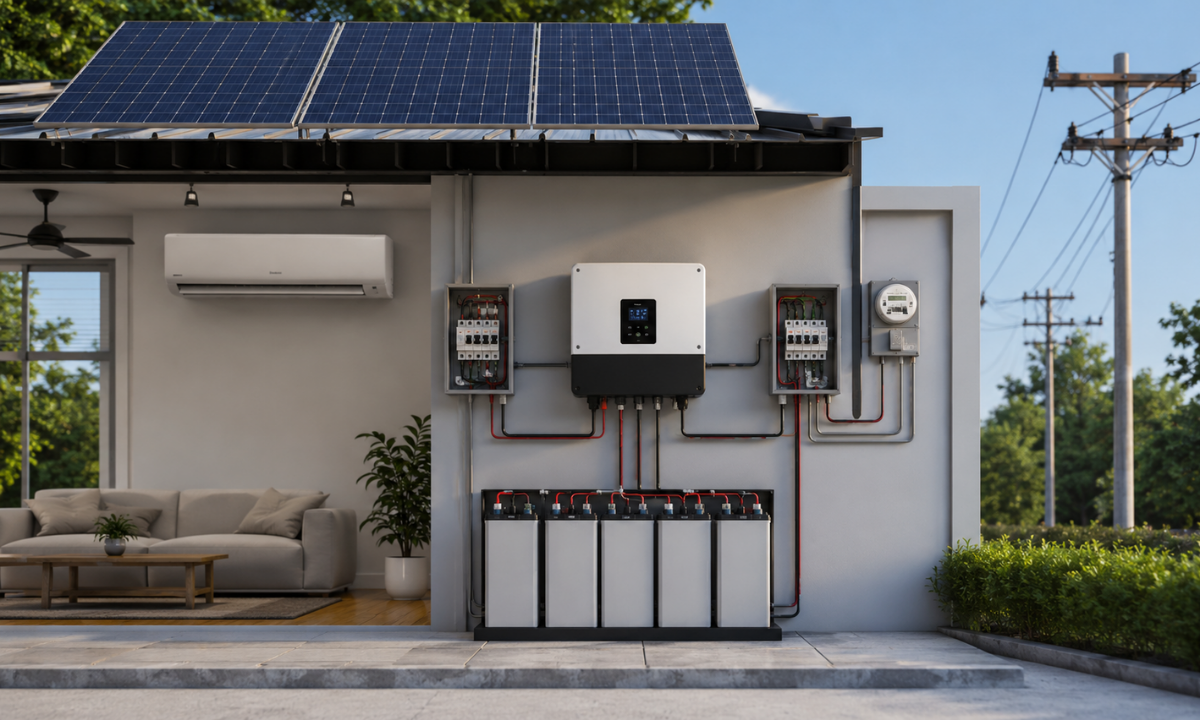
Running an AC on a lithium battery is not a standalone setup. It works as part of an integrated solar energy system involving key components working together:
Solar Panels generate DC electricity from sunlight during the day. This energy flows into the system continuously as long as there is sunlight available.
The Hybrid Solar Inverter manages the entire energy flow. It converts DC from the panels into AC for your appliances, charges the battery bank from solar or grid power, and switches seamlessly between sources depending on availability. It also handles the AC’s startup surge without any interruption.
A Lithium Battery Bank stores the energy generated during the day so it can be used at night or during grid outages. This is what powers your AC when solar generation is low or when the grid goes down.
ACDB and DCDB Panels – AC and DC distribution boxes manage the protection and switching of electrical circuits within the system. They house the fuses, MCBs, and surge protection devices that keep the entire setup safe from faults and voltage spikes.
Bi-Directional Solar Meter racks how much energy your system generates, how much you consume, and how much surplus is exported back to the grid. Essential for net metering and monitoring your actual savings month on month.
Together, these five components form a complete, reliable solar energy system – one that powers your AC, reduces your electricity bill, and keeps your home running during outages.
How Many Lithium Batteries Do You Need to Run an AC?
This is the most practical question, and the answer depends on three variables: your AC’s power consumption, how many hours you need it to run on battery, and the capacity of each battery unit.
Here is a clear breakdown based on common AC types in Indian homes:
| AC Type | Running Wattage | Battery for 4 Hours | Battery for 8 Hours |
|---|---|---|---|
| 1 Ton Split AC (5 Star) | 800 to 1,000W | 5 to 6 kWh | 10 to 12 kWh |
| 1.5 Ton Split AC (5 Star) | 1,200 to 1,500W | 6 to 8 kWh | 12 to 15 kWh |
| 1.5 Ton Split AC (3 Star) | 1,500 to 1,800W | 8 to 10 kWh | 15 to 18 kWh |
| 2 Ton Split AC | 1,800 to 2,200W | 10 to 12 kWh | 18 to 22 kWh |
A standard residential lithium solar battery comes in 5 kWh or 10 kWh units. For most families running a 1.5 ton 5-star AC for 6 to 8 hours on battery, a 10 to 15 kWh lithium battery bank is the practical starting point for either one larger unit or two smaller ones connected in parallel.
Keep in mind that the AC is rarely the only load running. Add fans, lights, a refrigerator, and a television to the equation, and you need to account for that total load when sizing the battery bank.
Lithium vs Lead-Acid – Why It Matters for AC Use
Many older solar installations in India used lead-acid batteries. For basic lighting and fan backup, they work adequately. For running an AC, they fall short in almost every way.
| Parameter | Lithium LFP Battery | Lead-Acid Battery |
|---|---|---|
| Usable Capacity | 80 to 90% | 40 to 50% |
| Performance Under High Load | Stable | Drops significantly |
| Lifespan | 10 to 15 years | 2 to 4 years |
| Weight | Lightweight | Heavy |
| Maintenance | Zero maintenance | Requires periodic maintenance |
| AC Suitability | Excellent | Poor to moderate |
The numbers speak clearly. A 10 kWh lead-acid battery gives you roughly 4 to 5 kWh of usable energy. A 10 kWh lithium battery gives you 8 to 9 kWh. For the same rated capacity, lithium delivers nearly double the actual runtime, which is the difference between your AC running through the night or shutting off at 2 AM.
Practical Tips to Maximizing the Efficiency of Your AC on Battery Power
Even with a correctly sized system, a few smart habits can meaningfully extend how long your batteries power the AC:
- Use a 5-star inverter AC. A 5-star rated inverter AC draws 20 to 30% less power than a 3-star unit for the same cooling output. Over 8 hours of nightly runtime, that difference translates directly into extra battery life.
- Set the thermostat to 24 to 26 degrees. Every degree below 24 increases power consumption by approximately 6%. Running at 26 instead of 18 can extend your battery runtime by an hour or more.
- Pre-cool the room before switching to battery. If you know a power cut is coming, run the AC on the grid for 30 minutes beforehand. A pre-cooled room requires significantly less effort to maintain temperature, reducing the load on your battery bank.
- Insulate the room properly. Curtains, sealed windows, and basic insulation reduce heat gain and allow the AC to cycle less frequently, directly reducing battery draw.
- Avoid running other heavy appliances simultaneously. A washing machine, microwave, or water heater running alongside the AC puts unnecessary pressure on the battery bank. Schedule heavy loads for when solar generation is active.
Why Choose Ionic Lithium Batteries for Running Your AC
Not all lithium batteries perform equally under the sustained, high-discharge demands of an air conditioner. Ionic lithium batteries built on LFP (Lithium Iron Phosphate) chemistry are specifically engineered for exactly this kind of application.
Here is why Ionic LFP batteries stand out for AC use in Indian homes:
Designed for High-Load Applications – Ionic lithium batteries are rated for continuous high-current discharge, which means they deliver stable, consistent power even when the AC compressor is working at full capacity. No voltage sag, no performance drop under load.
Longer Lifespan Than Any Alternative – Ionic LFP batteries are rated for 3,000 to 6,000 charge cycles, translating to 10 to 15 years of real-world use with daily deep cycling. For comparison, lead-acid batteries running the same AC load would need replacement every 2 to 3 years.
Safe for Indoor Installation – LFP chemistry is thermally stable and does not risk thermal runaway, the dangerous overheating that affects other lithium variants. Ionic batteries can be safely installed indoors, in utility rooms, or on walls without safety concerns.
Maximum Usable Capacity -With a depth of discharge of up to 90%, Ionic lithium batteries give nearly double the usable energy compared to lead-acid alternatives of the same rated capacity. For running an AC, this means a longer runtime per charge.
Zero Maintenance – Unlike lead-acid batteries that require periodic water top-ups and terminal cleaning, Ionic lithium batteries are completely maintenance-free. Install once, monitor via the BMS, and the battery manages itself.
Integrated Battery Management System – Every Ionic lithium battery comes with a built-in BMS that monitors voltage, temperature, and current in real time, protecting the battery and your system from overcharge, over-discharge, short circuits, and overheating.
Sun AP Ecopower supplies Ionic lithium batteries as part of complete solar systems designed for high-load residential and commercial applications. If you want to explore the right battery for your AC setup, visit our lithium battery page for the full range.
Conclusion
Running an AC on a lithium battery system is no longer a question of whether it is possible — it is a question of how well you size and set it up. For Indian homeowners dealing with rising electricity bills and unpredictable grid supply, a solar plus lithium battery setup is one of the smartest long-term investments available today.
The right lithium battery bank delivers enough usable capacity to keep your AC running through the night, charges itself through the day using solar energy, and pays for itself through electricity savings over time. No fuel, no noise, no dependence on the grid.
The only thing that determines whether the system works well or falls short is how accurately it is sized for your specific load. Get that right, and the results are consistent, reliable, and financially rewarding for years to come.
If you are ready to stop overpaying on electricity and want a system built around your actual usage, the Sun AP Ecopower team is here to help. As trusted solar product dealers in India, we assess your load, recommend the right lithium battery and inverter combination, and handle everything from supply to installation.
Frequently Asked Questions
Can a lithium battery run a 1.5 ton AC?
Yes. A 10 kWh lithium LFP battery paired with a compatible 5kW hybrid inverter can run a 1.5 ton 5-star AC for approximately 6 to 8 hours, depending on ambient conditions and simultaneous loads.
How long will a lithium battery run an AC?
A 10 kWh lithium battery running a 1,500W AC will last approximately 6 to 7 hours under typical conditions. Larger battery banks extend runtime proportionally. A 15 kWh bank can comfortably run the same AC through an 8 to 10-hour night.
Which is better for AC backup – lithium or lead-acid?
Lithium LFP batteries are significantly better. They deliver nearly double the usable capacity per rated kWh, handle high discharge rates without performance loss, and last 3 to 5 times longer than lead-acid alternatives.
How many solar panels do I need to charge the battery and run the AC?
For a system running one 1.5-ton AC for 8 hours daily, a 6kW to 8kW solar panel array is generally recommended to adequately recharge the battery bank through the day while covering daytime loads.
Is it safe to run an AC on lithium batteries?
Yes, provided the system is correctly sized and installed by a qualified professional. LFP lithium batteries with a built-in BMS are among the safest battery chemistries available for residential use in India.
What inverter capacity do I need to run an AC on battery?
A minimum 5kW inverter is recommended for a single 1.5 ton AC alongside standard home loads. The inverter must be rated to handle the startup surge of the AC compressor, which can spike to 3 to 4 times the running wattage momentarily.