Electricity meters are often treated as one product category, but they serve different purposes. Some meters decide how much you pay for your utility. Others help you understand where your energy goes. For homeowners, factory managers, EPC contractors and solar developers, knowing the difference between tariff and non-tariff meters helps you buy the right equipment, avoid compliance problems and manage energy costs more effectively.
This guide explains what each type does, how they differ, and what to check before buying, whether you are sourcing secure tariff meters for billing or evaluating non tariff meter distributors in India for internal monitoring.
What Is a Tariff Meter?
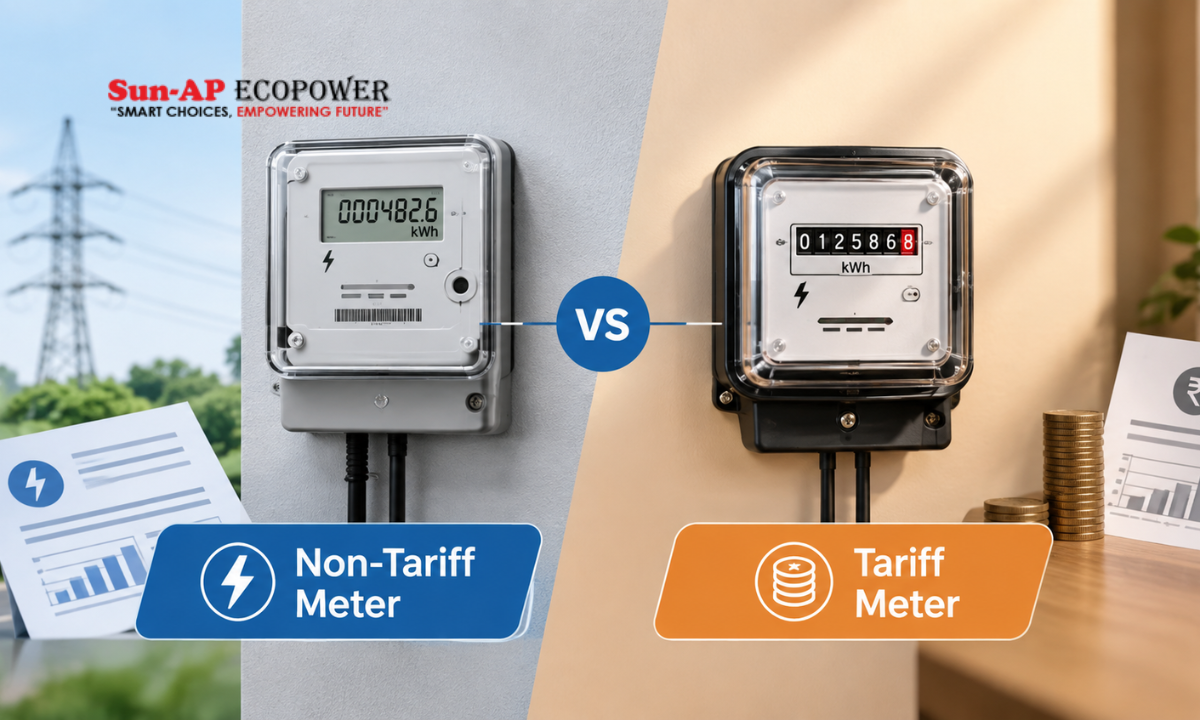
A tariff meter, also called a revenue meter or billing meter, measures electricity consumption for the purpose of charging the consumer. Utilities and distribution companies (DISCOMs) use its readings to generate bills based on the applicable tariff structure. Because the reading has financial and legal significance, these meters must meet strict accuracy, testing and sealing requirements.
Tariff meters typically record:
- Active energy (kWh) and, in many cases, apparent energy (kVAh)
- Maximum demand (kW or kVA)
- Power factor
- Time-of-day (ToD) consumption
- Import and export energy for net metering
They are installed at the point of supply, are usually sealed by the utility, and are often specified or approved by the DISCOM.
What Is a Non-Tariff Meter?
A non-tariff meter measures electrical parameters for purposes other than utility billing. Its readings help consumers monitor, analyze and allocate energy use, but they do not form the basis of the official electricity bill. Non-tariff meters are often installed downstream of the main billing meter.
Common uses include:
- Sub-metering: measuring consumption of individual floors, tenants, departments or production lines
- Energy audits: identifying high-consumption equipment and load patterns
- Cost allocation: dividing electricity charges fairly among users in shared buildings
- Solar monitoring: tracking generation from an inverter or plant for performance analysis
- Power quality analysis: observing voltage, current, harmonics and power factor
Many are multifunction meters that display a wide range of electrical parameters in real time.
Key Differences Between Tariff and Non-Tariff Meters
1. Purpose
A tariff meter exists for billing. A non-tariff meter exists for monitoring and management. This difference drives almost every other distinction below.
2. Regulatory Approval
Tariff meters generally must comply with applicable Indian standards, such as IS 13779 for static energy meters and IS 16444 for smart meters, and often require DISCOM-approved makes and models. Non-tariff meters usually have more flexibility, though quality and reliable accuracy remain important for credible data.
3. Accuracy Class
Billing meters commonly fall under higher accuracy classes, such as Class 1.0 or Class 0.5S and 0.2S for higher-voltage connections, because small errors multiply into significant sums. Non-tariff meters may use a range of accuracy classes depending on the application, though choosing a lower class than needed can undermine audit quality.
4. Sealing and Tamper Protection
Tariff meters are sealed, and tampering can invite penalties. They typically include extensive tamper detection, event logging and secure configuration.
Non-tariff meters may have fewer security layers, but secure non-tariff meters with protected settings and reliable data storage are valuable where internal cost allocation depends on trustworthy readings.
5. Installation Responsibility
Utilities usually control the installation, testing and sealing of tariff meters. Consumers can install non-tariff meters on their own, subject to electrical safety norms.
6. Features and Flexibility
Non-tariff meters often include a broader or more customizable parameter set, including multiple communication options and integration with building or energy management systems. Tariff meters prioritize billing-grade measurement, security and compliance, though smart tariff meters increasingly add remote communication.
7. Cost
Non-tariff meters are often more economical, but cost should reflect the role of the meter. A cheaper unit may be fine for monitoring a single circuit but unsuitable for tenant billing.
Quick Comparison
| Aspect | Tariff Meter | Non-Tariff Meter |
| Primary purpose | Utility billing | Monitoring and allocation |
| Approval | Standards compliance, often DISCOM approval | Flexible, quality dependent |
| Sealing | Utility-sealed | Typically user-controlled |
| Accuracy | Billing-grade | Application-dependent |
| Typical location | Point of supply | Downstream circuits |
Where Each Meter Fits in a Solar Setup
Solar installations often use both. A bidirectional tariff meter at the grid connection records import and export for net metering, so the utility can settle your account. A non-tariff meter on the solar output or on specific loads shows how much energy your system generates and how it is used. Together, they give you a complete picture. The tariff meter tells you what you owe or earn, while the non-tariff meter helps you understand why.
For this reason, buyers often prefer to source from experienced solar product dealers in India who can supply compatible metering alongside inverters, panels and protection equipment.
Key Features to Evaluate Before Buying
For secure tariff meters:
- Compliance with relevant standards and utility specifications
- Appropriate accuracy class for your connection
- Tamper detection, event logging and sealing provisions
- Bidirectional measurement if you have solar
- Reliable real-time clock and ToD support
- Test certificates from recognized laboratories
For non-tariff meters:
- Parameters measured (energy, demand, voltage, current, power factor)
- Communication options such as RS-485 with Modbus, or Ethernet
- Data logging capacity and display clarity
- Suitable CT compatibility for larger loads
- Password protection and data integrity
Choosing the Right Supplier
A reliable supplier matters as much as the meter. When shortlisting non tariff meter distributors in India, look for:
- Authorization: confirmation that they are authorized by the manufacturer
- Documentation: datasheets, calibration certificates and warranty terms
- Technical guidance: help with selecting the right meter, CT ratios and communication setup
- Support: after-sales service, spare availability and clear replacement policies
- Range: access to both billing-grade and monitoring meters
Be cautious of unbranded products without test certification, as inaccurate readings can lead to billing disputes or poor energy decisions.
Common Mistakes to Avoid
- Using a non-tariff meter where utility billing or regulatory approval is required
- Ignoring DISCOM specifications before purchasing a tariff meter
- Choosing a meter without checking CT compatibility
- Overlooking communication requirements for monitoring systems
- Prioritizing price over certification and accuracy
Final Thoughts
Tariff meters and non-tariff meters are complementary. One ensures accurate, compliant billing, while the other gives you the insight to reduce waste and improve efficiency. Matching each meter to its role, and buying from a knowledgeable, authorized supplier, protects both your finances and your data quality.
If you are looking for dependable solar product dealers in India or comparing secure tariff meters and secure non tariff meters for your project, explore the options at Sun-AP Eco Power.