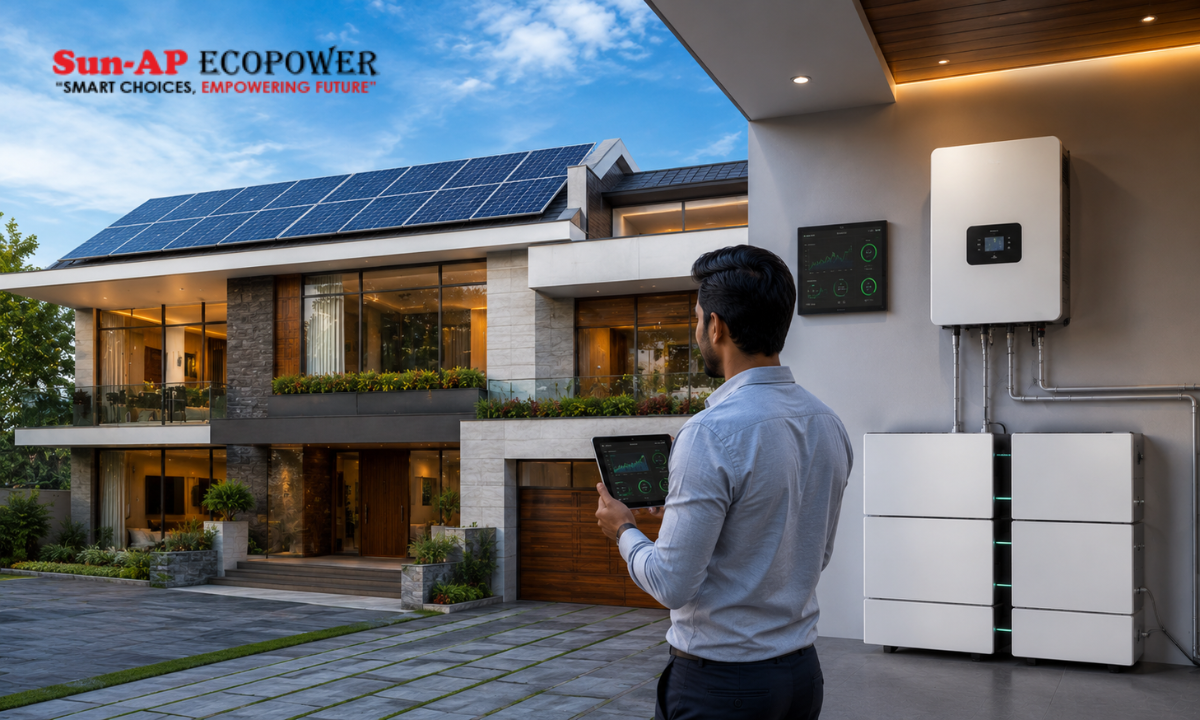
For years, residential solar was treated as a simple math equation: install panels to reduce your monthly electricity bill.
However, as we move through 2026, the equation has completely changed. With rising Time-of-Day (ToD) tariffs and increasingly frequent grid instability, a standard on-grid setup is no longer enough to guarantee operational continuity for a modern, high-load household.
Today, homeowners are actively seeking true energy independence, which has driven a massive spike in searches for the true hybrid solar system price in India.
Powered by intelligent Hybrid Solar Inverters, this architecture represents the ultimate home upgrade. It does not just push raw power back into the grid; it actively orchestrates a self-sustaining microgrid right in your backyard. Capturing solar energy during the day and storing it in high-capacity lithium reservoirs, a hybrid system completely insulates your home from public grid failures while driving your electricity costs down to zero.
If you are a homeowner or a solar EPC installer looking to deploy a system that actually delivers long-term financial returns, you cannot rely on generic, surface-level price charts.
Let’s break down the true cost of ownership, the components you are actually paying for, and why buying premium, authorized technology is the smartest financial decision you will make this decade.
What Are You Actually Paying For? Component Breakdown
When evaluating a hybrid solar system for a home, you will quickly notice a significant price gap compared to standard on-grid setups.
A common mistake made by consumers is treating solar quotes like generic commodities, assuming a 5kW system from a local vendor is identical to a 5kW system engineered with Tier-1 global technology.
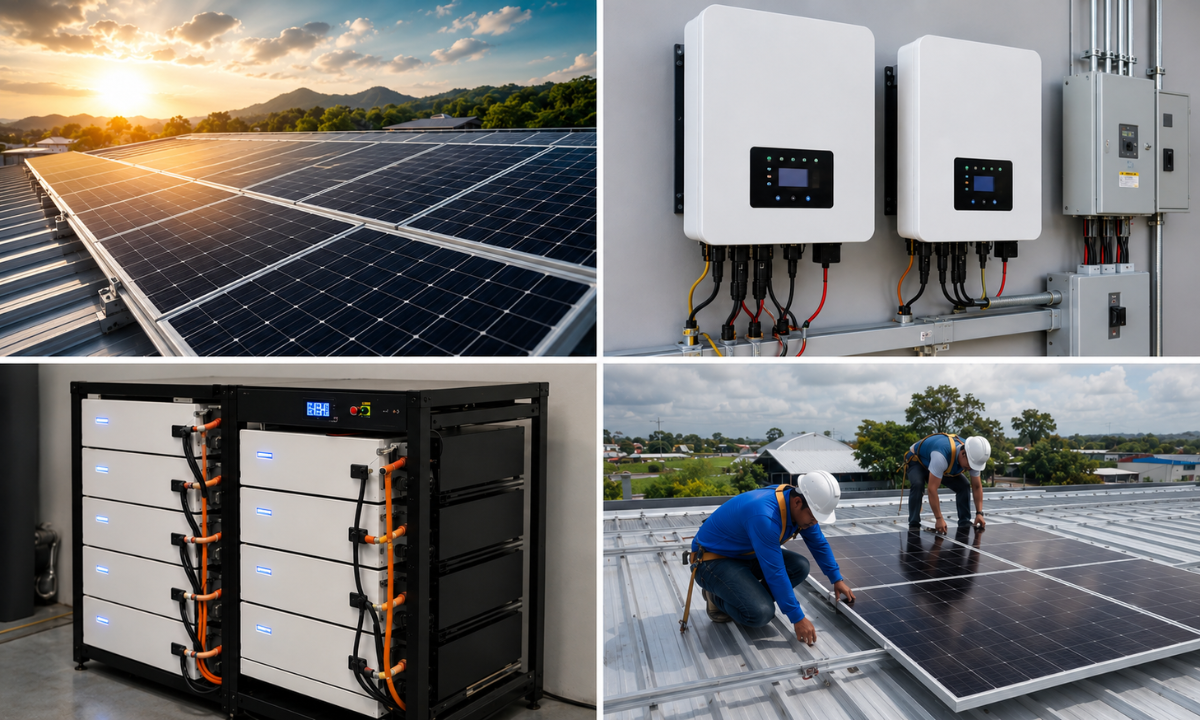
To understand the price, you have to look at the engineering. A premium hybrid architecture is fundamentally composed of three distinct, high-value technological pillars:
1. The Energy Engine: High-Efficiency Solar Panels (30% to 35% of total cost)
The cost of your solar array is dictated by the efficiency of the silicon. In 2026, legacy Polycrystalline panels are virtually obsolete.
Premium hybrid systems utilize advanced Mono PERC, TOPCon, or Bifacial panels (from global tier leaders like Adani, REC, and Panasonic). These panels perform exceptionally well in low-light conditions and require significantly less roof space to generate the same wattage, ensuring your battery bank charges quickly even on overcast days.
2. The Brain: The Smart Hybrid Inverter (20% to 25% of total cost)
This is not a simple DC-to-AC converter. High-end hybrid inverters (from brands like Deye or FIMER-ABB) are highly sophisticated bi-directional computers. They feature microsecond transfer switches (less than 20 milliseconds) to keep your Wi-Fi and appliances running without a flicker during a blackout.
They also contain integrated Battery Management System (BMS) communication protocols to safely orchestrate the charging cycles of high-voltage lithium cells.
3. The Reservoir: Lithium LFP Storage (35% to 40% of total cost)
This is the primary reason hybrid systems carry a higher upfront price tag, but it is also where the actual value lies.
While budget vendors will try to sell you heavy, toxic, and short-lived Lead-Acid or Tubular batteries, the 2026 standard demands Lithium Iron Phosphate (LiFePO4 or LFP) battery racks. LFP batteries can be safely discharged down to 10%, require absolutely zero maintenance, and are rated for 4,000 to 6,000 cycles (translating to a 10 to 15-year lifespan).
4. Balance of System (BoS) & Installation (10% to 15% of total cost)
The final slice of the financial pie goes toward the physical infrastructure that keeps the system safe. This includes hot-dip galvanized mounting structures that can withstand cyclonic winds, heavy-duty DC cabling, multi-stage lightning arrestors, and the skilled labor required for a flawless, code-compliant installation.
When you understand this breakdown, it becomes clear that a hybrid system is not just an appliance; it is a complex infrastructural investment. Attempting to cut corners on any of these four pillars directly compromises the safety and lifespan of the entire setup.
Estimated Price Benchmarks for Residential Homes (2026)
When engineering a long-term energy solution, providing a single flat price is often misleading. As of early 2026, the hybrid solar inverter cost, alongside the global price of lithium cells, has stabilized significantly.
According to recent market intelligence reports (including 2026 data from BloombergNEF and local Indian energy storage indices), Lithium Iron Phosphate (LiFePO4) battery packs have seen an approximate 15% year-over-year price drop, making premium storage far more accessible for residential consumers than it was in 2023.
However, Sun-AP Ecopower strictly recommends investing in Tier-1, globally certified components rather than budget local imports. While budget systems might look attractive on paper, their rapid degradation rates destroy your long-term Return on Investment (ROI).
Here is the authoritative 2026 premium pricing benchmark for fully installed, Tier-1 residential hybrid systems in India.
Note: These are pre-subsidy estimates and include top-tier Mono PERC/TOPCon panels, a smart bi-directional hybrid inverter, and high-capacity Lithium LFP battery storage.
The 2026 Premium Hybrid Cost Matrix
| System Capacity | Ideal Home Profile | Estimated Price Range (INR) | Recommended Battery Backup | What Powers During a Blackout |
|---|---|---|---|---|
| 3 kW Hybrid | 2-3 BHK Urban Homes (Mild power cuts) | ₹2,80,000 – ₹3,30,000 | 3.5 kWh to 5 kWh LFP | Lights, fans, Wi-Fi, TV, refrigerators, and minor kitchen appliances. |
| 5 kW Hybrid | 3-4 BHK Independent Villas | ₹4,50,000 – ₹5,50,000 | 5 kWh to 10 kWh LFP | All standard appliances+ 1 Inverter AC (1.5 Ton)+ 1 Water Pump. |
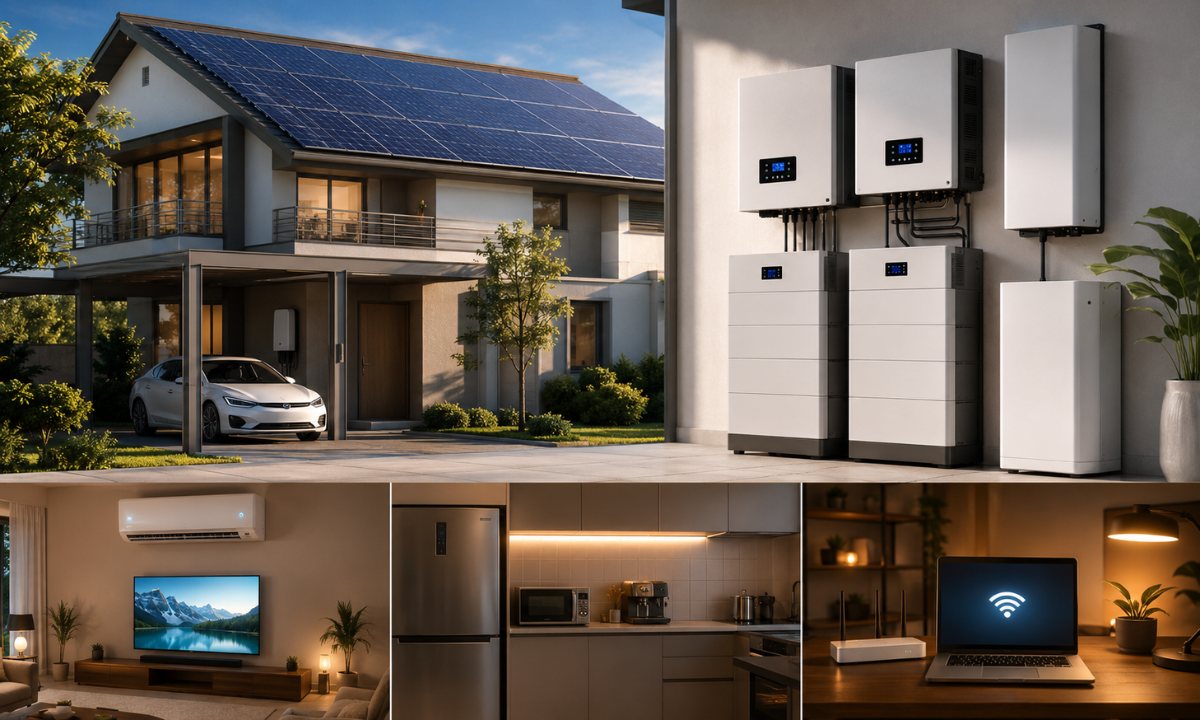
| 10 kW Hybrid | Large Villas, Farmhouses, or Home Offices | ₹8,50,000 – ₹10,50,000 | 10 kWh to 15 kWh LFP | Multiple ACs, EV Chargers, heavy inductive loads, and complete home automation. |
Pro Tip for Buyers: When reviewing quotes, always check the exact kWh capacity of the lithium battery included. A vendor offering a “cheap 5kW hybrid system” is almost certainly reducing the battery capacity to 2.4 kWh to undercut competitors, leaving you completely stranded during a long nighttime power cut.
By viewing your system through this premium lens, you aren’t just buying solar panels; you are purchasing a 15-to-20-year insurance policy against rising grid tariffs and regional power failures.
Navigating the PM Surya Ghar Subsidy for Hybrid Systems
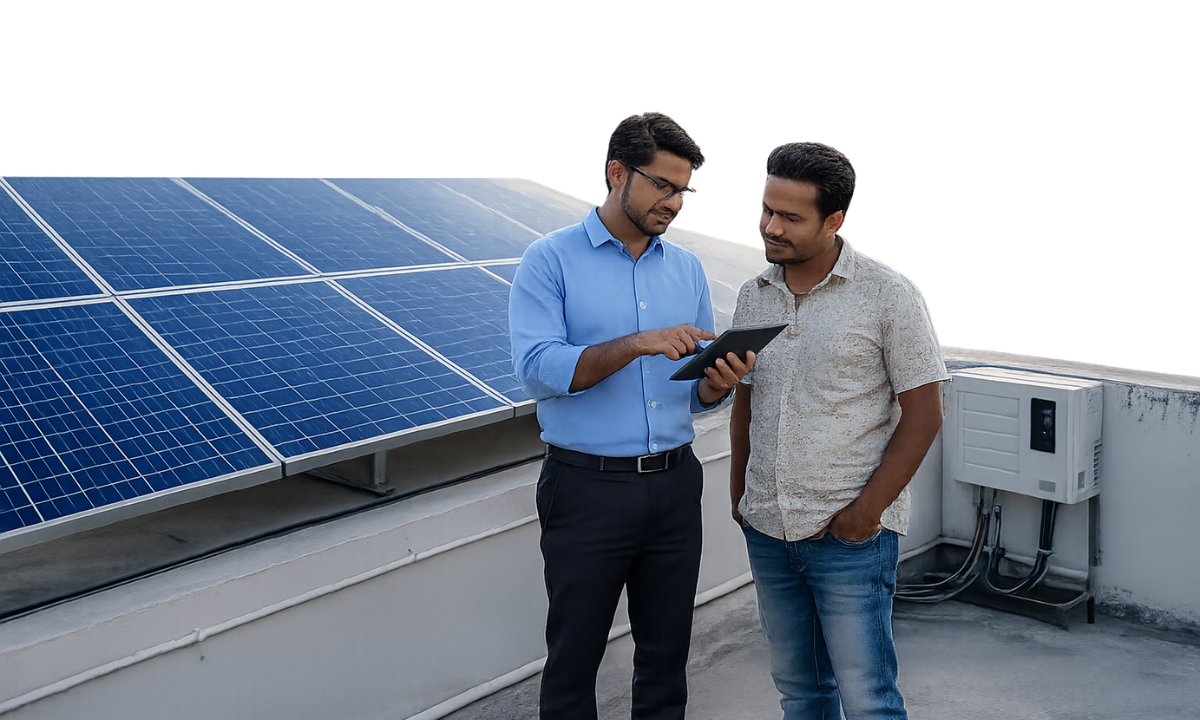
One of the most common questions homeowners ask when exploring a premium energy upgrade is whether they can offset the cost using government incentives. The short answer is yes, but you must understand exactly how the math works for an advanced architecture.
In 2024, the Indian government launched the PM Surya Ghar Muft Bijli Yojana, a massive solar subsidy scheme designed to accelerate residential rooftop adoption. As of 2026, the subsidy structure remains highly lucrative, but it comes with specific stipulations regarding hybrid technology.
The 2026 PM Surya Ghar Subsidy Slabs
The Central Financial Assistance (CFA) is calculated strictly based on the capacity of your solar array (the panels), capped at a maximum of 3 kW.
- Up to 2 kW: ₹30,000 per kW (Max ₹60,000)
- For the 3rd kW: An additional ₹18,000
- Maximum Subsidy Cap: ₹78,000 (for any system 3 kW or larger)
The Hybrid Caveat: What is Actually Covered?
The government’s primary goal is to promote grid-tied solar generation. Therefore, the PM Surya Ghar scheme subsidizes the solar panels and the inverter, but it does not subsidize the cost of the lithium battery storage bank.
However, this does not mean you are excluded! If you install a 5 kW hybrid system, you can still claim the maximum ₹78,000 subsidy against the panel and inverter portion of your invoice.
Leveraging this central assistance, the financial leap from a standard on-grid setup to a fully independent hybrid microgrid becomes significantly smaller and much more attainable for the average household.
The Compliance Trap
To successfully claim this ₹78,000, your system must meet strict 2026 regulatory guidelines. The most critical rule is the ALMM Mandate (Approved List of Models and Manufacturers). If your EPC installer uses cheap, imported solar panels that are not on the government’s approved domestic list, your subsidy application will be instantly rejected by the DISCOM inspector.
This is where sourcing through authorized distributors becomes vital. As Sun-AP Ecopower supplies top-tier, ALMM-compliant modules from domestic manufacturing giants (like Adani Solar) alongside BIS-certified smart hybrid inverters, our EPC partners can guarantee a flawless, 100% compliant subsidy approval process for their residential clients.
Cheap vs. Premium: The Long-Term ROI
When homeowners review quotes for a solar power backup system for their home, the immediate temptation is to choose the lowest bidder. The Indian market is flooded with unbranded, assembled hybrid kits that promise the world at a fraction of the cost. However, in high-end power electronics, cheap upfront pricing is almost always a front-loaded liability.
To understand the actual economic impact, you must look at your solar energy savings over a 10-to-15-year horizon rather than a 10-month window.
The Failure Mechanics of Low-Grade Systems
Cheap hybrid setups look identical to premium systems on a basic specification sheet, but they fail rapidly under real-world conditions due to two engineering flaws:
1. Inverter Thermal Stress: Low-end hybrid inverters use cheaper internal capacitors and lower-grade cooling fans. When subjected to India’s intense summer temperatures and rapid bidirectional switching between the grid and battery, these components degrade.
A cheap inverter typically fails or loses efficiency within 2 to 4 years, entirely wiping out your operational uptime.
2. Battery BMS Malfunction: A lithium battery pack is only as safe and long-lasting as its Battery Management System (BMS). Cheap, unbranded lithium packs feature primitive BMS chips that fail to balance the cells evenly during high-amperage charging.
This leads to localized cell degradation, micro-short circuits, and an early battery death, forcing you to buy a brand-new storage bank long before the system has paid for itself.
The Financial Reality: A 10-Year Cost Comparison
To contextualize this, let’s look at the lifecycle economics of a budget 5 kW system versus an authorized Tier-1 system sourced from a reliable distributor.
While the Tier-1 premium system requires a higher initial asset expenditure, it runs completely maintenance-free for over a decade.
It continuously maximizes your monthly utility savings because its high-efficiency components convert and store every single available milliwatt of solar generation without significant thermal loss.
When you purchase an authorized system built with components from trusted global manufacturers, you aren’t spending extra money for a brand logo; you are paying for thermal engineering, structural safety, certified software integration, and a guaranteed asset lifespan.
Why Sourcing via Sun-AP Ecopower Protects Your Investment?
When engineering an advanced hybrid solar solution, where you source your hardware matters just as much as the capacity you choose. As residential hybrid setups manage high-voltage bidirectional electricity and delicate lithium-ion chemical cells, skipping on component origin is a massive safety hazard.
As India’s premier, pure-play Solar product dealers in India, Sun-AP Ecopower provides the critical engineering and distribution bridge that ensures your home asset lasts for decades:
- 100% Authorized & Certified Tech Stack: We do not trade in gray-market or unverified imports. Every component from our ALMM-compliant Adani solar modules to our BIS-certified Deye and FIMER-ABB hybrid inverters comes straight from the manufacturer with genuine, fully enforceable warranty protection.
- Pre-Tested Communication Compatibility: Our engineering team ensures your hybrid inverter and lithium battery bank feature seamlessly synchronized BMS protocols. This eliminates firmware conflict glitches that can compromise your home backup system during an emergency.
India’s top-tier solar EPC contractors rely on our Bangalore-headquartered distribution pipeline because we back every single shipment with robust logistics, technical blueprint validation, and unmatched post-sale support.
Conclusion
Investing in a residential hybrid solar system is no longer about just reducing a utility bill; it is about securing complete operational sovereignty over your home’s power supply.
While the initial setup cost requires a thoughtful allocation of capital, the 2026 price stabilization of lithium storage paired with the ₹78,000 PM Surya Ghar subsidy makes this the perfect window to upgrade. By prioritizing premium, authorized components over budget compromises, your home secures an asset that pays for itself multiple times over.
Don’t let legacy grid failures dictate your lifestyle or business continuity. Take the next step toward true energy resilience. Connect with the clean tech experts at Sun-AP Ecopower today to find verified EPC installers in your region, get an accurate custom assessment, and experience the benchmark in modern renewable engineering.