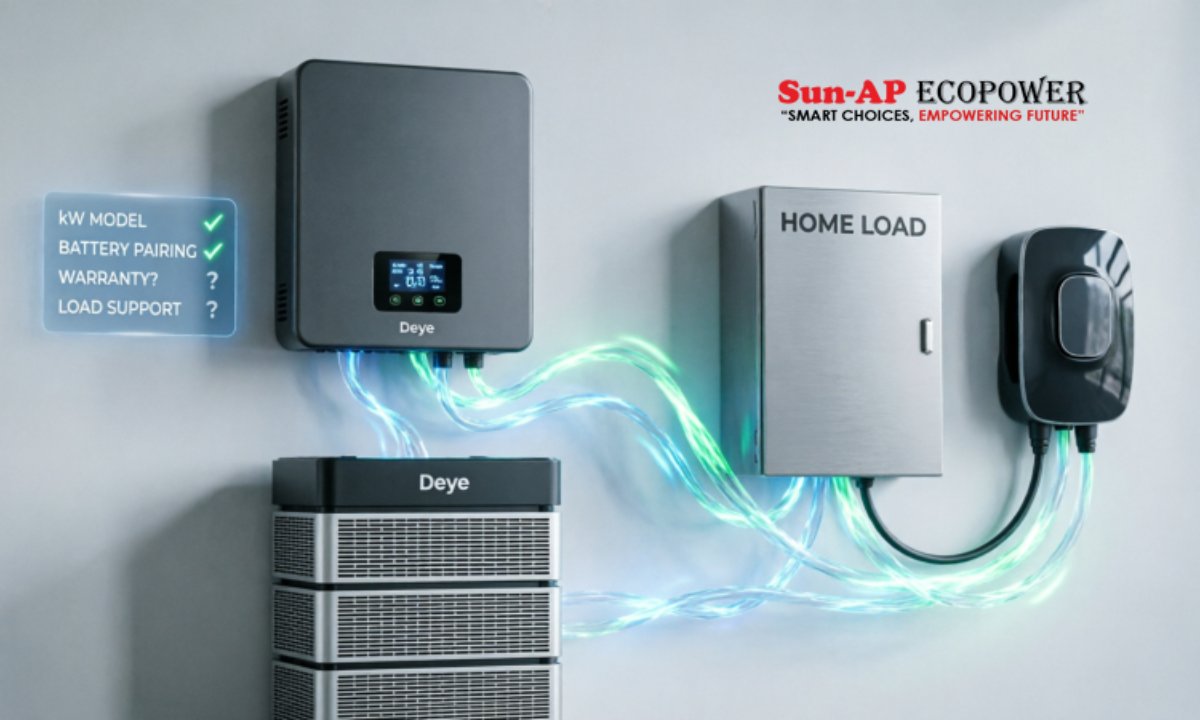
A DEYE solar inverter is a strong choice for homes and businesses that want dependable hybrid or on-grid performance. The inverter itself is only part of the decision, though. Most problems after installation come from mismatched batteries, panel strings that do not suit the inverter, or questions nobody asked before the order was placed. This guide covers what to check before you buy.
Quick Checklist Before You Order
- Decide whether you need an on-grid or a hybrid DEYE model.
- If hybrid, confirm the battery is compatible with the inverter.
- Check that your panel string voltage fits the inverter’s MPPT range.
- Compare the datasheet features that matter to your roof and loads.
- Plan for monitoring from day one.
- Buy from an authorised distributor and get the paperwork.
On-Grid or Hybrid DEYE Models?
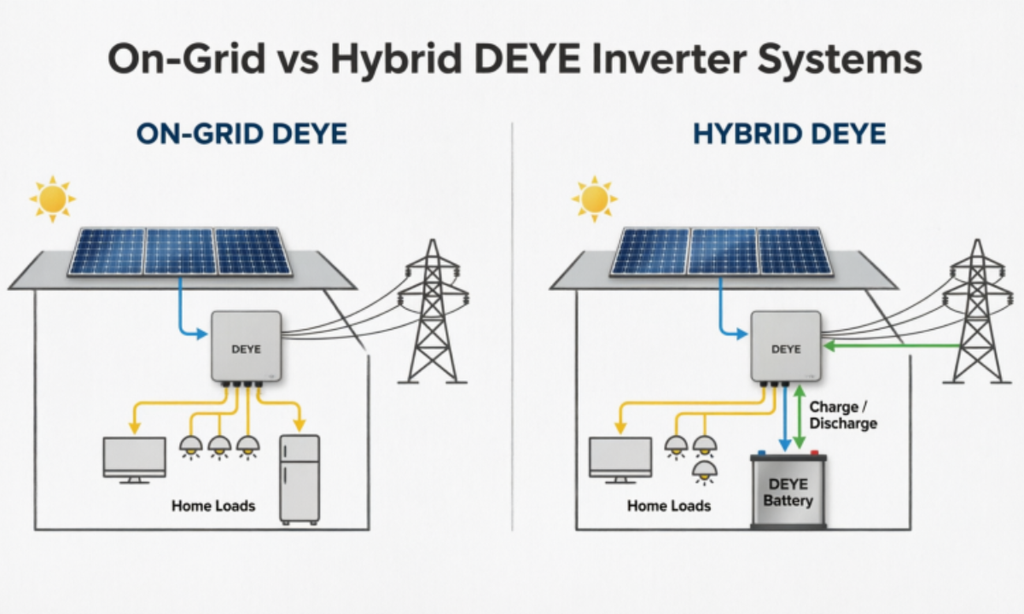
DEYE offers on-grid string inverters and hybrid inverters. On-grid units suit properties with steady grid supply and no backup need. Hybrid units add battery storage for outages and evening use. If you are unsure, tell us your monthly units and outage hours and we will suggest the better fit.
For a full explanation of how the two types differ and how to work out your backup load, see our hybrid inverter sizing guide. This page focuses on what is specific to buying a DEYE unit.
Pairing DEYE Inverters with Lithium Batteries
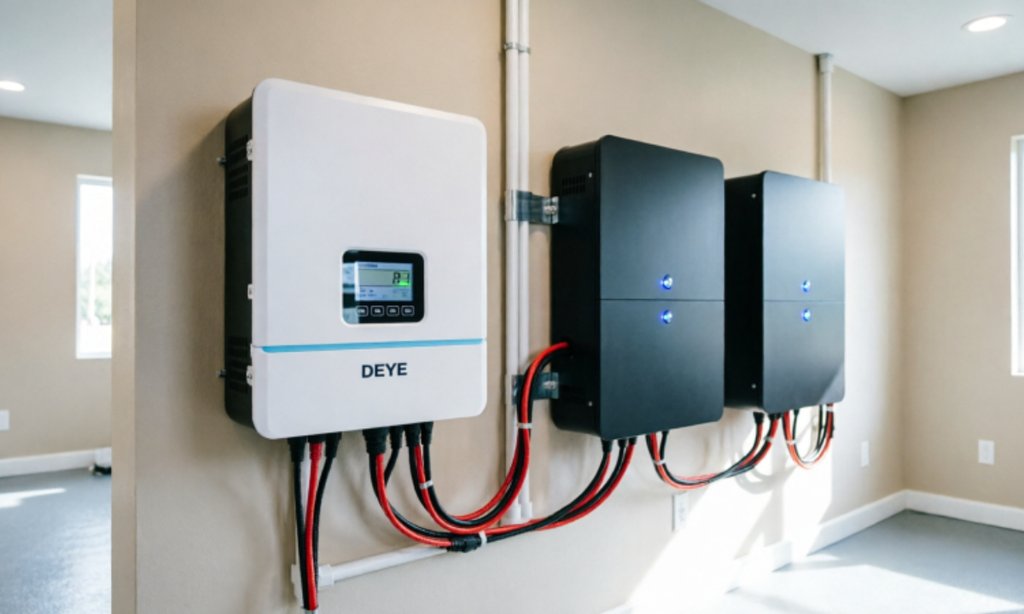
Hybrid DEYE inverters work with DEYE lithium solar battery packs. Check that the inverter’s battery voltage and communication match the pack, and that the battery capacity covers your evening load.
Battery pairing is where buyers most often go wrong, so it is worth slowing down here. A battery that looks suitable on paper can still fail to work properly with the inverter if the two cannot communicate or their voltage ranges do not line up.
What to Confirm for Battery Compatibility
- Battery voltage range. The battery’s operating voltage must sit within the range the inverter supports.
- Communication. Most lithium batteries talk to the inverter digitally (commonly over a CAN or RS485 link) so the inverter can read charge level and set safe limits. Confirm the pack and inverter are meant to work together.
- Charge and discharge current. The battery must be able to deliver the current the inverter may ask for at peak load.
- Usable capacity. Check the usable energy of the pack, not just the rated figure.
- Expansion. If you want to add packs later, ask how many can be connected together.
The simplest route is to choose a battery that is specified for the inverter. Browse our DEYE range, including hybrid inverters and lithium battery packs, or see our wider selection of lithium batteries. Avoid mixing batteries of different types or ages without advice from an engineer.
Which Size Do You Need?
A single phase 5kW unit fits many medium homes. Our shop lists the DEYE on-grid string inverter in 5kW single phase. Larger homes and offices may need three phase, so share your load details with us. Always confirm that the panel string voltage fits the inverter’s MPPT range before finalising a design.
How to Check String Voltage Against the MPPT Range
The MPPT (maximum power point tracker) is the part of the inverter that squeezes the most power out of your panels. It only works well within a specific voltage window. If your panel strings fall outside it, the inverter either wastes energy or cannot start properly.
- Find the panel’s voltage figures on its datasheet, especially open-circuit voltage (Voc) and the voltage at maximum power.
- Multiply by the number of panels in a string to get the string voltage.
- Compare with the inverter’s limits. The string’s open-circuit voltage must stay below the inverter’s maximum DC input voltage, and the operating voltage should sit inside the MPPT range.
- Allow for temperature. Panel voltage rises in cold conditions, so check the string against the inverter’s maximum on the coldest morning your site is likely to see.
Our engineers can do this calculation for you. Share your panel model and planned layout when you enquire. If you are still choosing panels, see our solar panels range.
Features to Compare
- Rated and peak output
- MPPT inputs for roofs with different orientations
- Monitoring through an app
- Warranty and local service support
What Each Feature Means for You
| Feature | Why it matters | What to ask |
| Rated and peak output | Rated output is what the inverter delivers continuously. Peak output covers short surges. | What are both figures for this model? |
| Number of MPPT inputs | Separate inputs let panels facing different directions work independently, which suits split roofs. | How many MPPT inputs does it have, and how many strings per input? |
| Maximum DC input voltage and MPPT range | Decides which panel strings the inverter can accept safely. | Does my planned string fit these limits, including in cold weather? |
| Battery voltage and communication (hybrid) | Decides which batteries work with the inverter. | Which battery packs are specified for this model? |
| Monitoring | Lets you track generation and spot faults early. | How do I set up the app, and does it need Wi-Fi? |
| Warranty and service | Protects you over the life of the system. | What is the current warranty term and who handles service locally? |
Common Mistakes to Avoid
- Choosing a battery that is not compatible with the inverter. Voltage and communication must both match.
- Oversizing the inverter far beyond panel capacity. You pay for capacity the panels can never fill.
- Skipping monitoring setup after installation. Without it, a fault can go unnoticed for weeks.
- Ignoring cold-weather voltage. A string that looks fine at noon can exceed the inverter’s limit on a cold morning.
- Forgetting roof orientation. East and west facing panels on one input can underperform. Ask about separate MPPT inputs.
Installation and Monitoring
A good installation decides how well any inverter performs. Ask for proper earthing, correct cable sizing and a shaded, ventilated mounting spot. Enable remote monitoring from day one so you can track daily generation and catch faults early.
Installation Quality Checklist
- Proper earthing for the inverter, panels and structure.
- Cable sizes matched to the current they carry, for both DC and AC runs.
- A mounting spot that is shaded from direct sun and has room to breathe, since heat reduces inverter performance.
- DC isolation and surge protection included in the design as required.
- Clear labelling of circuits and isolators.
Monitoring Setup Checklist
- Connect the inverter to your Wi-Fi network and link it to the app during commissioning.
- Check that daily generation figures appear and look sensible.
- Make sure alerts or fault messages are visible to you, not only to the installer.
- Compare monthly generation against expectations so a slow decline gets noticed.
What to Ask Before You Buy
Whether you buy from us or anyone else, put these questions to your seller:
- Which exact DEYE model is this, and is it on-grid or hybrid?
- Which battery packs are specified for this model, and how many can I connect?
- Does my panel string fit the maximum DC voltage and MPPT range?
- How many MPPT inputs are there, and does my roof need more than one?
- What is the current warranty term, and what does it cover?
- Who provides local service, and how quickly?
- What documents will I receive with the inverter?
Documents You Should Receive
- A proper invoice for the inverter and battery.
- The warranty details for each product.
- The datasheet or manual for the model supplied.
- Commissioning details, including the monitoring login.
Why Buy from an Authorised Distributor
Genuine stock, correct documentation and local after-sales help matter more than a small price gap. Sun-AP Ecopower supports you from selection to installation guidance. Explore our full range of solar inverters to see how DEYE sits alongside other brands we supply.
FAQs
Is DEYE suitable for homes?
Yes, single phase models are common for residences.
Can I add batteries later?
Yes, on hybrid models, if your design allows for it.
What warranty can I expect?
Terms vary by model, so ask us for the current warranty before buying.
Can I use any lithium battery with a DEYE hybrid inverter?
Not necessarily. The battery’s voltage range and communication must match the inverter. The simplest route is to use DEYE lithium solar battery packs that are specified for your model.
How do I know if my panel string fits the inverter?
Multiply the panel’s voltage by the number of panels in the string, then check it against the inverter’s maximum DC voltage and MPPT range, including cold-weather voltage. Our engineers can run this check for you.
Why do some roofs need more than one MPPT input?
Panels facing different directions produce power at different times and voltages. Separate MPPT inputs let each group work at its best point.
Does the DEYE app work without Wi-Fi?
Remote monitoring needs the inverter to be connected to the internet, so set up your Wi-Fi connection during commissioning and check that readings appear in the app.
Is it a problem if my inverter is much larger than my panels?
Oversizing the inverter far beyond panel capacity means paying for output the panels cannot supply. Ask our engineers to match the two sensibly.
How do I know the inverter I am buying is genuine?
Buy from an authorised distributor and ask for a proper invoice, warranty details and the model documentation.
Where can I buy on-grid DEYE inverters?
You can browse the DEYE range on our website or buy on-grid models in the Sun-AP shop.
Ready to Choose Your DEYE Inverter?
See our DEYE solar inverter range and buy on-grid models in the Sun-AP shop. Not sure about sizing? Read our hybrid inverter sizing guide. For more solar guides, visit our blogs, or contact us and our team will help you choose the right DEYE model and battery pairing.