Feston inverters are popular for high efficiency and long warranty cover. The real question is which type and size suits your roof, your electrical connection and your backup needs. This guide walks you through the choice step by step, so you can pick the right model the first time.
Quick Answer: Which Feston Inverter Should You Choose?
- Want the lowest bills and rarely face power cuts: on-grid inverter.
- Face frequent outages or want evening backup: hybrid inverter with battery.
- Apartment or small home on single phase: single phase model, 3kW to 6kW.
- Villa, farm or office on three phase: three phase model, up to 10kW.
What Makes Feston Inverters Stand Out
Feston string inverters are built for Indian homes and commercial rooftops. On our shop, listings show efficiency of 97.5% to 98.3% on on-grid models, 97.6% on hybrid models, and a 10-year warranty.
Efficiency matters because every percentage point lost in conversion is solar energy you paid for but never used. A long warranty matters because an inverter is the part of a solar system that works hardest, converting your panel output into usable power every day.
What Is a String Inverter?
A string inverter connects a group (or string) of solar panels and converts their combined DC output into AC power for your home. It is a simple, proven design that suits most residential and commercial rooftops where panels face the same direction and receive similar sunlight.
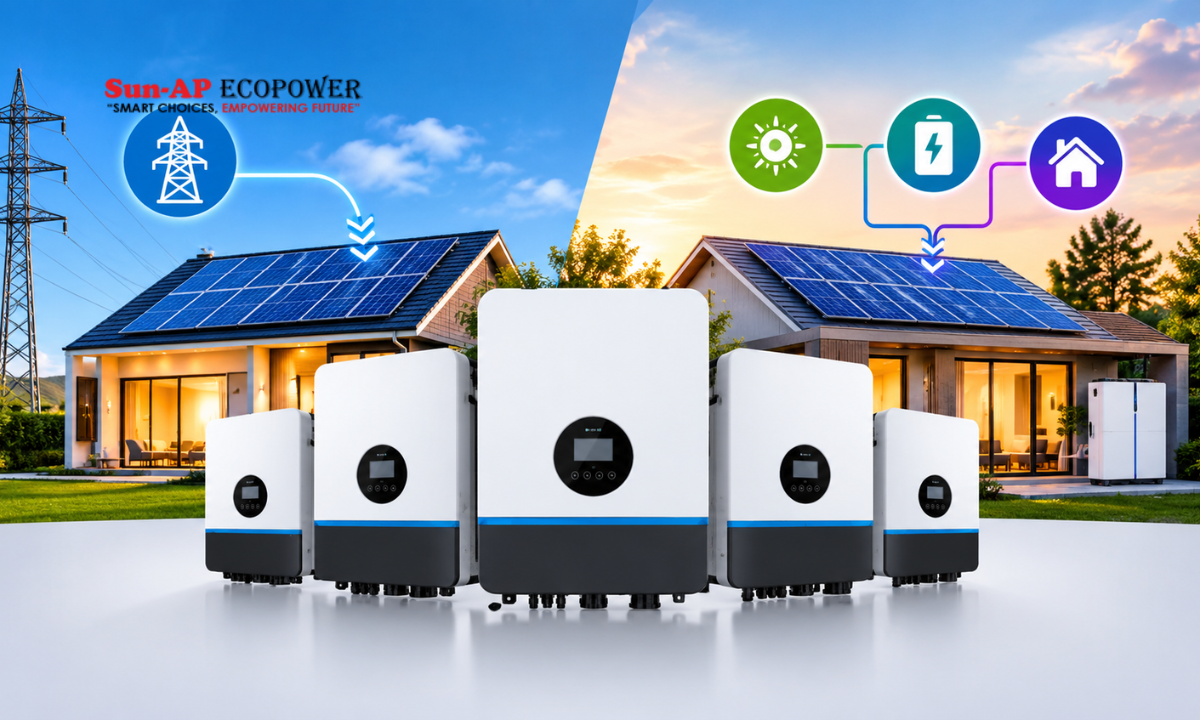
On-Grid vs Hybrid: Side-by-Side
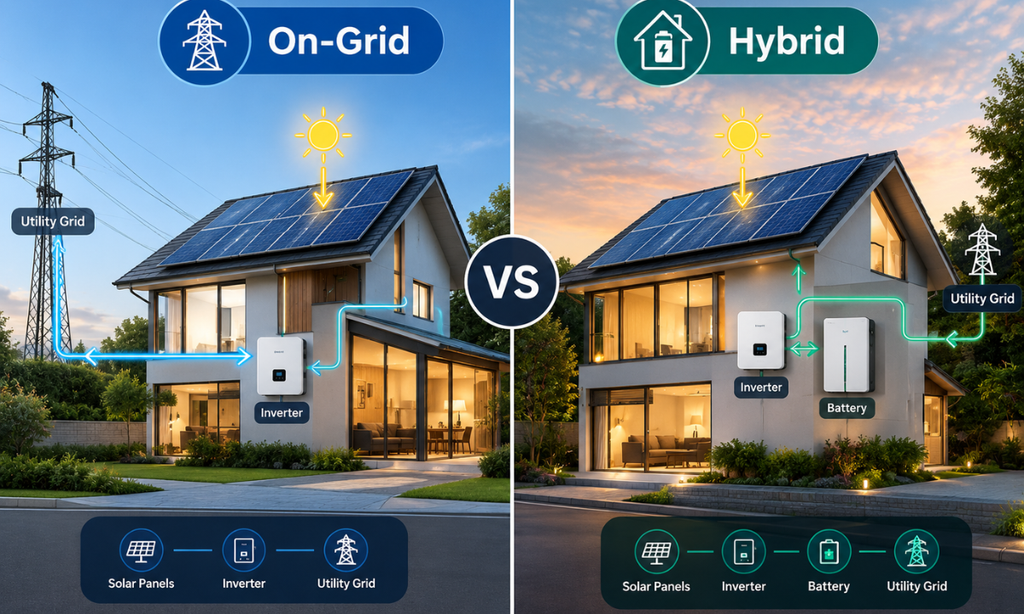
| Feature | Feston On-Grid | Feston Hybrid |
| Battery | Not needed | Adds battery backup |
| Efficiency (shop listings) | 97.5% to 98.3% | 97.6% |
| Warranty (shop listings) | 10 years | 10 years |
| Single phase sizes | 3kW and 5kW | 3kW to 6kW |
| Three phase sizes | 5kW, 8kW and 10kW | Up to 10kW |
| Best for | Cutting electricity bills at the lowest cost | Frequent outages and evening backup |
Feston On-Grid Inverters
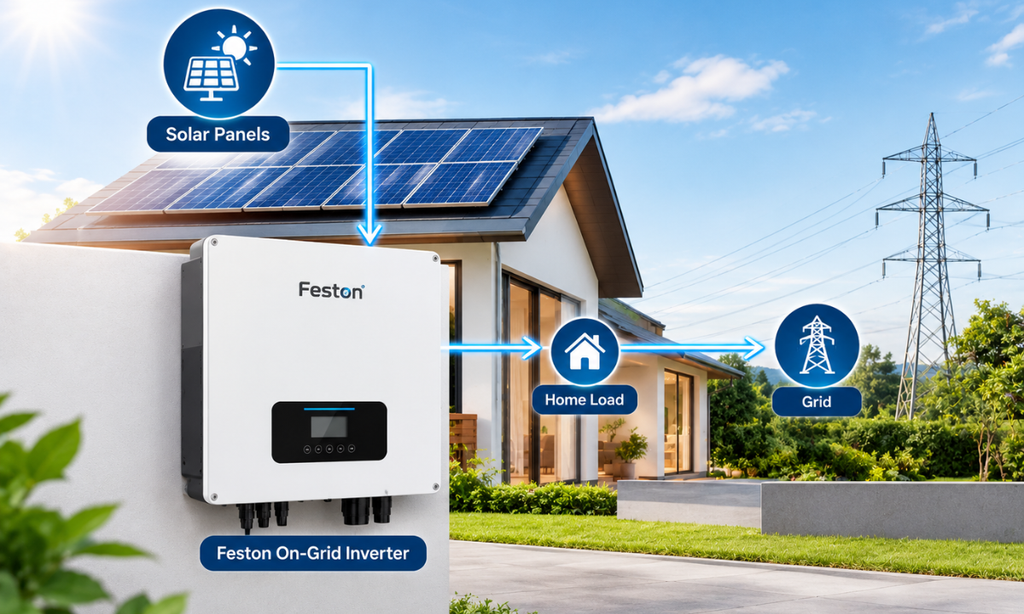
On-grid models feed solar power straight into your home and the grid, with no battery needed. They are the lowest-cost route to cutting your electricity bill, and they pair well with net metering where your utility allows it. Single phase options start at 3kW and 5kW, and three phase options run to 5kW, 8kW and 10kW.
Keep one point in mind: on-grid systems typically switch off during a grid outage for safety reasons, so they do not keep your lights on in a power cut. If outages are a regular problem for you, a hybrid model is the better fit. Net metering rules also differ by state and utility, so check the current policy with your electricity provider.
Who Should Choose On-Grid?
- Homes and businesses with a stable grid and few power cuts.
- Daytime-heavy users such as offices, shops and factories.
- Anyone who wants the lowest upfront cost and fastest payback.
Feston Hybrid Inverters
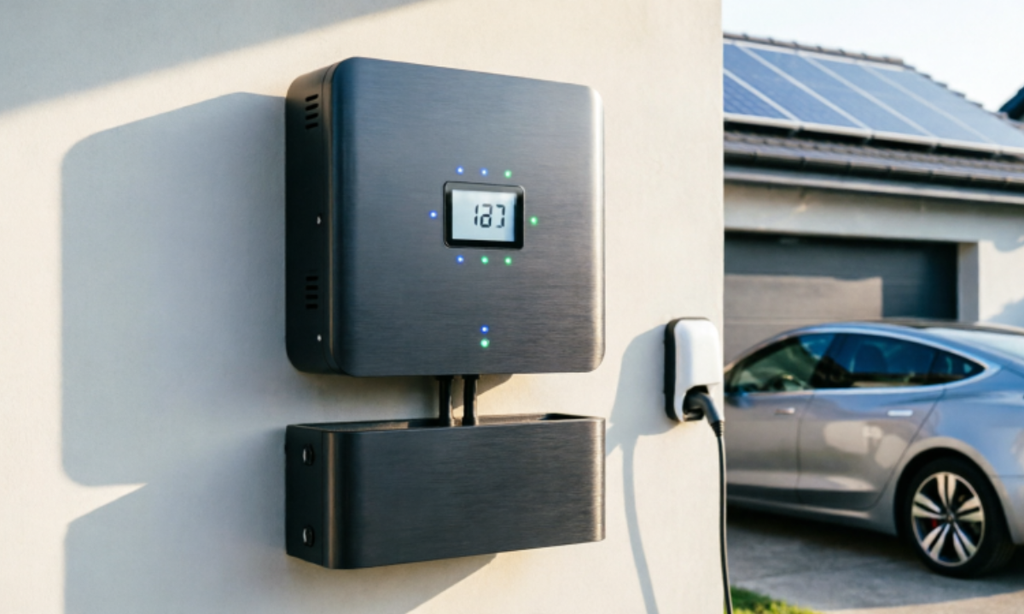
A hybrid model adds battery backup, so your essentials keep running in an outage and you store daytime surplus for the evening. Single phase hybrid units cover 3kW to 6kW, and three phase units go up to 10kW.
A hybrid system costs more than on-grid because of the battery, but it gives you control over when you use your solar energy. If you want to know how large a battery and inverter you need, see our hybrid inverter sizing guide, or browse our full range of hybrid solar inverters.
Who Should Choose Hybrid?
- Households and businesses that face frequent or long power cuts.
- Users who are home mostly in the evening and want to use stored solar power then.
- Anyone who wants to keep essentials such as lights, fans, Wi-Fi and a refrigerator running during outages.
Single Phase or Three Phase?
Match the inverter to your connection. Most apartments and small homes run single phase. Larger villas, farms and offices usually have three phase, which handles bigger loads more evenly.
| Connection | On-grid sizes | Hybrid sizes | Typical use |
| Single phase | 3kW, 5kW | 3kW to 6kW | Apartments and small to medium homes |
| Three phase | 5kW, 8kW, 10kW | Up to 10kW | Villas, farms, offices and small businesses |
Not sure which you have? Check your electricity bill or meter, or ask your electrician. The phase type decides which models you can use, so confirm it before choosing a size.
Quick Sizing Tip
Take your average daytime load and your roof area, then size the inverter close to your panel capacity. Slight undersizing of the inverter is common, but ask our engineers before you decide. Also think ahead: if you plan to buy an EV or add air conditioners, leave headroom now, because upgrading an inverter later costs more than choosing the next size up today.
A Simple Sizing Method
- Check your bill. Look at your monthly units consumed to understand how much power you use.
- Measure usable roof space. As a rough rule of thumb, each kW of solar panels needs about 100 square feet of shadow-free roof. Confirm this with our team for your site.
- Estimate generation. In good sunlight, a 1kW system commonly produces around 4 units per day, though this varies with location, season and panel angle.
- Match the inverter to the panel capacity. Choose a model close to your planned panel size.
- Add headroom. Plan for future loads such as an EV charger or extra air conditioners.
If an EV charging station is in your plans, factor it into the inverter size now, so you do not need to replace the inverter later.
Common Mistakes to Avoid
- Choosing hybrid when you rarely face outages. You pay extra for backup you seldom use.
- Choosing on-grid and expecting power during a cut. On-grid systems do not give backup on their own.
- Picking the wrong phase. Always match the inverter to your electrical connection.
- Ignoring future loads. An EV or extra air conditioners can outgrow a tightly sized inverter.
- Buying only on price. Genuine stock, documentation and local support matter far more over the life of the system.
Why Buy Feston from Sun-AP Ecopower
Sun-AP Ecopower is an authorised distributor, so you get genuine stock, correct documentation and local support from selection to commissioning. That matters over a 10-year warranty period, when a responsive service partner is worth more than a small price saving.
Our engineers can help you choose between on-grid and hybrid, confirm your phase, and match the inverter to your panels. Explore our wider range of solar inverters and solar panels to build a complete system.
FAQs
On-grid or hybrid?
Choose on-grid to save on bills. Choose hybrid if outages are frequent.
Can I add a battery later?
Only with a hybrid-ready model, so decide early.
Which phase suits a villa?
Check your electricity connection. Three phase suits larger loads.
Will an on-grid inverter work during a power cut?
Typically no. On-grid systems switch off during a grid outage for safety. If you need power during cuts, choose a hybrid inverter with battery backup.
What warranty do Feston inverters have?
Our shop listings show a 10-year warranty. Check the product page for the exact terms of the model you choose.
How efficient are Feston inverters?
Our shop listings show efficiency of 97.5% to 98.3% on on-grid models and 97.6% on hybrid models.
What sizes are available?
Single phase on-grid options start at 3kW and 5kW, and three phase on-grid options run to 5kW, 8kW and 10kW. Single phase hybrid units cover 3kW to 6kW, and three phase hybrid units go up to 10kW.
Does net metering work with Feston on-grid inverters?
On-grid models pair well with net metering where your utility allows it. Rules vary by state and provider, so check the current policy with your electricity supplier.
Which size is right for my home?
Take your average daytime load and roof area, then size the inverter close to your panel capacity. Leave headroom if you plan to add an EV or air conditioners. Our engineers can confirm the right size for your site.
Is it cheaper to choose a bigger inverter now?
If you expect your load to grow, yes. Upgrading an inverter later costs more than choosing the next size up today.
Where can I buy Feston inverters?
You can compare the range on our Feston page or buy online in the Feston shop.
Ready to Choose Your Feston Inverter?
Compare the full Feston inverters range or buy online in the Feston shop. For backup planning, read our hybrid inverter sizing guide. For more solar and inverter guides, visit our blogs, or contact us and our team will help you pick the right size and type for your connection.