Most hybrid solar inverters disappoint their owners for one reason: wrong sizing. A system that is too small trips under load or runs out of backup by evening, and one that is too large wastes money on capacity you never use. Use this simple five-step method to get it right the first time.
At Sun-AP Ecopower, our engineers size hybrid systems for homes and businesses every day, and these are the steps and mistakes we see most often.
Quick Answer: How Do You Size a Hybrid Solar Inverter?
- List the loads that must run during an outage and add their running watts.
- Allow for the starting surge of motors such as pumps, refrigerators and air conditioners.
- Multiply your backup load in kW by the hours of backup you want to get battery capacity.
- Match the solar panel capacity so the array can charge the battery and run daytime loads together.
- Pick single or three phase to match your home’s connection.
Step 1: List Your Critical Loads
Decide what must run in an outage: lights, fans, Wi-Fi, fridge, pumps. Add their running watts to get your backup load in kW. Be honest about what is truly essential, because every extra appliance adds to the inverter size and the battery you need.
The table below shows an example. The wattages are typical approximate values, so check the label on your own appliances for exact figures.
| Appliance | Quantity | Approx. running watts | Total |
| LED lights | 6 | 10W each | 60W |
| Ceiling fans | 4 | 70W each | 280W |
| Wi-Fi router | 1 | 20W | 20W |
| Refrigerator | 1 | 200W | 200W |
| Television | 1 | 100W | 100W |
| Laptop and phone charging | – | 140W | 140W |
| Backup load | about 800W (0.8kW) | ||
Step 2: Allow for Starting Surge
Motors in pumps, refrigerators and air conditioners can draw several times their running power for a moment at start. Choose a hybrid inverter whose surge capacity covers this.
A common mistake is to add up running watts and stop there. If a pump runs at 0.5kW but pulls several times that for a second or two at start, the inverter must handle that peak, or it may trip or shut down. Check the surge or peak rating on the inverter’s specifications, and tell our engineers which motor-driven appliances you want to run on backup.
Step 3: Calculate Battery Capacity
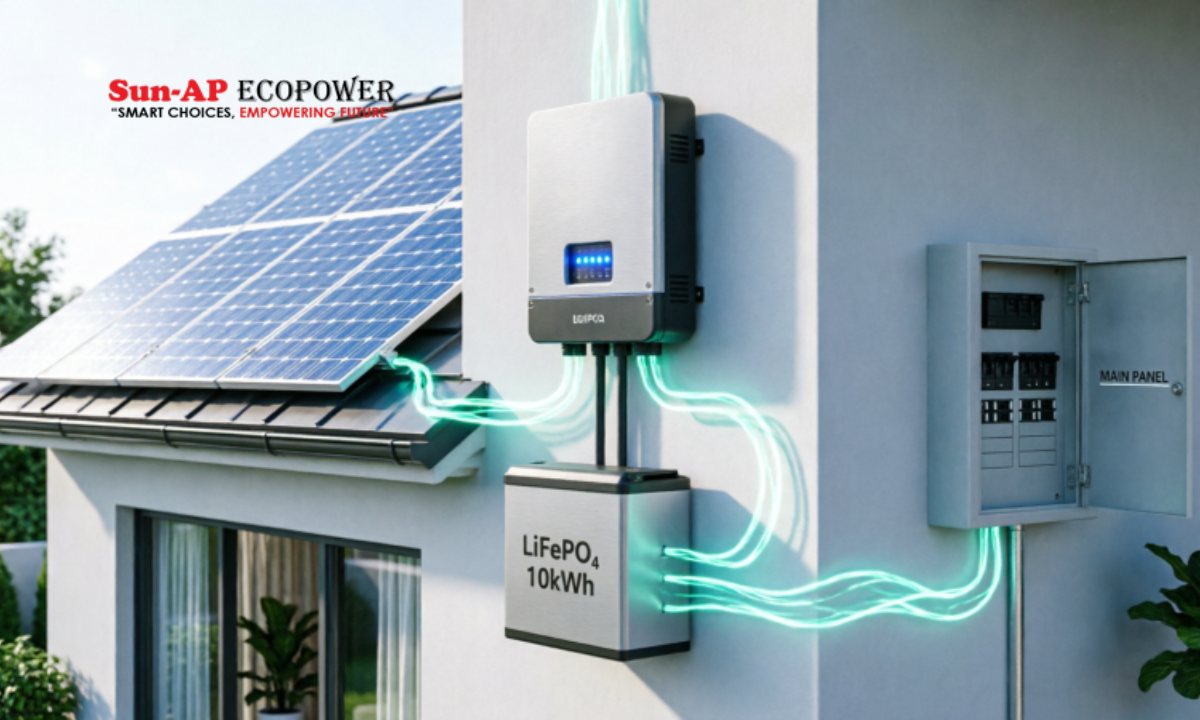
Multiply your backup load in kW by the hours of backup you want. Example: 1kW for 4 hours needs about 4kWh of usable battery. Lithium batteries allow deeper usable capacity than lead-acid, so they need less nominal size.
The “usable” part matters. Lithium batteries can generally be discharged much deeper than lead-acid batteries, which are usually not drained as far if you want a long life. That means a lithium battery gives you more usable energy per kWh of rated size. Allow a small margin for conversion losses, and check the usable capacity stated for the specific battery you choose. You can explore our range of lithium batteries and energy storage systems.
How Long Will Backup Last?
The table below shows ideal-case backup time for a battery with 3.2kWh of usable capacity at different loads. Real-world times will be slightly shorter because of conversion losses.
| Load during outage | Backup time (3.2kWh usable) |
| 0.4kW (lights, fans, Wi-Fi) | about 8 hours |
| 0.8kW (adds fridge and TV) | about 4 hours |
| 1.2kW (adds more appliances) | about 2.7 hours |
Step 4: Match Solar Panel Capacity
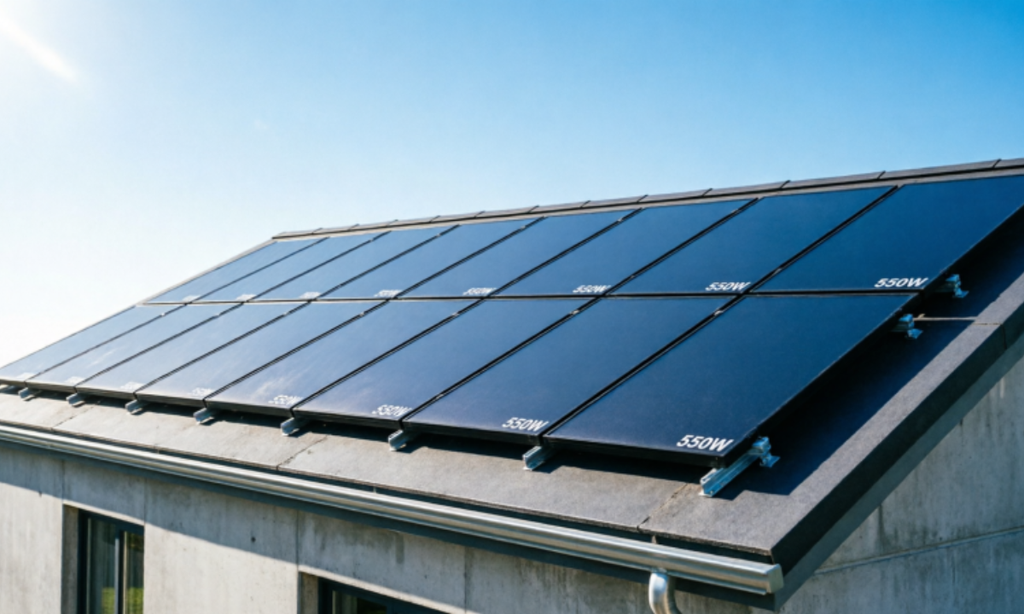
The array should charge your battery and run daytime loads together. Our team checks roof area, shading and tilt before recommending a panel size. Shading, orientation and local weather all change daily output, so a site visit gives a more accurate number than a rule of thumb.
As a starting point, think of two jobs for your panels: running your home during the day, and refilling the battery before evening. An array that only covers daytime use leaves the battery half-empty by sunset, which defeats the purpose of a hybrid system. See our solar panels range to plan the array.
Step 5: Pick Single or Three Phase
Match your home’s connection. Three phase hybrid inverters balance larger loads across phases, which suits villas and small businesses. Most apartments and smaller homes run single phase. If you are unsure, check your electricity bill or ask your electrician before choosing a model.
A Worked Example
A home with 0.8kW of essential loads and a 4-hour backup target needs about 3.2kWh of usable battery. Add a 0.5kW pump that starts occasionally, and a 3kW hybrid inverter gives comfortable headroom for its start-up surge. Round up slightly so you have room to grow.
Here is the same example in summary:
- Backup load: 0.8kW
- Backup target: 4 hours
- Usable battery needed: 0.8kW x 4 hours = 3.2kWh
- Pump allowance: a 0.5kW pump that starts occasionally, with a start-up surge above its running power
- Inverter choice: a 3kW hybrid inverter gives comfortable headroom
- Future growth: round up the battery and inverter slightly
When a Hybrid Inverter Is the Right Choice
Choose hybrid when outages are frequent, when you want to use more of your own solar power in the evening, or when you plan to add batteries in stages. If your supply is stable and your goal is only lower bills, an on-grid inverter costs less.
Hybrid vs On-Grid at a Glance
| Question | On-grid | Hybrid |
| Battery backup | No | Yes |
| Evening use of solar power | No, exports to grid | Yes, from stored energy |
| Upfront cost | Lower | Higher, due to battery |
| Best for | Stable grid, lower bills | Frequent outages, evening use |
Common Sizing Mistakes
- Sizing only by panel kW. The inverter must match your loads and surge, not just the panel capacity.
- Ignoring surge loads. Pumps, refrigerators and air conditioners can trip an undersized inverter.
- Buying a battery too small to cover evenings. If the battery empties by 9pm, the backup you paid for is not there when you need it.
- Adding every appliance to backup. Heavy loads drain the battery fast. Keep the backup circuit to essentials.
- Not planning for growth. An EV charger or extra air conditioners can outgrow a tightly sized system.
- Guessing the panel size. Shading, orientation and tilt change output, so a site check is worth it.
Checklist Before You Buy
- List your critical loads and their running watts.
- Note any motor-driven appliances and their surge needs.
- Decide how many hours of backup you want.
- Confirm whether your connection is single phase or three phase.
- Check roof area, shading and tilt for the solar array.
- Think about future loads such as an EV charging station.
- Confirm whether you can add batteries later.
Choosing Your Hybrid Inverter
Once you know your load, surge, battery and phase, you can compare models. Single phase Feston hybrid units cover 3kW to 6kW, and three phase units go up to 10kW. Read our Feston inverters overview, or browse the full range of solar inverters to compare brands.
FAQs
Can a hybrid inverter run without batteries?
Yes, it works like a grid-tied unit, but you lose backup.
Can I expand later?
Many systems allow extra batteries, so confirm before buying.
How long will backup last?
It depends on battery size and what you run. Light loads stretch backup, heavy appliances shorten it.
How do I calculate the battery size I need?
Multiply your backup load in kW by the hours of backup you want. For example, 1kW for 4 hours needs about 4kWh of usable battery.
Why do lithium batteries need less nominal size than lead-acid?
Lithium batteries allow deeper usable capacity than lead-acid, so you get more usable energy from each kWh of rated size.
What is surge capacity and why does it matter?
Motors in pumps, refrigerators and air conditioners can draw several times their running power for a moment at start. The inverter’s surge capacity must cover this, or it may trip.
What size hybrid inverter do I need for a home?
It depends on your backup load and surge. In our worked example, a home with 0.8kW of essential loads and an occasional 0.5kW pump is comfortably served by a 3kW hybrid inverter.
Should I choose single phase or three phase?
Match your home’s connection. Three phase hybrid inverters balance larger loads across phases, which suits villas and small businesses.
Is a hybrid inverter better than an on-grid inverter?
It depends on your goal. Choose hybrid when outages are frequent or you want to use more solar power in the evening. If your supply is stable and you only want lower bills, an on-grid inverter costs less.
How many solar panels do I need for a hybrid system?
The array should charge your battery and run daytime loads together. Roof area, shading, orientation and tilt all affect output, so a site visit gives a more accurate number than a rule of thumb.
Where can I buy a hybrid solar inverter?
You can explore our hybrid solar inverters page, compare Feston inverters, or browse the Sun-AP shop.
Ready to Size Your Hybrid System?
Explore our hybrid solar inverters, compare Feston inverters, or browse the Sun-AP shop. For more solar and backup guides, visit our blogs, or contact us and our engineers will help you size the right system for your home or business.