Buying an EV is the easy part. Choosing the right charger is where many owners go wrong, either paying for power the car can’t use or ending up with a slow setup that doesn’t suit their parking routine. A Panasonic EV charger works well in a home garage, an apartment parking bay, an office or a commercial site, but the right model depends on your car, your electrical supply and how long the vehicle stays parked.
This guide explains the options so you can choose without overspending or under-buying. At Sun-AP Ecopower, we supply Panasonic’s range as an authorised distributor, and these are the questions we hear most often.
Quick Answer: Which Panasonic EV Charger Should You Buy?
- Independent house with single phase supply: 7.4kW Type 2 AC charger.
- Office or gated community with three phase supply: 11kW Type 2 AC charger.
- Fleets and busy commercial parking: 22kW Type 2 AC charger.
- Highways, retail hubs and fast turnaround sites: Panasonic DC charger with CCS2 connectors.
Read on to see why, and how to confirm the right fit for your car and your supply.
How Panasonic AC EV Chargers Work
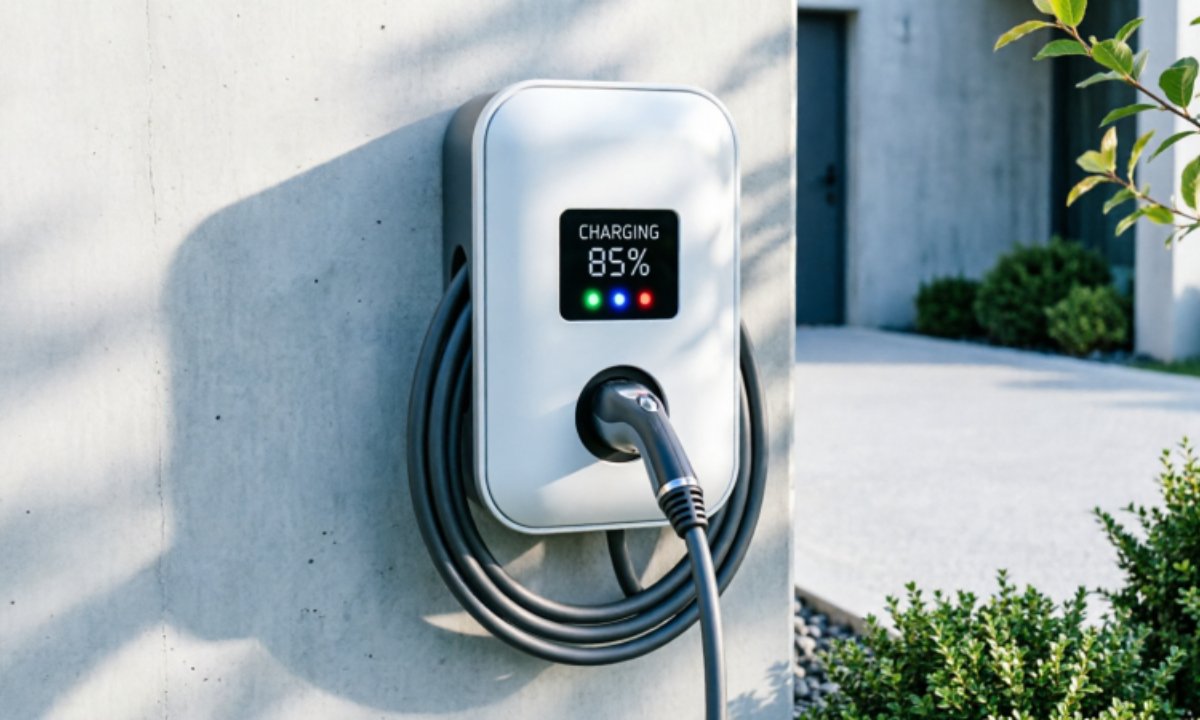
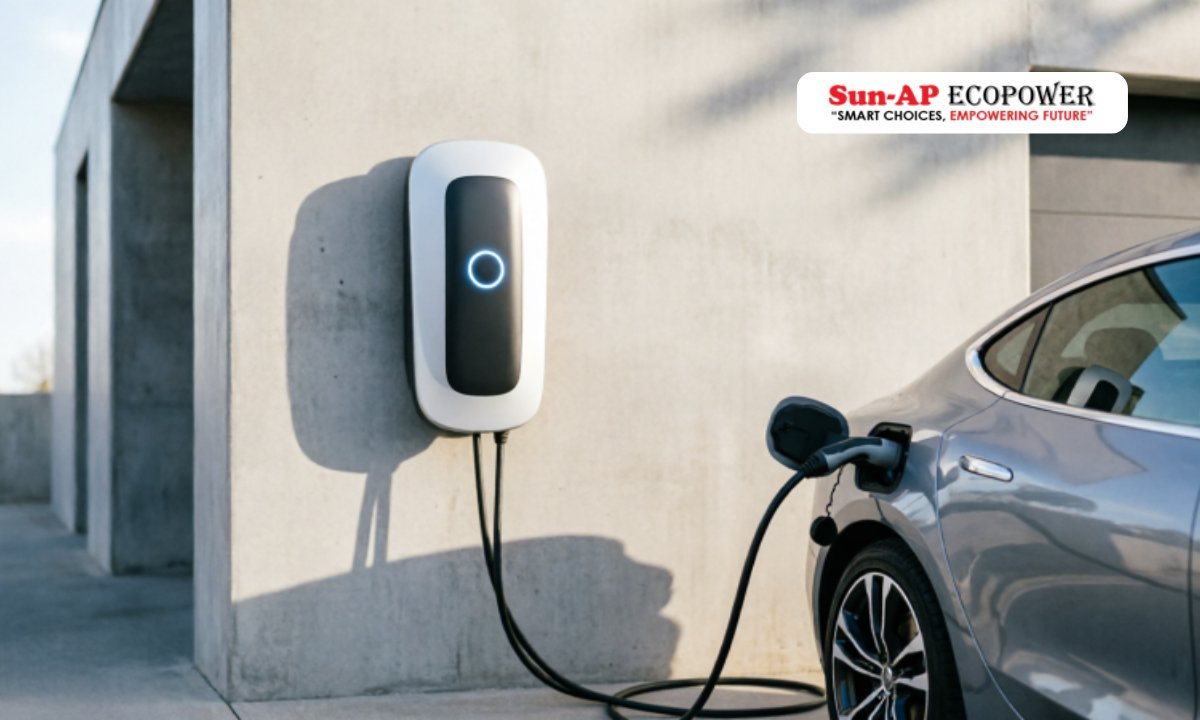
An AC charger sends alternating current to your vehicle. The car’s onboard charger converts it to DC to fill the battery. The charger and the car communicate in both directions throughout, which keeps charging safe and controlled. That is why AC units are the standard choice for homes, offices and apartment parking, where the car sits for hours.
AC vs DC Charging: What Is the Difference?
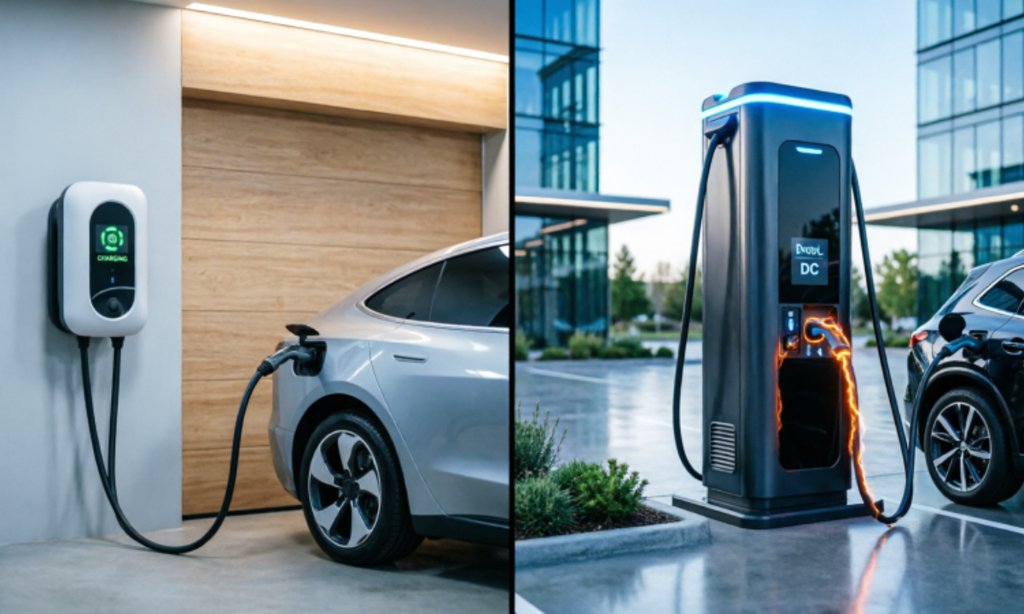
With AC charging, the conversion to DC happens inside your car, so the speed is limited by the car’s onboard charger. With DC charging, the conversion happens inside the charger itself and power goes straight to the battery, which is why DC units are much faster and far more expensive to install and run. For everyday parking, AC is the practical and economical choice. DC is for sites where vehicles need a quick top-up and cannot wait for hours.
7.4kW, 11kW or 22kW: Compare the Options
| Rating | Supply | Specs | Best for |
| 7.4kW Type 2 | Single phase, 240V | Up to 32A, IP54 | Independent houses |
| 11kW Type 2 | Three phase, 415V | 16A | Offices and gated communities |
| 22kW Type 2 | Three phase | 32A | Fleets and busy commercial parking |
One point catches many buyers out: your car’s onboard charger sets the real charging speed. A 22kW charger will not charge faster than your car’s maximum AC input allows. Check your vehicle’s AC limit before you choose. You can usually find it in the owner’s manual or the manufacturer’s specification sheet.
How Long Will Charging Take?
A simple way to estimate charging time is to divide the energy you need (in kWh) by the lower of two numbers: the charger’s rating and your car’s maximum AC input. The table below shows the ideal-case time to charge from empty to full. Real charging takes a little longer because of losses and the slowdown near the top of the battery, so treat these as estimates.
| Battery size | Car limited to 3.3kW | 7.4kW charging | 11kW charging* |
| 30 kWh | about 9 hours | about 4 hours | about 2.7 hours |
| 40 kWh | about 12 hours | about 5.4 hours | about 3.6 hours |
| 60 kWh | about 18 hours | about 8 hours | about 5.5 hours |
*The 11kW column applies only if your car can accept three phase AC at that rate. If it cannot, charging speed falls back to your car’s limit.
For most households, a 7.4kW charger fills a typical battery overnight, which is exactly why it is the most popular choice for independent houses.
How to Choose the Right Model
Check these three things before ordering:
- Your vehicle’s AC limit. This is the ceiling on your charging speed.
- Your sanctioned load and phase. A single-phase home connection can’t run a three-phase charger. Confirm your sanctioned load with your electricity supplier before you decide.
- Parking time. If the car sits overnight, you don’t need the fastest charger.
For overnight home charging, a 7.4kW unit is usually enough. Three-phase models make sense only when both your car and your supply can use them.
Choosing for Your Parking Situation
- Home garage: The car is parked for 8 to 12 hours, so 7.4kW is ample and keeps your installation simple.
- Apartment parking: Each resident usually wants their own bay. Plan the supply point and approvals first, then pick the rating that your building’s electrical supply can support.
- Office: Cars stay parked through the working day. An 11kW charger on a three phase supply suits this well, and RFID access helps control who charges.
- Fleet depot: Vehicles need to be ready quickly between shifts. 22kW AC makes sense if your vehicles can accept it, and DC charging suits very short turnaround needs.
Installation Matters as Much as the Charger
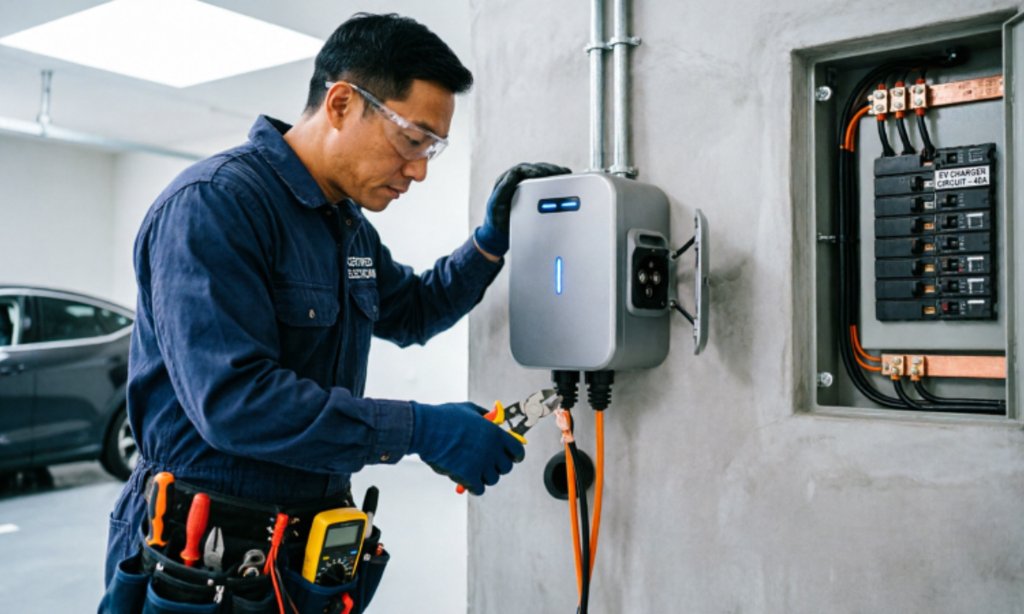
A good charger on a poor installation is a risk. Use a dedicated circuit with proper earthing and a correctly rated breaker, and place the unit within easy cable reach of the parking bay. Our team can guide you on supply requirements before you order, so there are no surprises on installation day.
Before installation, run through this checklist:
- Confirm your car’s maximum AC input.
- Check your sanctioned load and whether your supply is single phase or three phase.
- Choose a spot close to the parking bay so the cable reaches without stretching or tangling.
- Make sure the circuit is dedicated to the charger and properly earthed.
- Ask a qualified electrician about the correct breaker rating for your charger.
- For apartments, get society approval before work begins.
Common Mistakes to Avoid
- Buying more power than the car can use. A 22kW charger gives no speed advantage to a car limited to a lower AC input.
- Ignoring sanctioned load. A charger the supply cannot support leads to tripping or an unsafe setup.
- Sharing a circuit with other appliances. A charger draws power for hours, so it needs its own circuit.
- Placing the charger too far from the bay. This leads to cable strain and daily inconvenience.
- Skipping society approval. In apartments, this can mean removing the charger later.
Charge Your EV with Solar
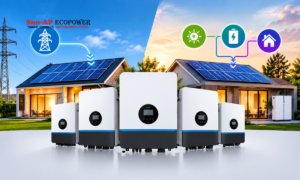
Charging from the grid every night adds to your running cost. Pairing your charger with rooftop solar brings that cost down. Add a hybrid solar inverter with battery storage, and your daytime surplus can charge the car at night. If you don’t need storage, an on-grid solar inverter is a simpler way to offset daytime charging. Either option works with a good set of solar panels on your roof.
If your car is parked at home during the day, solar charging is straightforward. If the car is away at work and returns in the evening, battery storage with a hybrid inverter is what lets you use that solar energy after sunset.
DC Fast Charging for Commercial Sites
Highways, fleets and retail hubs need speed. Panasonic DC chargers use CCS2 connectors and deliver 30kW to 60kW per gun. They suit sites where many vehicles need a quick top-up in a short time. Plan your parking layout and power connection with a qualified team before you commit, because the electrical load is much larger than for AC units.
DC charging is not meant for homes or apartments. For those, AC charging is cheaper, simpler to install and perfectly suited to cars that stay parked for hours.
FAQs
Can I install a charger in an apartment?
Yes, with society approval and a dedicated, properly rated supply point.
Does a higher kW always charge faster?
No. Charging speed is limited by your car’s AC input, whatever the charger can deliver.
Is a smart charger worth it?
For societies and offices, yes. Smart models with RFID access let you control who charges.
Which is better for a house, 7.4kW or 11kW?
If you have a single-phase supply, 7.4kW is the practical choice and covers overnight charging for most cars.
Which connector do Panasonic chargers use?
The AC models listed above use a Type 2 connector, and the DC models use CCS2. Check your car’s charging port before you order.
Do I need a three phase supply for the 11kW or 22kW charger?
Yes. Both are three phase models, so your supply must be three phase, and your car must also be able to accept that power to benefit from it.
How long will it take to charge my car?
Divide the energy you need in kWh by the lower of the charger’s rating and your car’s AC limit. A 7.4kW charger fills many batteries overnight. Real times run slightly longer than the estimate.
Can I charge my EV with solar power?
Yes. Pairing the charger with rooftop solar reduces your running cost, and a hybrid solar inverter with battery storage lets you use daytime surplus to charge at night.
Is the 7.4kW charger suitable for outdoor use?
It has an IP54 rating, which gives protection against dust and water splashes. For best results, install it in a covered parking bay or sheltered location near the car.
Is a DC fast charger suitable for a home or apartment?
No. DC chargers deliver 30kW to 60kW per gun and are meant for commercial sites such as highways, fleets and retail hubs. Homes and apartments are better served by AC chargers.
What should I check before installing a charger in a housing society?
Get society approval, confirm a dedicated and properly rated supply point, and decide which charger rating suits your parking layout. Contact our team and we can guide you on supply requirements before you order.
Where can I buy a Panasonic EV charger?
You can explore the range on our Panasonic page or order from the Sun-AP shop.
Ready to Choose Your Charger?
Browse the full Panasonic EV charger range, see our EV charging stations page for options across brands, or order directly from the Sun-AP shop. For more guides on solar, inverters and EV charging, visit our blogs, or contact us and our team will help you pick the right model for your supply.