For high-end residential estates and sustainable modern homes, power management has evolved far beyond simple battery backup.
The volatile nature of localized grid infrastructure, combined with the implementation of complex time-of-use (ToU) electricity tariffs, means that selecting the right hybrid solar inverter in India is now a core financial and asset-allocation strategy.
A standard net-metered configuration leaves your property entirely vulnerable during a blackout due to mandatory anti-islanding safety protocols, but an advanced, multi-mode Hybrid solar inverter bridges this gap, functioning as an intelligent energy clearinghouse.
To truly educate yourself before deploying capital, you must understand that a modern hybrid system is fundamentally different from the old-school solar inverters of the past decade. Historically, residential backup relied on primitive off-grid PCUs tied to heavy, fast-degrading lead-acid batteries.
Today, the industry benchmark has shifted toward high-efficiency, transformerless architectures capable of managing simultaneous power streams. The inverter dynamically routes power from your rooftop solar panels to your household appliances, channels the surplus into high-density Lithium Iron Phosphate (LFP) storage cells, and exports any excess back to the utility grid only when tariffs are financially optimal.
When you source a system through premium technical channels rather than unverified e-commerce aggregators, you are investing in infrastructure that stabilizes voltage fluctuations, eliminates the drop-out click that reboots sensitive home servers, and manages massive inductive startup currents.
This guide strips away the marketing jargon to analyze the critical engineering metrics and compare the seven finest hybrid solutions available for the Indian residential market.
Disclaimer
The electrical schematics, technical benchmarks, and component comparisons outlined in this guide are intended strictly for educational, engineering, and general informational contexts. This material does not constitute a formal technical endorsement or binding site-specific engineering layout. Because physical roof conditions, regional utility line behaviors, and state DISCOM net-metering policies undergo frequent regulatory adjustments, you must secure a professional site layout audit and system engineering verification from a qualified field technician before executing any physical solar installations or hardware asset purchases.
Deconstructing the Engineering: Transfer Times, Battery Bus Voltage, and Load Dynamics
Deploying a hybrid energy infrastructure requires looking past superficial marketing specs and analyzing raw electrical engineering metrics.
The performance of your asset under stressful conditions such as sudden grid drops or scorching mid-summer peak demands depends entirely on three core technical vectors: load balancing, switching latency, and battery communication.
1. Sizing the Architecture between 3kW vs. 5kW Load Parameters
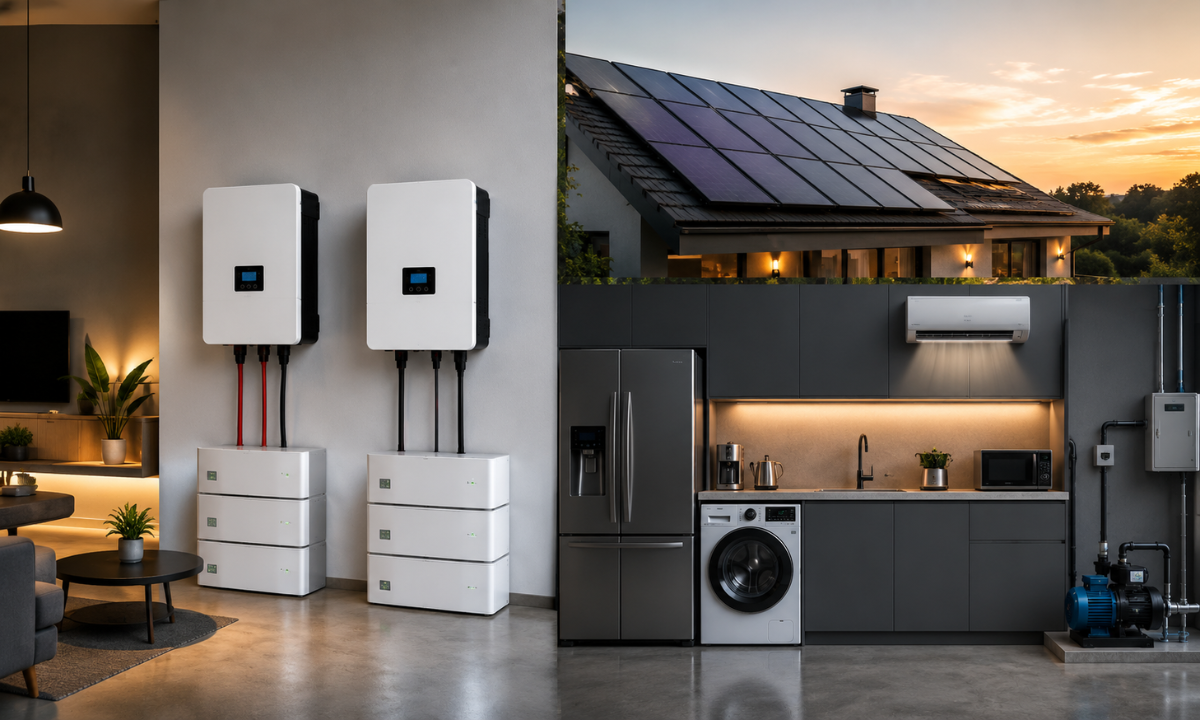
Selecting the capacity of your hybrid engine alters your property’s entire internal power distribution dynamics. It is not merely a question of how many panels you can mount on your roof, but how much instantaneous power the inverter can pass through during a blackout.
- The Baseline Entry: Deploying a hybrid solar inverter 3kw framework is an excellent strategy for modern apartments or boutique residences focused primarily on base-load management.
These systems typically operate on a single Maximum Power Point Tracking (MPPT) channel and are paired with a low-voltage (48V) battery bank. A 3kW architecture handles your essential infrastructure LED lighting networks, high-efficiency refrigeration, Wi-Fi routing hubs, and home entertainment setups, but will safely trip its circuit breakers if subjected to heavy inductive loads.
- The Enterprise Benchmark: Moving up to a heavy-duty hybrid solar inverter, a 5 kW engine transitions your property into true operational resilience. A 5kW hybrid system is designed with dual-MPPT trackers, allowing for multi-directional string layout (such as East-West panel splitting to maximize solar generation curves across the entire day).
More importantly, a 5kW architecture features a robust surge capacity (frequently up to 10kVA for 10 seconds), providing the precise electrical muscle required to crank heavy inductive starting currents from 1.5-ton inverter air conditioners, deep-well water pumps, and luxury kitchen appliances.
2. The Transfer Time Imperative

In a digitally integrated modern home, a standard backup changeover time is entirely unacceptable. When the utility grid fails, a traditional backup system can take anywhere from 100 to 500 milliseconds to detect the drop and ignite its internal relays.
This latency is a systemic shock to your home infrastructure; it causes smart home automation hubs to freeze, drops active video conferences, and forces sensitive network-attached storage (NAS) hard drives into unsafe hard reboots.
The industry benchmark for elite hybrid architecture is UPS-grade transfer time (sub-10ms to sub-20ms). By leveraging high-speed microprocessors and rapid solid-state switching mechanisms, the inverter cuts over to the battery storage bank so fast that the internal power supplies of your sensitive electronics never register the disruption.
3. Closed-Loop BMS Integration and Preserving Storage Capital
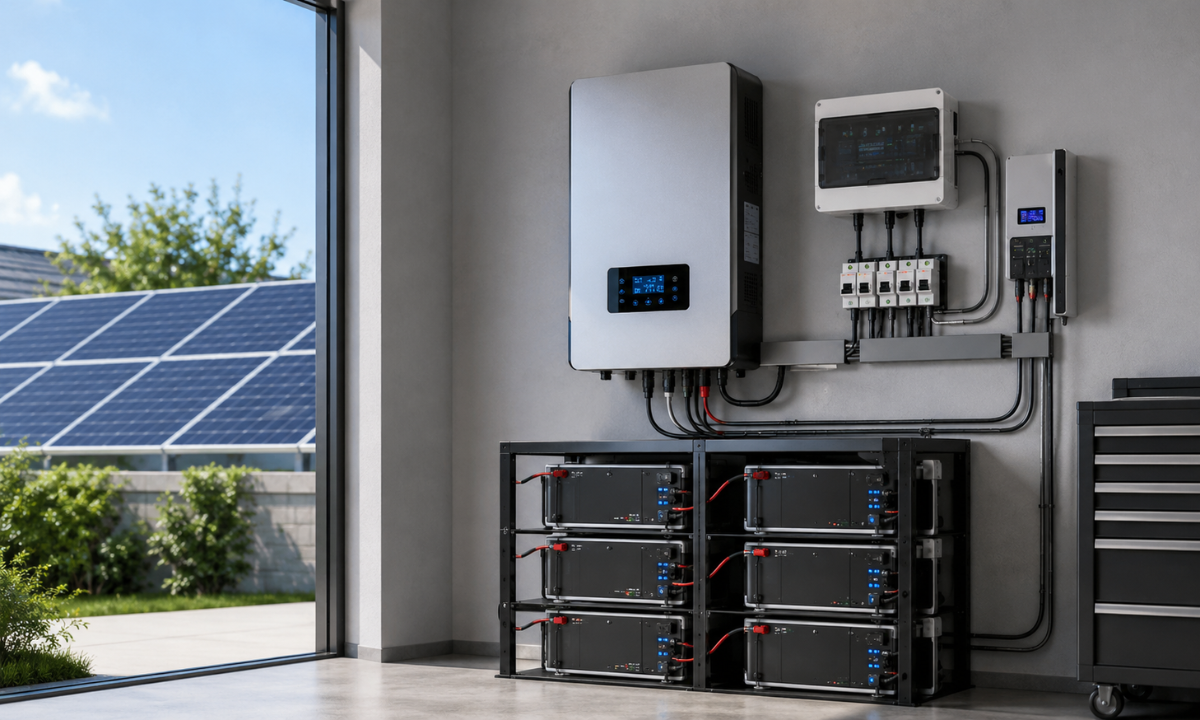
The single most expensive component of your hybrid energy system is the battery bank. Historically, solar systems treated batteries blindly, charging them based on crude voltage estimates. Modern high-density storage demands a continuous, intelligent conversation between the inverter’s charging core and the battery pack.
Your hybrid system must employ Closed-Loop Communication via native CAN or RS485 communication protocols directly with the Lithium Iron Phosphate (LFP) Battery Management System (BMS). Instead of guessing the state of charge based on fluctuating terminal voltages, the inverter receives real-time, cell-level telemetry regarding temperature, internal resistance, and precise State of Charge (SoC).
This closed-loop integration prevents the system from overcharging during high ambient summer temperatures (which accelerate thermal degradation) and optimizes the depth of discharge (DoD) during long winter nights, stretching the operational life of your lithium investment up to 6,000 cycles or more.
Top 7 Hybrid Inverters Compared
When evaluating high-performance equipment, navigating a saturated market can lead to analysis paralysis.
Many consumers look for a Solar inverter online by sorting simply by price-per-watt, but engineers and project managers look for the underlying topology.
To bring structural clarity to your energy planning, our technical team has benchmarked the top seven systems across the specific load profiles, surge requirements, and thermal boundaries of the Indian grid.
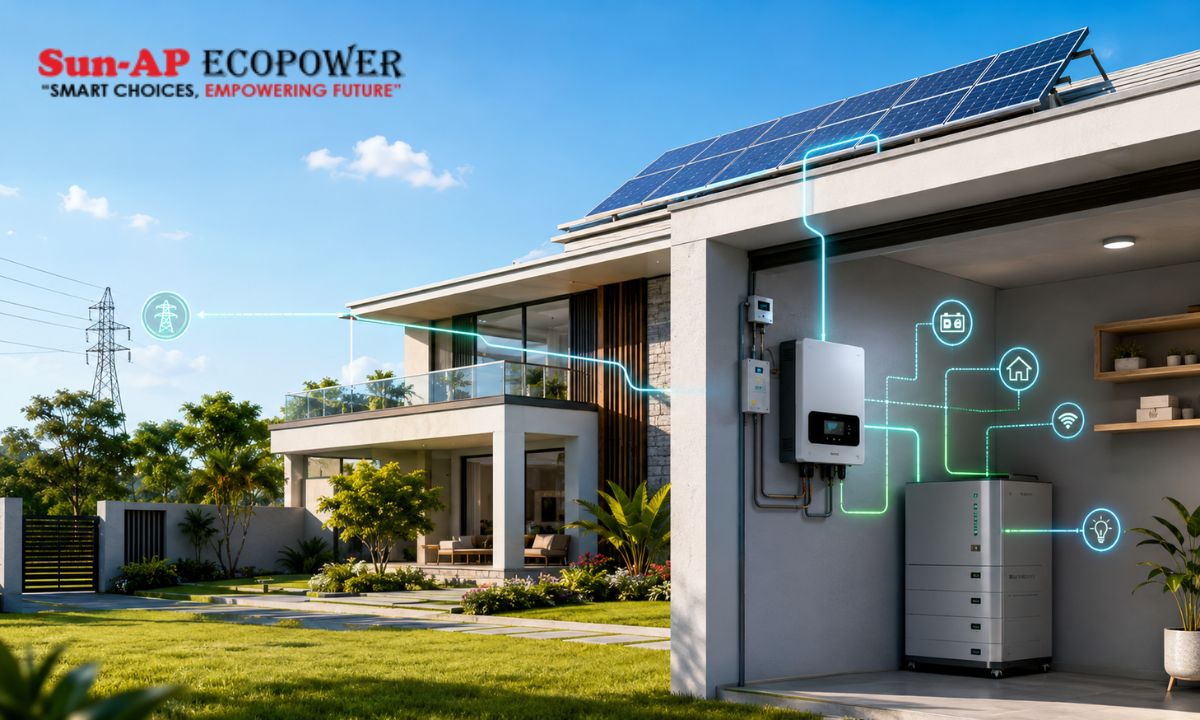
When analyzing the modern wall-mounted system, look for clean DC/AC separation conduits and a centralized LCD control interface. This physical footprint allows for rapid diagnostics, heat dissipation, and immediate manual isolation, which are critical elements when handling continuous multi-kilowatt throughput.
Deploying an integrated hybrid solar inverter with a battery bank eliminates the inefficiencies of standalone off-grid configurations.
The matrix below highlights exactly how the leading seven choices handle real-world operational stress:
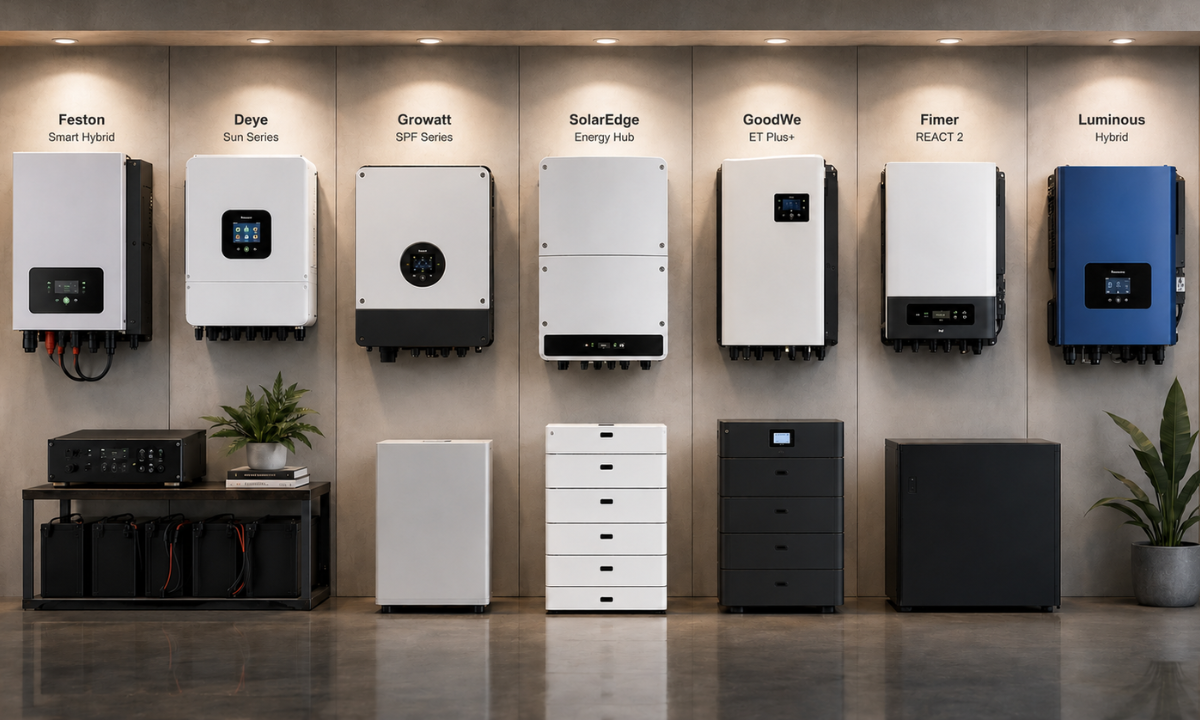
| Inverter Model | Phase / Topology | Transfer Latency | Surge Handling Max | Core Engineering Advantage |
|---|---|---|---|---|
| Feston Smart Hybrid | Single / Three Phase (Transformerless) | sub-20ms | 150% for 10s | Intelligent time-of-use (ToU) routing and peak-shaving algorithm. |
| Deye Sun Series | Single / Three Phase (Bi-Directional) | 4ms | 200% for 10s | The dedicated generator auxiliary port supports up to 16 units in parallel. |
| Growatt SPF Series | Single Phase (High Frequency) | sub-20ms | 200% for 5s | Low idle-consumption curve; maximum value-to-yield ratio. |
| SolarEdge Energy Hub | Single Phase (DC-Optimized) | sub-10ms | 130% continuous | Panel-level MPPT; integrated arc-fault protection (AFCI). |
| GoodWe ET Plus+ | Three Phase (High-Voltage Bus) | sub-10ms | 200% for 60s | Wide battery voltage (180V–600V) drastically minimizes copper losses. |
| Fimer REACT 2 | Single Phase (Modular Core) | sub-20ms | 140% for 30s | Premium European build; stackable, native modular lithium storage. |
| Luminous Hybrid | Single Phase (Low Frequency) | sub-20ms | 300% for 3s | Heavy internal copper transformer survives extremely low-voltage drops. |
The Structural Winner for Grid Fluctuations:
While SolarEdge rules for sheer architectural safety and GoodWe dominates for high-voltage commercial-scale conversions, the Deye Hybrid Series remains the most practical, rugged selection for properties facing unpredictable utility infrastructure.
Its ultra-fast 4ms switching speed guarantees absolute continuity for IT hardware, while its native capacity to accept and command an external diesel generator ensures infinite autonomy during extended disasters.
Battery Optimization & Backup Security for Maximizing Storage Lifespan and Autonomy
A hybrid inverter’s true engineering value is proven during a prolonged grid failure. When the utility grid stays dark for days due to extreme weather or localized transformer blowouts, your facility transforms into a standalone microgrid. At this stage, your hybrid solar inverter with battery backup system must pivot from a simple economic optimizer into an aggressive life-support engine for your property’s electrical infrastructure.
To achieve absolute energy security, you must understand how your inverter manages the thermodynamic and electrochemical limits of your storage bank.
1. Decoding the C-Rate: The Speed of Power Extraction
- 0.5C Rating (The Longevity Zone): Most mid-tier storage banks operate at a 0.5C continuous rate. This means a 10kWh battery pack can continuously output 5kW of power. Attempting to draw more will cause the internal BMS to trigger a protective trip.
- 1.0C Rating (The High-Performance Zone): Premium systems (like Feston or Deye paired with high-spec LFP cells) support a 1.0C continuous rate. A 10kWh battery bank can output a full 10kW of instantaneous power, allowing you to run heavy, power-hungry appliances simultaneously without stalling the system.
2. The Round-Trip Efficiency (RTE) Leak
Energy is lost as heat every time it changes form from DC (Solar Panels) to Chemical (Batteries) and back to AC (Home Appliances). This is known as Round-Trip Efficiency (RTE). Standardizing your system configuration drastically alters these operational losses:
Low-Voltage (48V) Architecture
- The Reality: Common in entry-level residential installations.
- The Inefficiency: Shifting 5kW of power at 48V requires over 100 Amps of current. High current generates massive internal heat (I²R copper losses) in the cables and inverter circuits, dropping your overall round-trip efficiency to around 82–88%.
High-Voltage (150V–600V) Architecture
- The Reality: Utilized by premium solutions like the GoodWe ET or SolarEdge Energy Hub.
- The Efficiency: Moving that same 5kW of power at 400V requires a mere 12.5 Amps. By keeping the current low, thermal losses drop to near zero, yielding a phenomenal round-trip efficiency of 95–97%. Over a decade of operation, this architecture saves thousands of units of solar energy from being wasted as pure heat.
3. Smart Load Triaging: The Dual-Output Strategy
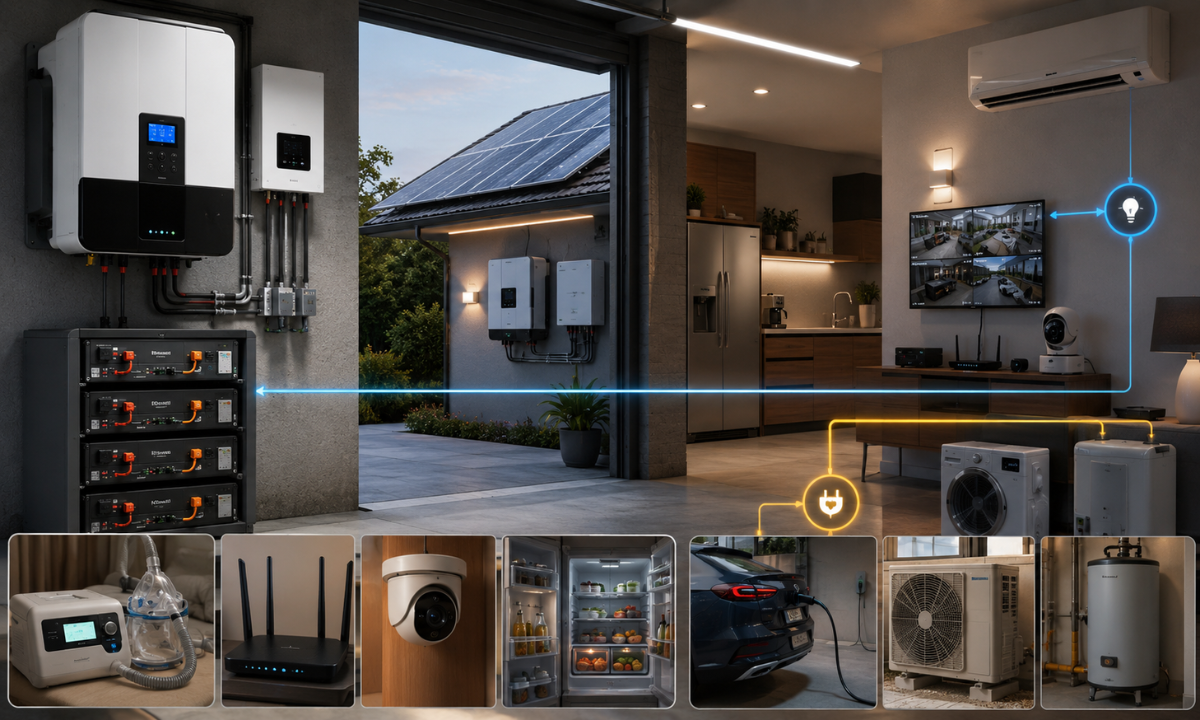
When facing an extended power outage, treating all household appliances equally will drain your battery bank within hours. Elite hybrid configurations implement physical “Smart Load Triaging” by utilizing dedicated dual-output terminals directly on the inverter body.
The Critical Load Terminal (Essential Isolation)
This output stays energized permanently. The inverter reserves your remaining battery capacity strictly to run your essential life-support systems:
- Medical equipment and CPAP systems.
- Home routing networks, firewalls, and security CCTV arrays.
- Deep-freeze refrigeration to preserve food supplies.
- Basic LED lighting paths.
The Smart/Non-Critical Terminal (Dynamic Shedding)
This output is instantly decoupled the moment the grid drops or when the battery state-of-charge drops below a user-defined threshold (e.g., 50%). It prevents heavy, non-essential loads from completely exhausting your backup capital:
- Electric Vehicle (EV) fast-chargers.
- HVAC systems and central water geysers.
- Borewell pumps and pool filtration systems.
Pro Engineering Tip: A well-configured hybrid inverter allows you to program “Solar-Only” rules for the smart terminal.
This means if your batteries are full and your roof is generating a massive 6kW surplus at noon during an outage, the inverter will dynamically click the smart terminal back online to charge your EV using pure, real-time excess solar power, without pulling a single watt-hour from your reserved battery bank.
Eliminating Systemic Failure: Overcoming the Real-World Stress Factors of the Indian Grid
A solar power plant is only as reliable as its weakest link. When high-end residential energy systems encounter operational downtime, the fault is rarely caused by a simple mechanical defect in the inverter itself.
Instead, the system collapsed because it was deployed as a generic product rather than an engineered solution tailored to withstand the volatile environmental and electrical stresses of the Indian grid.
The three most destructive operational vectors encountered on local networks require proactive technical mitigation:
1. Midday Grid Overvoltage Trips (The Feedback Loop)
In regions with dense residential solar penetration, utility lines experience an unmapped phenomenon known as midday voltage rise.
Around 1:00 PM, when regional solar production peaks and household baseloads are low, hundreds of residential systems simultaneously pump excess power back into local distribution transformers.
As the local distribution network (DISCOM) infrastructure is often outdated, the line voltage climbs sharply, frequently breaching 270V.
To prevent this sudden, un-notified generation gap, premium hybrid systems must be dynamically programmed with wide grid-tolerance parameters or configured to execute volt-watt active power derating. Instead of shutting down completely, the inverter recognizes the grid overvoltage trend, throttles its export limits, and routes the excess solar capacity directly into charging your lithium battery storage bank.
2. The Conductive Mud Phenomenon (PV Isolation Faults)
In India, dry weather conditions create thick layers of particulate dust across solar panels and mounting structures. When this dust is exposed to early morning dew or light seasonal rain, it forms a highly conductive “mud track” between the aluminum module frames, DC cables, and the roof structure.
This creates a minute pathway for electricity to leak to the ground, triggering a PV Isolation Error or Ground Fault Error.
- The Protective Trap: To prevent fatal electrical shock or DC arcing, high-frequency inverters instantly freeze operations and lock the system behind a red fault light.
- The Mitigation Protocol: Eliminating isolation breakdowns requires strict adherence to advanced balance-of-system (BOS) standards.
- Deploying exclusively UV-stabilized XLPE DC cabling enclosed in heavy-duty conduit routing to eliminate physical cable degradation.
- Implementing independent, dedicated dual-earthing networks (separate lines for the inverter body, AC distribution board, and DC array structure) using chemical copper-bonded electrodes to maintain a ground resistance value strictly less than 1 Ohm.
3. Thermal Derating (The Balcony and Rooftop Trap)
Solar inverters are massive power-electronic computing nodes. During peak summer months, ambient temperatures on rooftops or unventilated service balconies easily hit 45°C to 50°C. At these extremes, the internal switching transistors (IGBTs) can scale rapidly toward 75°C+.
To shield internal circuits from melting down, mid-tier inverters deploy an aggressive protective mechanism known as Thermal Derating. The system purposefully drops its generation output by 30% to 50%. You may have bought a 5kW system, but under peak afternoon heat, it throttles itself down to a 3kW machine.
| Environmental Stress | Standard Product Reaction | Sun AP Engineered Solution |
|---|---|---|
| High Ambient Heat (45°C+) | Sudden output throttling (thermal derating). | Advanced multi-channel fan convection, oversized aluminum heat-sink blocks, and optimal physical clearance configurations. |
| Voltage Fluctuations | Frequent system resets and offline dropouts. | Extended operating voltage parameters and real-time firmware phase stabilization. |
| Monsoon Humidity | Internal moisture ingress leading to board shorts. | Strict NEMA 4X / IP65 industrial weatherproof enclosures designed for aggressive outdoor deployment. |
Why Choose Sun AP Ecopower
Transitioning your property to a hybrid solar infrastructure requires moving past generic retail procurement and embracing precise corporate and electrical engineering. At Sun AP Ecopower, operating out of our centralized distribution facility in JP Nagar, Bangalore, we do not view ourselves as simple equipment traders.
When EPC contractors, institutional installers, and discerning estate owners source their systems through Sun AP Ecopower, they unlock distinct structural advantages:
- Unbiased Multi-Brand Tier-1 Access: We are officially authorized distributors for the world’s leading clean-tech manufacturers, including Feston, Deye, Enphase, SolarEdge, Fimer ABB, and Panasonic. Because we are not bound to a single brand, we design custom, multi-source setups perfectly balanced for your specific load profiles and architectural demands.
- Pre-Dispatch Technical Calibration: We do not drop-ship blind boxes. Every hybrid inverter that exits our warehouse undergoes a rigorous pre-dispatch testing protocol at our engineering desk. We pre-flash specialized grid profiles to handle localized utility overvoltage spikes and verify flawless closed-loop CAN/RS485 communication with your LFP storage cells before the hardware arrives on-site.
- Flawless DISCOM & Regulatory Clearance: Navigating net-metering synchronization without structural delays requires compliant hardware. Our entire components matrix strictly complies with the latest BEE mandatory efficiency standards, Central Electricity Authority (CEA) technical guidelines, and local utility mandates (such as BESCOM and CESC approval parameters), guaranteeing immediate, hassle-free grid approval.
- B2B Procurement Efficiency: As a high-volume, pure-play solar distributor, we provide a unified procurement point for complete project lifecycles. From Tier-1 solar modules and smart bi-directional energy meters to custom LT distribution panels and UV-stabilized balance-of-system (BOS) components, we provide full institutional warranty backing and clear, GST-compliant transactional reporting.
We act as elite value-added technical partners, stocking, optimizing, and calibrating the finest global energy assets to ensure your project delivers uncompromised resilience under the harshest real-world grid conditions.
Conclusion
An advanced hybrid solar configuration is a significant capital investment designed to function as an independent, intelligent utility clearinghouse for your property for decades. Relying on cheap component pairings or generic online listings to manage multi-kilowatt, high-voltage throughput introduces severe points of failure that can compromise your storage lifespan, stall expensive household appliances, and cause persistent system downtime.
True energy autonomy demands a configuration engineered for real-world grid fluctuations, thermal stresses, and immediate sub-20ms transfer responses. By anchoring your home with a robust hybrid inverter topology, you insulate your estate from the rising costs of localized utility distribution and build an unassailable shield of continuous power.
Do not risk your electrical infrastructure with uncalibrated components. Connect with our senior engineering consultants at the Sun AP Ecopower Private Limited office on 2nd Cross, Dollars Colony, JP Nagar 4th Phase, Bangalore. Let our technical desk audit your home’s baseline electrical load profiles and engineer the uncompromised, high-yield hybrid energy ecosystem your property deserves.