Choosing the right hybrid solar inverter is one of the most important decisions when setting up a solar power system. Go too small, and your inverter struggles to handle your load. Go too big, and you end up overspending on capacity you never use.
The most common question we get at Sun AP Ecopower is simple: should I go with a 3kW, 5kW, or 10kW hybrid inverter?
The honest answer is it depends on your load, your usage pattern, and your plans. This guide breaks it all down so you can make the right call before investing.
First, What Does Inverter Capacity Actually Mean?
The capacity of a hybrid solar inverter, measured in kilowatts (kW), tells you the maximum amount of power it can handle at one time. A 5kW inverter can manage up to 5,000 watts of combined load from your appliances at any given moment.
It does not mean how much solar energy you generate per day. That depends on your solar panel array size and the number of sunlight hours. The inverter capacity needs to match or slightly exceed your peak simultaneous load – the maximum watts all your running appliances draw at the same time.
Getting this right is the foundation of a well-designed solar system.
How to Calculate Your Load Before Choosing Capacity
Before picking a capacity, you need a rough idea of your peak load. Here is a simple way to do it:
- List every appliance you run simultaneously at peak hours
- Note the wattage of each (usually on the back label or in the manual)
- Add them all up
For example, a typical Indian home running lights, fans, a refrigerator, a television, and a washing machine at the same time would draw somewhere between 2,000 and 3,500 watts at peak. An air conditioner alone adds 1,500 to 2,000 watts on top of that.
This gives you a starting point for which capacity range makes sense.
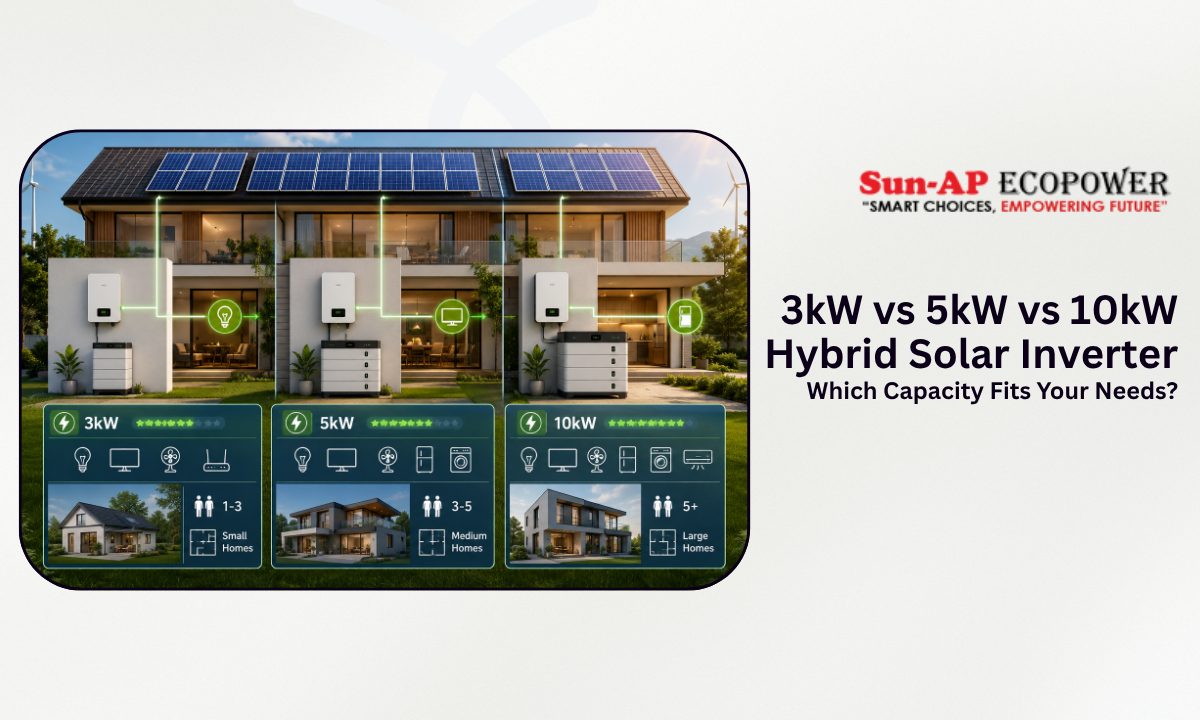
3kW Hybrid Solar Inverter – Who Is It For?
A 3kW hybrid solar inverter is the entry point for residential solar backup systems. It is compact, cost-effective, and well-suited for smaller homes with moderate power needs.
Best suited for:
- Small apartments or 1 to 2 BHK homes
- Homes without air conditioning or with only one small AC
- Households with a monthly electricity bill of Rs 1,500 to Rs 3,000
- Those looking for backup for essential loads only — lights, fans, refrigerator, TV
What it can typically handle:
- 6 to 8 LED lights
- 4 to 5 ceiling fans
- 1 refrigerator
- 1 television
- 1 washing machine (not simultaneously with heavy loads)
Limitations: A 3kW system starts to struggle the moment you add an air conditioner or multiple heavy appliances running together. If your home already has one AC or you plan to add one in the next year or two, starting at 3kW may mean upgrading sooner than expected.
5kW Hybrid Solar Inverter – Who Is It For?
The 5kW hybrid solar inverter is the most popular choice for Indian residential installations right now, and for good reason. It offers enough capacity for a well-equipped urban home while staying within a reasonable budget.
Best suited for:
- 2 to 3 BHK homes
- Households with one or two air conditioners
- Homes with a monthly electricity bill of Rs 3,000 to Rs 6,000
- Small home offices or work-from-home setups with additional equipment
What it can typically handle:
- All the essentials (lights, fans, refrigerator, TV)
- 1 to 2 split ACs of 1.5 ton capacity
- Washing machine, microwave, and other kitchen appliances
- A desktop computer or home office setup
Why it is the sweet spot: Most families in urban India find that a 5kW hybrid inverter covers their entire home comfortably while leaving room for growth. It also pairs well with a 5kW solar panel array, which is sufficient to generate meaningful savings on the electricity bill month on month.
At Sun AP Ecopower, we are authorised hybrid solar inverter dealers for trusted brands including Deye, Livguard, and Fimer ABB – all available in the 5kW range with lithium battery compatibility.
10kW Hybrid Solar Inverter – Who Is It For?
A 10kW hybrid solar inverter moves into the territory of large homes, villas, and small commercial establishments. This is not a residential entry-level product; it is designed for high-consumption properties or businesses that need serious power backup and maximum solar utilisation.
Best suited for:
- Large 4 BHK homes, villas, and bungalows
- Small offices, shops, clinics, and commercial setups
- Properties with 3 or more air conditioners running simultaneously
- Businesses with heavy equipment loads
- Households with a monthly electricity bill of Rs 8,000 to Rs 10,000
What it can typically handle:
- All residential loads of a large home simultaneously
- 3 to 4 split ACs of 1.5 ton each
- Commercial equipment like water pumps, large refrigeration units, or industrial fans
- Multiple workstations or server setups
Important note: A 10kW system also requires a larger solar panel array — typically 10kW or more — to be used effectively. Installation costs, structural requirements, and available roof space all need to be factored in before going this route.
Quick Comparison – 3kW vs 5kW vs 10kW
| Feature | 3kW | 5kW | 10kW |
|---|---|---|---|
| Best For | Small homes, apartments | Medium homes, urban families | Large homes, commercial |
| AC Support | None or 1 small AC | 1 to 2 ACs (1.5 ton) | 3 to 4 ACs |
| Monthly Bill Range | Rs 1,500 to Rs 3,000 | Rs 3,000 to Rs 6,000 | Rs 8,000 and above |
| Recommended Panel Size | 3kW array | 5kW array | 10kW array |
| Ideal Usage | Backup for essentials | Full home coverage | Large home or commercial |
| Approx. Cost Range | Lower investment | Mid-range | Higher investment |
| Future Scalability | Limited | Good | Excellent |
Common Mistakes People Make When Choosing Capacity
Undersizing to save money upfront. A 3kW inverter costs less, but if your home needs 5kW, you will either live with constant load shedding from the inverter or end up buying a new one within two years. The upgrade cost is almost always more than the difference in price upfront.
Oversizing without checking the panel requirement. A 10kW inverter paired with a 3kW solar panel array is a mismatch. Your panels cannot generate enough power to justify the inverter capacity. Always size the system as a whole, not just the inverter.
Not accounting for future appliances. If you are planning to buy an AC next summer or add an EV charger in a year, factor that into your capacity decision today. A slightly larger inverter now saves a full replacement later.
Ignoring the battery compatibility. Hybrid inverters work with lithium batteries. Make sure the inverter capacity you choose is compatible with the battery size you plan to install, both in voltage and storage capacity.
So Which One Should You Choose?
Here is a simple way to decide:
- If your home is small, your bill is under Rs 3,000 a month, and you do not use AC — go with 3kW
- If you have a standard family home, use one or two ACs, and want full coverage — 5kW is your answer
- If you have a large property, run heavy loads, or have commercial requirements — 10kW is the right fit
Still not sure? The best approach is to share your latest electricity bill and a list of your major appliances with us. Our team at Sun AP Ecopower can calculate your exact load and recommend the right capacity, brand, and battery pairing for your specific situation at no extra cost.
Choosing the right hybrid solar inverter capacity is the single most important step in designing a solar system that actually delivers results. If you would like expert guidance before making a decision, reach out to our team. As authorised hybrid solar inverter suppliers across India, we help you pick the right capacity, the right brand, and the right battery so your solar investment works for you from day one.
Frequently Asked Questions
Can I expand a 3kW system to 5kW later?
In most cases, no. Hybrid inverters are not easily upgradeable in capacity. You would need to replace the inverter unit. This is why sizing correctly from the start matters.
Which brand should I choose for a hybrid solar inverter in India?
It depends on your budget and requirements. Deye and Fimer ABB are strong performers in the 5kW to 10kW range. Livguard offers reliable options at competitive price points. Sun AP Ecopower supplies and installs all three — contact us for a brand recommendation based on your load profile.
Does a hybrid inverter work during a power cut?
Yes, that is one of the core advantages of a hybrid inverter. When the grid goes down, it switches to battery power automatically and seamlessly, keeping your essential loads running without interruption.
How many solar panels do I need for a 5kW hybrid inverter?
A 5kW system typically requires 12 to 15 solar panels of 400W each, depending on panel efficiency. Roof space and orientation also affect the final number.
Is a 10kW hybrid inverter suitable for a home?
It can be, for a very large home with high consumption. For most standard homes in India, a 5kW system is sufficient. A 10kW is more commonly used for villas, bungalows, or small commercial setups.