The power goes out.
Maybe it’s a stormy night. Maybe it’s one of those mysterious afternoon outages that lasts three hours with no explanation. Whatever the cause, the moment the lights go dark, you face a choice that millions of Indian homeowners face every single year: do you run to your generator, or does your inverter handle it quietly without you doing anything at all?
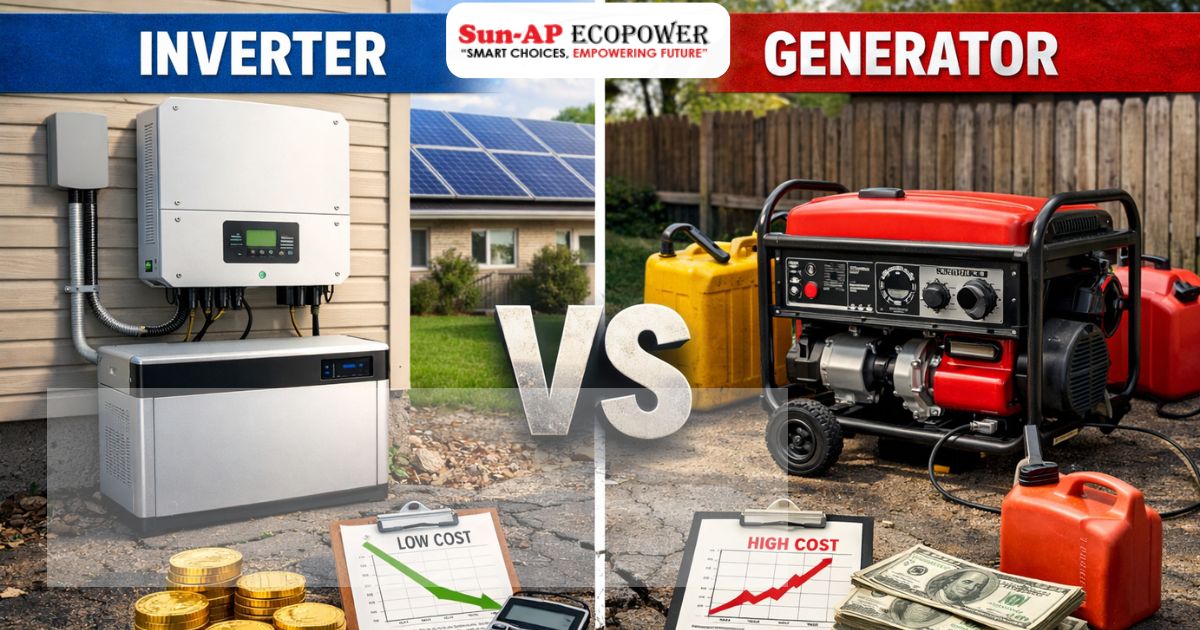
On the surface, both options seem to solve the same problem — keeping your home powered when the grid lets you down. But here’s the thing: once you look beneath the surface, inverters and generators are so fundamentally different that comparing them feels almost unfair.
One is loud, fuel-hungry, fume-producing, and demands your attention every time it’s needed. The other is silent, automatic, fuel-free, and so unobtrusive that you often forget it’s even there — until a blackout reminds you exactly how valuable it is.
As one of Bangalore’s most trusted solar inverter suppliers in Bangalore, Sun-AP Ecopower has helped hundreds of homeowners permanently replace their generators with hybrid solar inverter systems. Let’s dig into every dimension that matters — efficiency, long-term cost, convenience, safety, and real-world performance — and settle this debate once and for all.
First Things First: How Do These Two Technologies Actually Work?
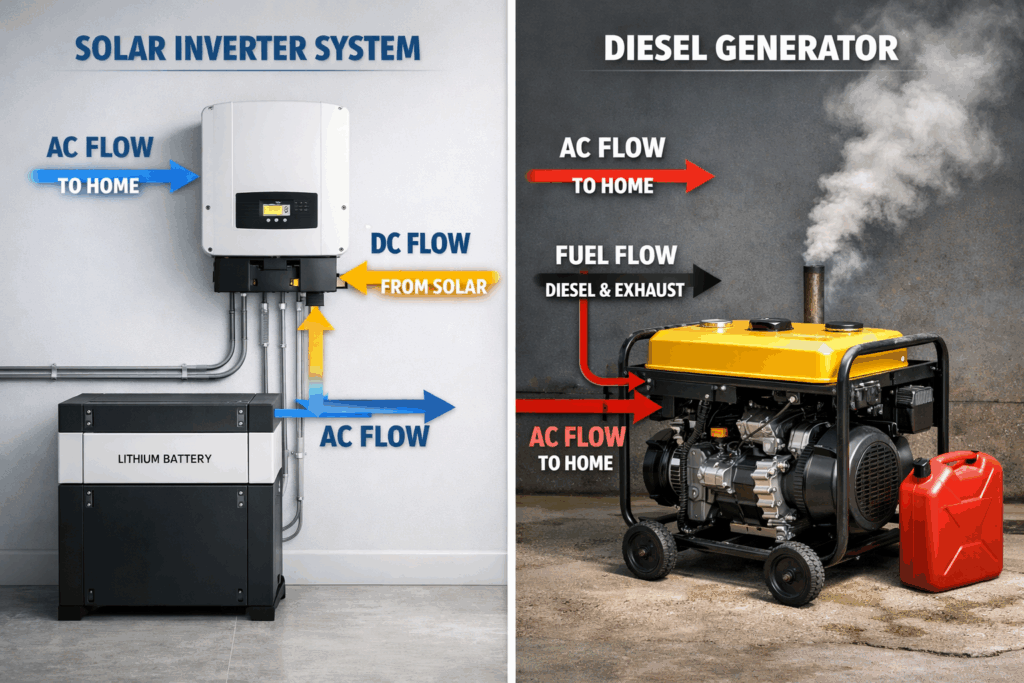
Understanding the core technology difference makes everything else in this comparison make immediate sense.
A solar inverter (particularly a hybrid solar inverter) converts DC electricity stored in a battery bank into AC power for your home. It operates completely silently, requires no fuel, and activates automatically within milliseconds of a power outage — without any intervention from you whatsoever.
A generator is a combustion engine. It burns diesel or petrol to mechanically spin a motor that produces electricity. It requires manual starting — either a pull cord or electric start — produces significant noise and exhaust fumes, and takes anywhere from 30 seconds to several minutes to come fully online during an outage.
That fundamental difference in how they work shapes every aspect of how they feel to live with.
Efficiency: And It’s Not Even Close
Let’s start with a number that might genuinely surprise you.
Modern solar inverters convert stored battery energy to usable AC power at efficiencies of 95–99%. Almost every unit of stored energy becomes usable electricity in your home. The losses are tiny.
Generators, by contrast, convert only 20–30% of their fuel’s energy into usable electricity. The remaining 70–80% is released as heat, noise, and exhaust gases into the atmosphere. Think about that for a moment — for every 100 rupees of diesel you burn, only 20–30 rupees worth of electricity reaches your home. The rest is literally wasted into the air.
And here’s what makes the gap even more dramatic: solar inverter systems use free solar energy as their primary charging source. Once your system is installed, your fuel cost drops to essentially zero during daylight-charged operations. The efficiency advantage of the inverter isn’t just technical — it’s financial, every single day.
The Full Long-Term Cost Picture
This is the comparison that changes minds the most dramatically — especially when you lay it out side by side.
| Cost Factor | Solar Hybrid Inverter | Diesel/Petrol Generator |
| Initial Setup Cost | Higher | Lower |
| Fuel Cost | Near Zero (solar charging) | High (diesel every outage) |
| Maintenance Cost | Very Low (annual servicing) | High (oil, filters, regular servicing) |
| Operating Noise | Completely Silent | 65–90 dB (very loud) |
| System Lifespan | 10–15 yrs (inverter), 25+ yrs (panels) | 8–12 years |
| Environmental Impact | Zero emissions | CO₂, NOₓ, carbon emissions |
| Response to Outage | Milliseconds (automatic) | 30 sec – 3 min (manual start) |
| Indoor Safety | Completely safe indoors | Cannot run indoors (toxic fumes) |
| Impact on Electricity Bills | Significantly reduces monthly bills | Zero impact on electricity bills |
The pattern is unmistakable. Generators appear cheaper because of their lower purchase price — but they compensate by charging you continuously through fuel, maintenance, oil changes, filter replacements, and eventual engine servicing.
A typical generator consuming 1–2 litres of diesel per hour during a 4-hour outage costs you 400–800 rupees in fuel alone. Multiply that by frequent outage events throughout the year, and generator “fuel tax” quietly becomes one of your home’s most expensive recurring costs.
The Convenience Factor: Living With Each Day-to-Day

Let’s be honest about something the technical specs don’t capture: how does each option actually feel to live with?
With an inverter, the honest answer is: you barely notice it. When the power goes out, the inverter activates automatically in milliseconds. Your home stays powered. Your family continues watching TV, cooking dinner, sleeping peacefully. There is no action required from you. No noise. No disruption. Just continuous power.
With a generator, every outage is an event. You need to go to where the generator is stored — often outdoors or in a garage. You start it manually. You wait for it to warm up. You bring fuel to it if it’s running low. You shut it down when the grid comes back. And throughout the entire process, it’s producing a constant, penetrating noise that your family — and your neighbors — definitely notice.
In Bangalore’s urban and residential neighborhoods, generator noise is genuinely one of the most significant quality-of-life complaints that Sun-AP Ecopower hears from homeowners who are switching to solar inverter systems.
Safety: A Conversation Nobody Wants to Have, But Everyone Needs to
Here’s the uncomfortable truth about generators that many homeowners discover only after a close call.
Generators produce carbon monoxide — a colorless, odorless gas that is lethally toxic in enclosed or semi-enclosed spaces. Every year, preventable deaths and hospitalizations occur from carbon monoxide poisoning caused by generators being operated too close to homes. This means generators must always be operated outdoors, well away from windows, doors, and vents — which makes them dangerously impractical during the heavy rain and storms that cause many power outages in the first place.
Solar inverters produce zero emissions. They’re completely safe for indoor installation. They generate no toxic gases, no open flame, and no combustion risk. From a pure safety standpoint, there is no competition.
Real Questions From Homeowners Who’ve Made the Switch
“Is there any scenario where a generator genuinely makes more sense?”
Generators can make sense for very high-power, extended-duration needs in specific industrial or construction contexts. For standard residential backup needs, inverters are superior in virtually every real-world scenario.
“How long can a home inverter system actually power my house?”
A properly sized hybrid solar inverter system can typically power an average Indian home through an entire night — approximately 8 to 12 hours — on stored battery energy, with solar panels recharging the battery the following day.
“Which delivers better 10-year ROI — inverter or generator?”
Solar inverter systems deliver dramatically better 10-year ROI due to near-zero running costs, reduced electricity bills, and minimal maintenance. Generator costs compound significantly over a decade through fuel and servicing expenses.
“Can a solar inverter system completely replace my generator?”
For the vast majority of Indian homes, absolutely yes. A well-designed hybrid solar inverter system with adequate battery storage can fully replace generator dependency — with better reliability, zero running costs, and complete silence.
“Where can I find a trusted solar inverter supplier in Bangalore to make the switch?”
Sun-AP Ecopower is one of the most trusted solar inverter suppliers in Bangalore, offering hybrid solar inverter systems designed specifically to replace generators — with complete installation, commissioning, and long-term service support across Bangalore.
The Bottom Line on Long-Term Value
- The “cheap generator” illusion is one of the most expensive traps homeowners fall into — the upfront savings evaporate within 2–3 years of fuel and maintenance costs
- Solar inverter systems add measurable resale value to your home — generators are viewed as a temporary fix and add essentially no property value
- Increasing urban regulations on generator noise and emissions are making solar inverter systems not just preferable but potentially mandatory in certain housing societies
- Every day your solar inverter runs, it’s reducing your electricity bill — generators provide zero such ongoing financial benefit, no matter how long you own one
Conclusion
When you honestly evaluate every dimension that matters to a homeowner — efficiency, running costs, convenience, safety, environmental impact, long-term ROI, and quality of life — the inverter vs. generator debate stops being a debate. Generators solve the problem of power cuts. Inverters eliminate the problem of power cuts — automatically, silently, cleanly, and at a cost that keeps falling year after year as solar energy becomes cheaper and battery technology improves.
In 2026, for any Bangalore homeowner who’s genuinely serious about reliable home power backup, Sun-AP Ecopower — your trusted solar inverter supplier in Bangalore — is ready to design, supply, and install the hybrid solar inverter system that permanently ends your generator dependency. Get in touch today for a free home assessment.