When homeowners and commercial facility managers decide to upgrade their energy infrastructure, they often focus entirely on the panels. This is a massive financial miscalculation. The actual brain of your power ecosystem is the Solar inverter.
If you are planning to install an on-grid solar inverter or looking to upgrade your current Solar On-grid inverter, you must understand that this single piece of hardware dictates your total energy yield and long-term financial return. Before you rush to buy solar products online, you must absolutely understand the latest inverter technology shaping the current energy market.
A legacy conversion box is no longer sufficient to manage a modern smart home or a high-capacity industrial facility.
You need an intelligent energy manager capable of real-time grid synchronization, localized fault detection, and maximum power point tracking. Relying on outdated hardware is a guaranteed way to drain electrical efficiency and cost you money on your monthly utility bills.
To ensure you make a mathematically sound and future-proof investment for your energy infrastructure, this clinical breakdown will cover the following critical areas:
- A definitive baseline explanation of what inverter technology is and how it has evolved from basic direct current conversion to predictive energy management.
- The strict technical difference between smart inverter and digital inverter hardware proves exactly why legacy digital systems are completely obsolete.
- How deploying a true smart inverter maximizes your financial return by actively communicating with your solar array, your home battery storage, and the national utility grid.
Mastering these concepts is the only way to protect your property from highly inefficient energy cycles and grid instability.
Once you understand the underlying mathematics of modern conversion technology, you will realize why choosing the right hardware is the most important decision in your entire solar journey.
What is Inverter Technology?
To understand the advanced systems dominating the current market, we must first establish a strict operational definition of what inverter technology is at its absolute core.
Solar photovoltaic panels generate electricity in the form of Direct Current (DC). However, your home appliances, industrial machinery, and the national utility grid operate exclusively on Alternating Current (AC).
An inverter serves as the critical bridge between raw power production and actual consumption. It mathematically restructures the raw DC power into a clean, highly regulated AC frequency.
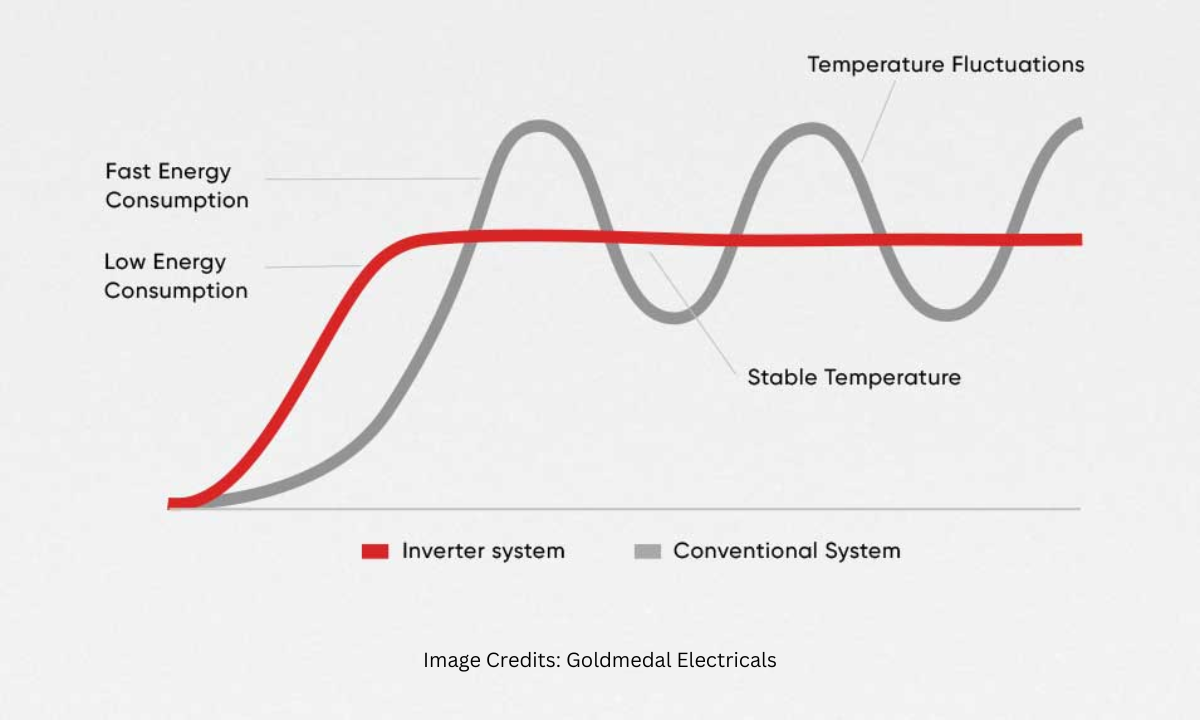
In the early days of solar infrastructure, this conversion process was blunt and highly inefficient. Early models produced jagged square waves or modified sine waves that caused sensitive electronics to overheat and fail prematurely.
Modern technology has completely eradicated this problem. Today’s enterprise-grade inverters utilize advanced high-frequency switching components to generate a pure sine wave. This pure sine wave perfectly mirrors the electricity provided by the utility grid.
It ensures zero operational damage to your expensive appliances and operates at an efficiency rate that frequently exceeds 98 percent. This pure power conversion is the absolute baseline requirement. However, simply converting power is no longer enough to manage a modern energy asset.
The industry has rapidly evolved past basic conversion, splitting the market into outdated digital boxes and highly advanced smart systems capable of autonomous decision-making.
Difference Between Smart and Digital Inverters
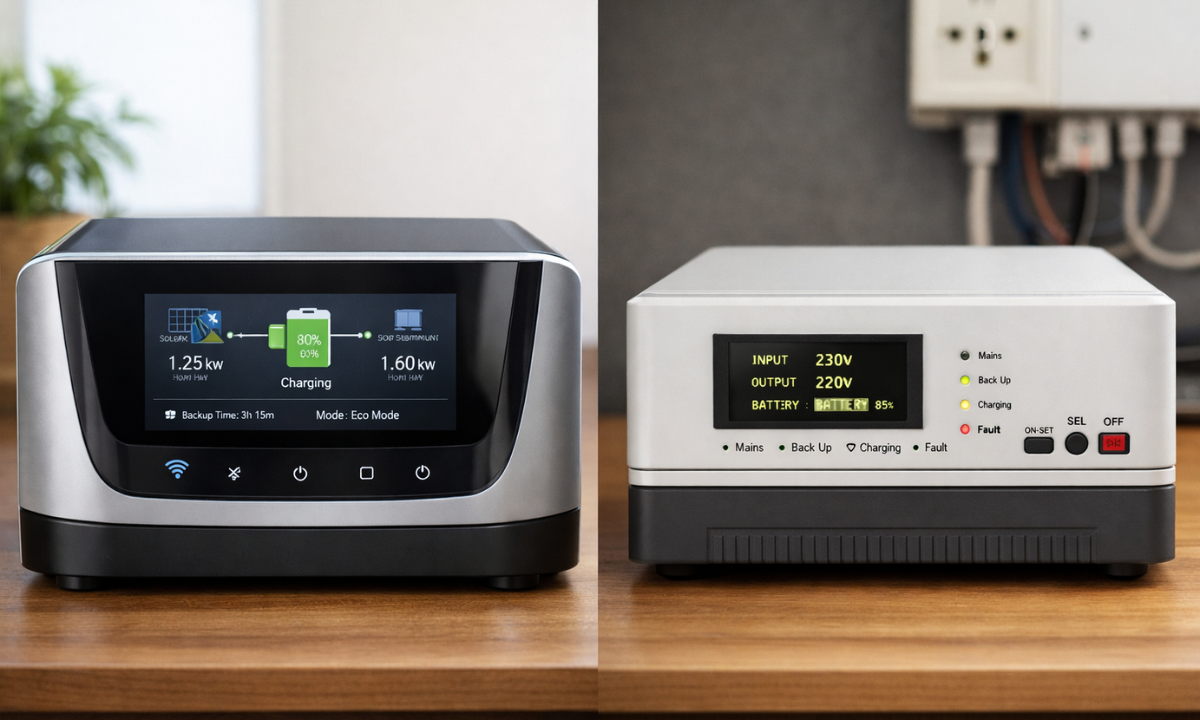
The solar market is constantly flooded with deceptive terminology. Many local vendors aggressively market basic systems under the label of “digital” to confuse uneducated buyers and inflate prices.
You must strictly understand the difference between smart inverter and digital inverter architecture to protect your capital investment.
A digital inverter is simply a legacy conversion box equipped with a basic LCD screen. It displays past energy generation data but completely lacks the processing power to make autonomous grid decisions.
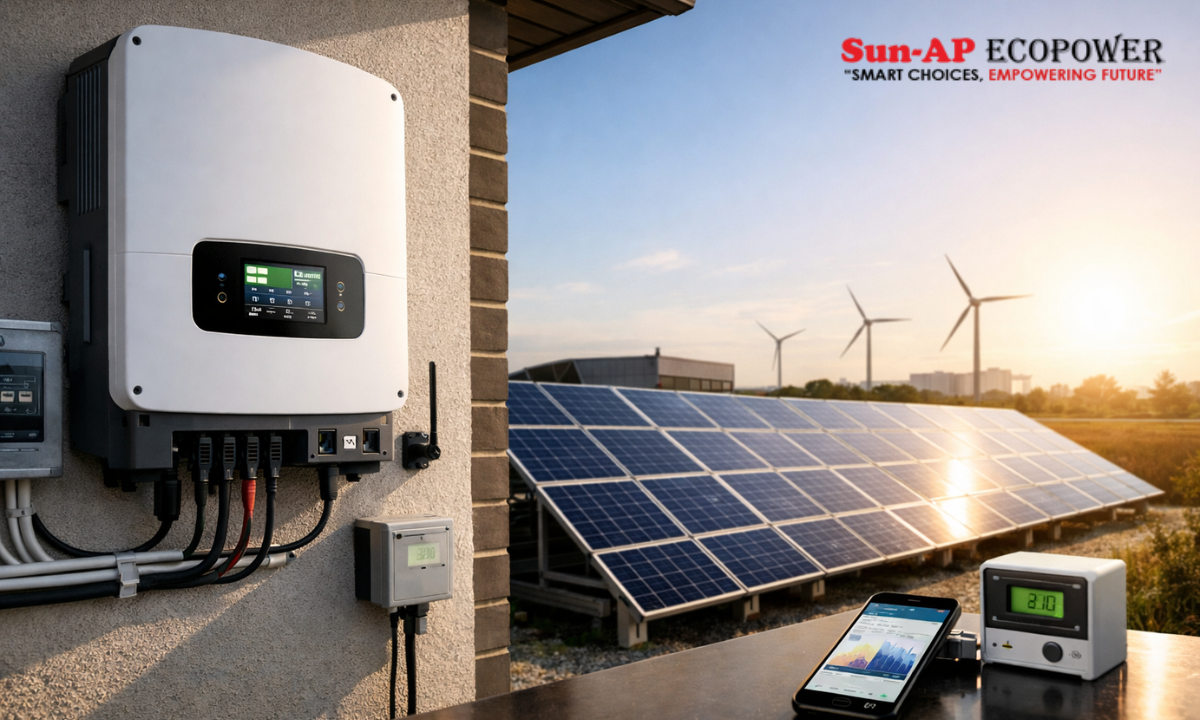
In strict contrast, a true smart inverter is an internet-connected, localized command center. It actively monitors grid voltage, predicts consumption patterns, and reroutes power to maximize your exact financial return. It does not just passively convert energy; it actively manages your entire electrical ecosystem.
To completely dismantle the marketing jargon, you must evaluate the strict operational differences between these two systems:
| Technical Capability | Legacy Digital Inverter | Modern Smart Inverter |
|---|---|---|
| Grid Communication | Blind operation. It pushes alternating current without analyzing external utility grid stability. | Bi-directional communication. It actively responds to grid signals to stabilize local voltage and frequency fluctuations. |
| Fault Diagnostics | Reactive. You only discover a hardware failure when your electricity bill suddenly spikes at the end of the month. | Predictive. Cloud-based telemetry detects micro-faults and instantly alerts your service provider before a total system failure occurs. |
| Energy Routing | Static. Power flows in a single direction with absolutely zero real-time financial optimization. | Dynamic. Automatically shifts excess solar power to your battery storage or exports it to the grid based on peak pricing schedules. |
| Remote Upgrades | Hardcoded. The firmware you buy on day one remains the same until the hardware physically dies. | Agile. The system receives over-the-air software updates to continuously improve conversion efficiency and compliance with new grid regulations. |
Investing in a digital box in the modern energy landscape is a guaranteed way to bleed operational efficiency.
A smart system is an absolute non-negotiable requirement for any serious commercial facility or high-end residential property looking to eliminate utility reliance.
Microinverters vs. String Inverters
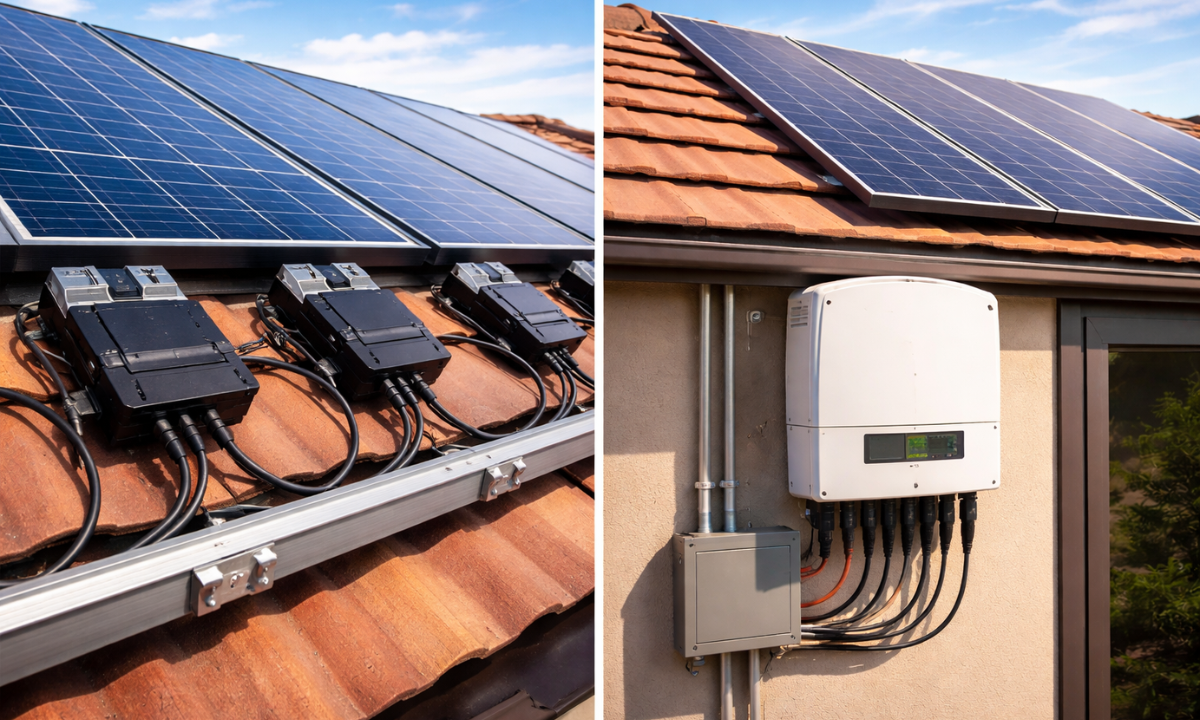
The most critical architectural shift in the current solar market is the aggressive transition away from centralized power processing, with growing adoption of microinverters vs string inverters.
Historically, residential and commercial systems relied entirely on legacy string inverters. In a string configuration, all solar panels are connected in a single series circuit that feeds into one large central inverter. This creates a massive single point of failure.
If just one panel is shaded by a passing cloud, covered in dust, or physically damaged, the electrical output of the entire string immediately drops to the level of that weakest panel.
To eliminate this bottleneck, elite solar installations now deploy microinverter technology. Instead of routing high-voltage direct current across your entire roof to a central box, microinverters are installed directly underneath every individual solar panel.
This decentralized architecture provides three non-negotiable advantages for maximizing your financial return:
- Absolute Panel Independence: Because each panel has its own dedicated microinverter, shade or debris on one section of your roof will never degrade the performance of the remaining array.
Every panel operates at its absolute maximum capacity independently of the others.
- Granular Performance Monitoring: Legacy systems only show you the total energy generated by the entire roof. Microinverters provide strict, panel-level telemetry.
You can open a smart dashboard and see the exact wattage produced by each module, allowing for immediate, pinpoint maintenance if a specific panel underperforms.
- Elimination of High-Voltage Arcing: String inverters force hundreds of volts of direct current to travel across your property, creating a severe fire hazard if a cable is damaged.
Microinverters convert the power to safe alternating current immediately at the panel level, completely removing the risk of high-voltage DC arcing and securing your property against electrical fires.
Global leaders like Enphase Energy have mathematically proven that this decentralized model yields significantly higher long-term energy generation compared to legacy string setups. When you upgrade to panel-level conversion, you are buying absolute energy resilience.
ROI of High-Efficiency Inverters
The most expensive component of any solar installation is not the hardware itself. It is the energy you fail to harvest because you installed sub-optimal conversion technology.
When commercial facility managers or homeowners attempt to cut upfront costs by purchasing budget inverters, they are committing a massive financial error. Every single percentage point of efficiency lost during the DC to AC conversion process equals real money burned every single day for the next 25 years.
To completely understand why premium hardware is an investment rather than an expense, we must look at the strict mathematical reality of system efficiency.
Let us calculate the absolute financial bleed of a standard 10kW residential system operating in Bangalore, comparing a budget legacy box to an elite high-efficiency smart inverter:
| Financial Metric | Budget Legacy Inverter (95% Efficiency) | Premium Smart Inverter (98.5% Efficiency) |
|---|---|---|
| Daily Conversion Bleed | Loses roughly 2 to 3 units of electricity per day purely as waste heat during the conversion process. | Retains almost all the generated power, losing less than half a unit per day. |
| Annual Financial Loss | Destroys approximately ₹7,000 to ₹9,000 of potential savings every single year. | Maximizes grid export and battery storage, capturing the full financial value of your roof. |
| 25-Year Opportunity Cost | Over ₹2,00,000 was lost in wasted energy, completely wiping out the initial “savings” of buying the cheaper hardware. | Delivers compounding financial returns, effectively acting as a high-yield, tax-free fixed deposit. |
| Hardware Replacement Cycle | Built with cheap silicon components that degrade rapidly, forcing a complete hardware replacement within 5 to 7 years. | Engineered with aerospace-grade Silicon Carbide components, often backed by 12 to 25-year warranties that guarantee zero replacement costs. |
When you analyze the raw data, the conclusion is absolute.
The premium inverter pays for its higher initial price tag within the first 36 to 48 months through superior energy capture alone. Every single month after that break-even point is pure, unadulterated profit. Buying a cheap inverter is not a cost-saving measure; it is a guaranteed subscription to long-term energy loss.
Why Sun AP Ecopower is the Trusted Solar Partner
When you decide to transition your property to a smart energy grid, you cannot afford to hire a standard local electrical vendor. You must partner with a technical engineering firm that understands the strict mathematical reality of long-term energy generation. To guarantee your property operates at absolute maximum efficiency, we enforce a highly rigorous deployment architecture:
- Elite Hardware Partnerships: We completely reject budget and unproven technology.
We strictly deploy global tier-one hardware from industry leaders like Panasonic, REC, and Enphase Energy. This ensures your installation is backed by aerospace-grade components and 25-year performance warranties.
- Technical Site Audits: We do not guess your energy requirements. Our engineering team conducts a brutal, comprehensive audit of your current electrical consumption, roof shading patterns, and future load projections to design a mathematically perfect solar architecture.
- Zero-Downtime Integration: Whether you require a high-capacity commercial hybrid system or a residential microinverter array, our deployment protocol ensures seamless integration with your existing infrastructure, providing immediate financial returns from day one.
Sun AP Ecopower does not simply sell solar panels. We engineer complete, high-performance energy ecosystems designed to eliminate your reliance on the unstable utility grid.
Conclusion
The era of the basic solar setup is completely over. Relying on outdated digital inverters is a mathematical guarantee that you will bleed financial value every single time the sun rises.
The modern energy landscape demands intelligent, decentralized hardware that actively manages your power generation and protects your property from electrical faults.
Execute this strict final sequence to secure your energy independence today:
- Stop the Passive Bleed: Immediately audit your current electricity bills and recognize the exact amount of capital you are losing to the utility grid every month.
- Demand Smart Architecture: Refuse to install legacy string inverters or basic digital boxes. Insist on a true smart inverter or a microinverter system to maximize your long-term return on investment.
- Deploy with Sun AP Ecopower: Stop trusting your 25-year energy asset to unverified local vendors. Book a comprehensive technical site audit with the Sun AP Ecopower engineering team right now to map out your exact path to zero utility costs.
The sun provides the raw fuel, but your inverter dictates the actual profit. Secure the smartest brain for your energy ecosystem and permanently lock in your financial independence.