Solar energy generation is inherently dynamic. Unlike conventional power sources, photovoltaic modules do not produce a fixed output. Their voltage-current characteristics change continuously depending on irradiance levels, ambient temperature, shading patterns, dust accumulation, and panel ageing.
For installers, EPC contractors, commercial users, and homeowners working with Sun AP Ecopower, one engineering concept determines whether a solar installation operates at 70% efficiency or consistently above 98%: the maximum power point tracking algorithm.
Understanding this concept is not merely academic. It directly impacts:
- System yield
- Financial return
- Equipment lifespan
- Grid stability
- Long-term performance guarantees
This comprehensive guide explains how maximum power point tracking techniques function, explores the maximum power point formula in practical engineering terms, and clarifies how environmental fluctuations affect real-world installations.
Understanding the Physics Behind Maximum Power Point
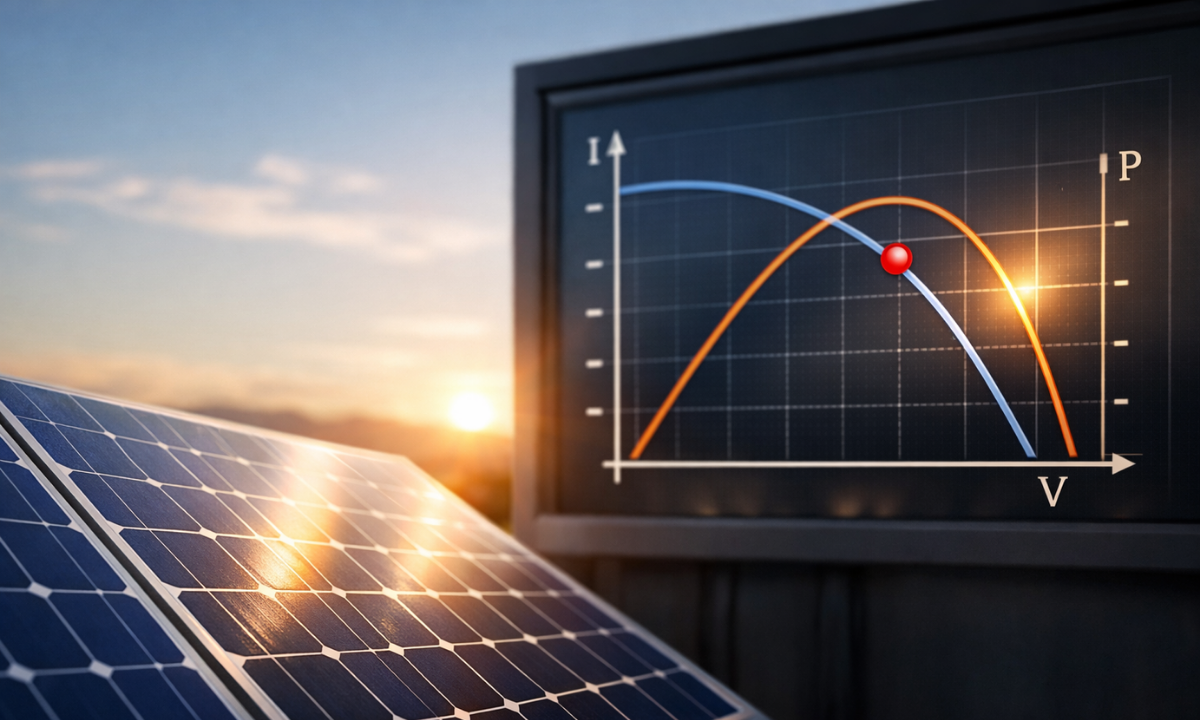
Every solar panel has a characteristic I–V (current–voltage) curve.
At one specific operating point on that curve:
[Power = Voltage \times x Current]
This is derived from the maximum power point formula:
[P_{max} = V_{mpp} \times I_{mpp}]
At this precise combination of voltage and current, the panel produces its highest power output.
However, this point is not fixed.
It shifts due to:
- Cloud movement
- Seasonal irradiance variation
- Temperature changes
- Partial shading
- Load variation
Without active tracking, panels operate away from this optimum.
Why MPPT Is Essential in Modern Solar Systems
In practical installations, especially those deployed by Sun AP Ecopower across residential and commercial segments, the difference between fixed operation and dynamic MPPT can mean:
- 15–30% energy loss prevention
- Faster return on investment
- Improved system bankability
- Better compliance with grid standards
Modern solar inverters integrate MPPT controllers internally, ensuring automatic optimization without manual intervention.
Classification of Maximum Power Point Tracking Techniques
Let us now examine each tracking approach in detailed engineering depth.
1. Perturb and Observe (P&O)
How It Works
The controller makes a small voltage change and measures the power response.
If power increases:
- Continue adjusting in that direction.
If power decreases:
- Reverse direction.
This method creates small oscillations around the MPP.
Engineering Insight
While simple, this oscillation leads to micro-losses under steady conditions.
In rapidly changing weather, P&O can misinterpret temporary drops as incorrect direction signals.
Best Application
Small-scale residential systems where cost optimization is prioritized.
Limitations
- Reduced precision during fluctuating irradiance
- Minor steady-state oscillation loss
2. Incremental Conductance
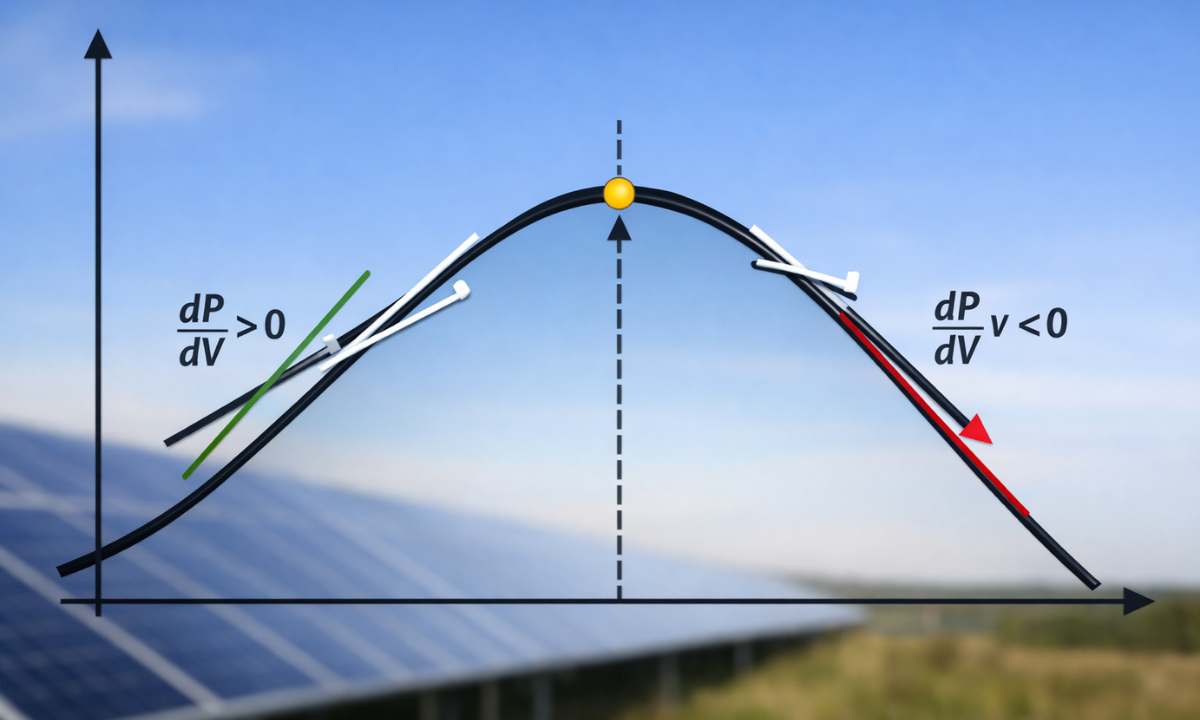
This method calculates:
[\frac{dP}{dV} = 0]
By evaluating the slope of the power curve.
At MPP:
- Incremental conductance equals instantaneous conductance.
Practical Advantage
Unlike P&O, it distinguishes between environmental fluctuation and actual MPP deviation.
Why It Matters
In areas with variable cloud cover, this technique maintains higher efficiency. Frequently integrated into advanced hybrid inverters, where battery interaction adds system complexity.
3. Fractional Open Circuit Voltage
This approach estimates MPP voltage as a proportion of open-circuit voltage.
Though mathematically elegant, it requires momentary disconnection to measure Voc.
Real-World Implication
In larger installations, interruptions are not desirable.
Hence, this method is generally used in simpler systems.
4. Fractional Short Circuit Current
A similar concept is applied to current measurement.
Better suited to systems with stable irradiance.
5. Fuzzy Logic Control
This method moves beyond rigid mathematics.
It evaluates linguistic variables such as:
- “Small increase”
- “Moderate change”
- “Large drop”
Using membership functions and rule-based inference.
Engineering Value
Handles non-linear panel behavior efficiently.
Use Case
Commercial rooftop and industrial installations.
Often available in premium systems distributed via solar products online procurement channels.
6. Artificial Neural Networks
ANN-based tracking learns panel behavior patterns.
Inputs include:
- Temperature
- Irradiance
- Voltage
- Current
The system predicts optimal voltage output dynamically.
Why This Is Powerful
- Eliminates steady oscillation
- Responds instantly to shading
- Suitable for multi-array installations
Limitations
- Requires trained models
- Higher controller cost
7. Genetic Algorithm
Inspired by natural selection.
The controller iteratively converges to the optimal power output.
Advantage
Handles partial shading better than conventional methods.
Limitation
Computational intensity.
8. Particle Swarm Optimization
Simulates the collective behavior of particles searching for an optimal solution.
Excellent under:
- Irregular shading
- Large solar farms
Real-World MPPT in Grid Systems
When integrated into on-grid inverters, MPPT ensures:
- Stable export to the utility grid
- Compliance with voltage fluctuation limits
- Maximum financial credit under net metering
Multi-MPPT Architecture in Modern Systems
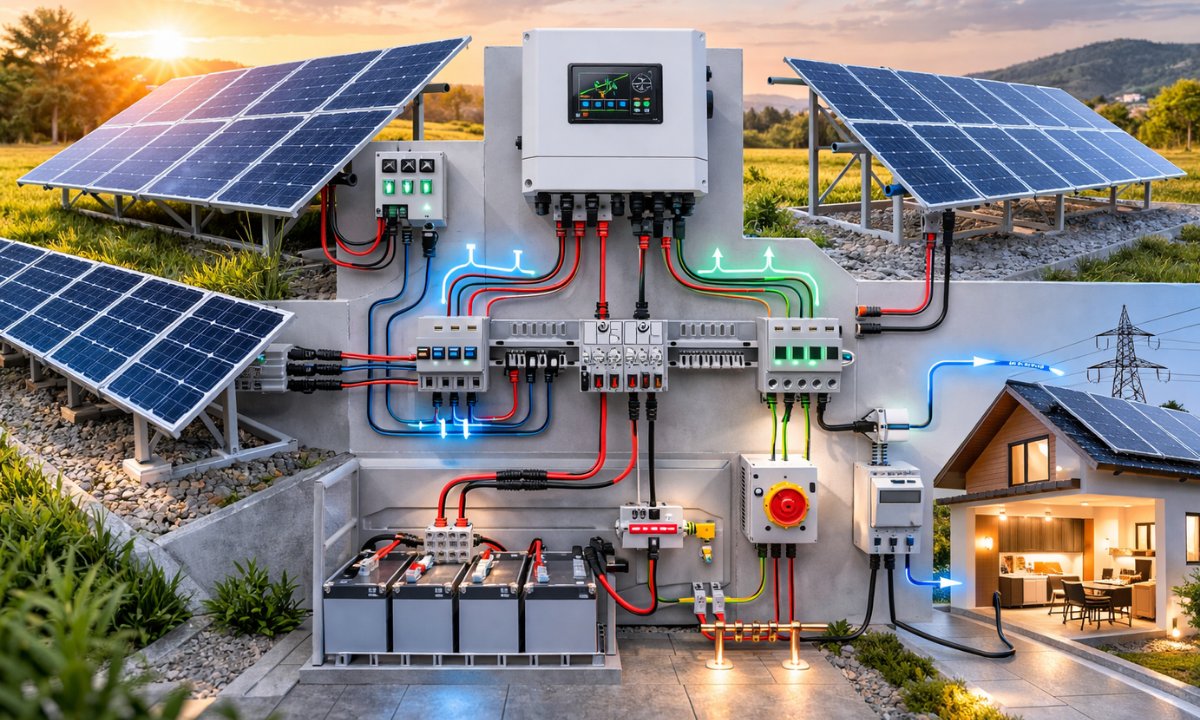
Advanced systems use:
- Dual MPPT inputs
- Independent string optimization
- Multi-orientation array handling
This allows east-west panel configurations without performance compromise.
Environmental Factors Influencing MPPT Efficiency
Maximum Power Point Tracking performance does not depend only on the algorithm. External environmental and system conditions directly influence how effectively the controller extracts energy. Below are the key factors that impact MPPT efficiency.
Temperature Coefficient of Panels
Solar panels are highly sensitive to temperature variations. The Temperature Coefficient of Panels determines how much voltage decreases as panel temperature rises. On hot days, panel voltage drops, which shifts the maximum power point. If not properly tracked, energy losses occur. An efficient MPPT system continuously adjusts to these temperature-induced voltage changes to maintain optimal power extraction.
Mismatch Losses
Mismatch Losses occur when panels within the same array produce different power levels due to manufacturing tolerances, dirt accumulation, ageing, or uneven sunlight exposure. Since panels are often connected in series, the weakest panel can reduce the performance of the entire string. Advanced MPPT systems help minimize these losses by optimizing the operating point of the array despite inconsistencies.
Partial Shading Patterns
One of the most challenging issues for solar systems is Partial Shading Patterns caused by trees, buildings, dust, or passing clouds. Even minor shading on a single module can significantly reduce output. Shading creates multiple local maximum power points, making tracking more complex. Advanced MPPT algorithms are designed to detect and navigate these variations to locate the true global maximum power point.
Cable Resistance
Energy losses can also occur due to Cable Resistance, especially in systems with long wiring distances between panels and inverters. Higher resistance leads to voltage drops, which reduce overall system efficiency. Proper cable sizing and installation reduce these losses. MPPT systems perform more effectively when voltage losses within transmission lines are minimized through professional design.
Panel Degradation
Over time, solar modules experience a gradual efficiency reduction due to ageing and environmental exposure. Panel Degradation affects output consistency and shifts operating characteristics. As panels degrade, their maximum power point changes slightly. A responsive MPPT controller adapts to these long-term variations, ensuring sustained energy optimization throughout the system’s lifespan.
Importance of Professional System Design
Professional system design ensures that algorithm selection aligns with installation conditions. Factors such as climate, shading risk, wiring layout, and system size determine whether basic or advanced MPPT algorithms should be used. Proper alignment between environmental conditions and tracking technology maximizes efficiency, reliability, and return on investment.
Choosing the Right MPPT for Your System
When working with Sun AP Ecopower, system design considerations include:
Roof Orientation
Roof orientation plays a crucial role in determining solar panel performance. Panels installed facing the optimal direction receive maximum sunlight throughout the day, directly influencing energy output. In the northern hemisphere, south-facing installations typically yield higher efficiency. Poor orientation can reduce daily generation, making MPPT systems work harder to optimize fluctuating voltage levels. Proper system design considers orientation to ensure consistent and predictable power production.
Shading Risk
Shading risk significantly impacts solar system efficiency. Obstacles such as trees, neighboring buildings, water tanks, or chimneys can cause partial shading at different times of the day. Even minimal shading on one panel can reduce the output of an entire string in traditional systems. Advanced MPPT controllers and proper layout planning help minimize energy losses caused by uneven sunlight exposure. Conducting a shading analysis before installation is essential for long-term performance.
Budget Constraints
Budget constraints influence the type of components and technology chosen for a solar system. While advanced MPPT controllers and optimizers improve efficiency, they may increase initial investment costs. A balanced approach is required to evaluate long-term savings versus upfront expenses. In many cases, investing slightly more in efficient tracking technology yields higher returns by improving energy harvest. Careful financial planning ensures performance without unnecessary overspending.
Grid Integration
Grid integration determines how the solar system interacts with the local electricity network. Grid-connected systems require compatible inverters and regulatory compliance to ensure safe energy export and consumption. MPPT performance becomes critical in grid-tied systems to maintain voltage stability and maximize feed-in benefits. Proper integration ensures seamless energy flow between solar panels, batteries (if present), and the grid without power quality issues.
Future Expansion Capability
Future expansion capability is an important consideration during system design. Homeowners and businesses may wish to add more panels, batteries, or hybrid components later. Choosing scalable inverters and MPPT systems ensures compatibility with future upgrades. Designing with expansion in mind prevents costly replacements or rewiring later. A flexible system architecture supports long-term growth and energy independence goals.
MPPT selection is not generic. It is engineered.
Future Trends in MPPT Technology
- AI-enhanced adaptive tracking
- Integration with smart grid systems
- Predictive weather-based optimization
- Distributed module-level power electronics
MPPT will increasingly become intelligent rather than reactive.
Frequently Asked Questions
What is the primary function of MPPT?
The primary function of Maximum Power Point Tracking (MPPT) is to continuously monitor and adjust the operating voltage and current of a solar panel system so it operates at its maximum power point. Since solar output changes with sunlight intensity, temperature, and shading, MPPT dynamically adapts in real time. This ensures the system extracts the highest possible power under varying environmental conditions. Without MPPT, a solar system may operate below its optimal efficiency.
Which algorithm is most efficient?
Among various MPPT algorithms, Artificial Neural Network (ANN)-based and fuzzy logic systems are considered highly efficient due to their ability to predict and adapt quickly to changing environmental conditions. These advanced algorithms provide higher precision and faster response compared to traditional methods like Perturb and Observe. However, they require more computational power and are relatively expensive to implement. Therefore, they are typically used in large-scale or high-performance solar systems.
Does MPPT improve battery charging?
Yes, MPPT significantly improves battery charging efficiency by ensuring that maximum available power from solar panels is directed to the battery system. In hybrid or off-grid systems, MPPT controllers dynamically regulate voltage to match battery charging requirements. This prevents undercharging and reduces energy losses. As a result, batteries charge faster, operate more efficiently, and generally experience improved lifespan.
Is MPPT necessary for small systems?
Yes, even small residential or off-grid solar systems benefit from MPPT technology. Although small systems may operate at lower power levels, environmental fluctuations still affect performance. MPPT ensures optimal energy harvesting regardless of system size, improving overall efficiency. Over time, the energy gains can justify the slightly higher initial cost of an MPPT controller.
Conclusion
The maximum power point tracking algorithm is the invisible intelligence behind every efficient solar system.
From simple perturb-based control to advanced AI-driven optimisation, each technique serves a specific engineering context.
At Sun AP Ecopower, system design goes beyond installation. It incorporates algorithm selection, inverter configuration, and long-term optimisation strategy.
Understanding maximum power point tracking techniques empowers system owners to make informed decisions and maximize their energy investment.
References
- Esram, T., & Chapman, P. L. (2007). Comparison of Photovoltaic Array MPPT Techniques. IEEE Transactions on Energy Conversion.
- IRENA Renewable Energy Report 2023.
- European Photovoltaic Industry Association (EPIA) Technical Guidelines.
- Solar Energy Engineering – Duffie & Beckman.
- IEEE Standard for Interconnecting Distributed Resources.