Power cuts are no longer occasional inconveniences. With rising electricity demand, weather volatility, and increased home appliance usage, choosing the correct inverter size for the home has become a practical necessity rather than a luxury.
At Sun AP Ecopower, we regularly meet homeowners who either overinvest in oversized systems or underestimate their requirements and face repeated overload trips. Both mistakes are avoidable.
This comprehensive guide will help you determine the correct Inverter size, battery configuration, load calculation method, and system type, while also understanding how modern solar inverters, on-grid inverters, and hybrid inverters fit into your long-term energy planning.
Why Choosing the Correct Inverter Size Matters
An inverter is not just a backup device. It is the central control system that:
- Converts stored battery energy into usable AC power
- Manages appliance load distribution
- Protects devices from voltage fluctuations
- Integrates with solar panels where applicable
Selecting the wrong system can result in:
- Frequent overload shutdowns
- Shortened battery life
- Poor runtime during outages
- Unnecessary capital expenditure
Correct sizing ensures efficiency, longevity, and financial optimization.
Step 1: Calculate Your Power Requirement
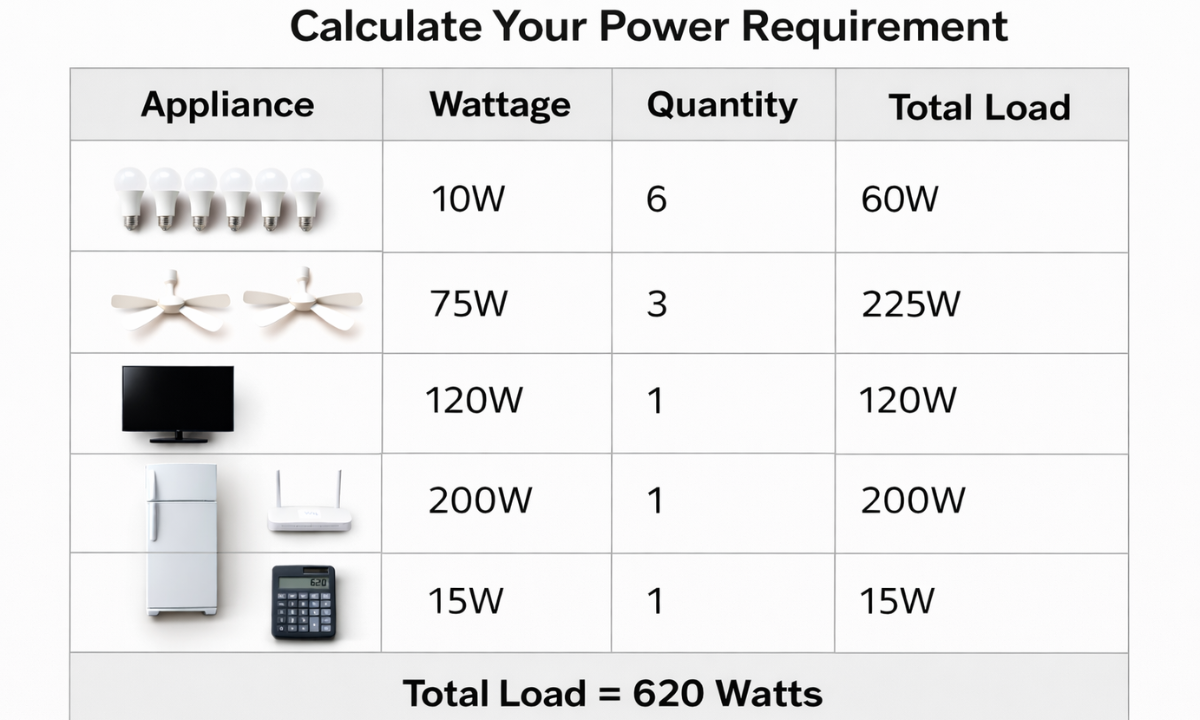
Before purchasing, list the appliances you intend to run during a power cut.
Example Load Calculation
| Appliance | Wattage | Quantity | Total Load |
|---|---|---|---|
| LED Lights | 10W | 6 | 60W |
| Ceiling Fans | 75W | 3 | 225W |
| Television | 120W | 1 | 120W |
| Refrigerator | 200W | 1 | 200W |
| Wi-Fi Router | 15W | 1 | 15W |
Total Load = 620 Watts
Add a 20–25% safety margin to accommodate starting surges and future expansion.
Adjusted Load = ~750 Watts
This gives you the base reference for deciding on inverter capacity.
Step 2: Understand Inverter Capacity Ratings
Inverters are rated in VA (Volt-Amperes), not Watts.
To convert Watts to VA:
VA = Watts ÷ Power Factor
Assuming a typical power factor of 0.8:
750W ÷ 0.8 = 937 VA
In this case, a 1000 VA inverter would be suitable.
Step 3: Consider Backup Duration
Capacity alone is not enough. You must determine how long you need backup.
Example:
If your load is 750W and you want 3 hours of backup:
Energy Required = 750 × 3 = 2250 Wh
Battery selection becomes critical here.
Step 4: Choosing the Right Battery Size
The correct inverter battery size for the home depends on:
- Total load
- Desired backup time
- Battery voltage (usually 12V or 24V systems)
Battery Capacity Formula:
Battery Ah = (Total Load × Backup Hours) ÷ (Battery Voltage × Efficiency)
For a 12V battery system:
2250 ÷ (12 × 0.85) ≈ 220 Ah
This calculation acts as a practical inverter battery size calculator for homeowners.
Step 5: Understanding Inverter Standard Size Options
Common inverter standard size categories in Indian households include:
- 600 VA – Basic lighting and fan support
- 900–1100 VA – Small apartment loads
- 1500 VA – Mid-sized homes
- 2000 VA+ – Larger homes with refrigerators and multiple appliances
Selecting the correct size avoids overspending while ensuring reliability.
Step 6: Space Considerations and Inverter Box Size
Physical installation matters.
The inverter box size varies depending on:
- Battery capacity
- Single vs dual battery setup
- Cooling ventilation design
Ensure:
- Adequate airflow
- Moisture protection
- Accessible maintenance clearance
Avoid placing units in enclosed cabinets without ventilation.
Step 7: Budget Planning and Price Awareness
Many buyers focus heavily on the small-sized inverter with battery price, but affordability should not override performance.
Approximate Pricing (2026 Market Estimates):
- 800–1000 VA with battery: ₹18,000 – ₹28,000
- 1500 VA systems: ₹30,000 – ₹45,000
- Larger hybrid systems: ₹50,000+
Always compare warranty terms and service support.
Should You Consider Solar Integration?
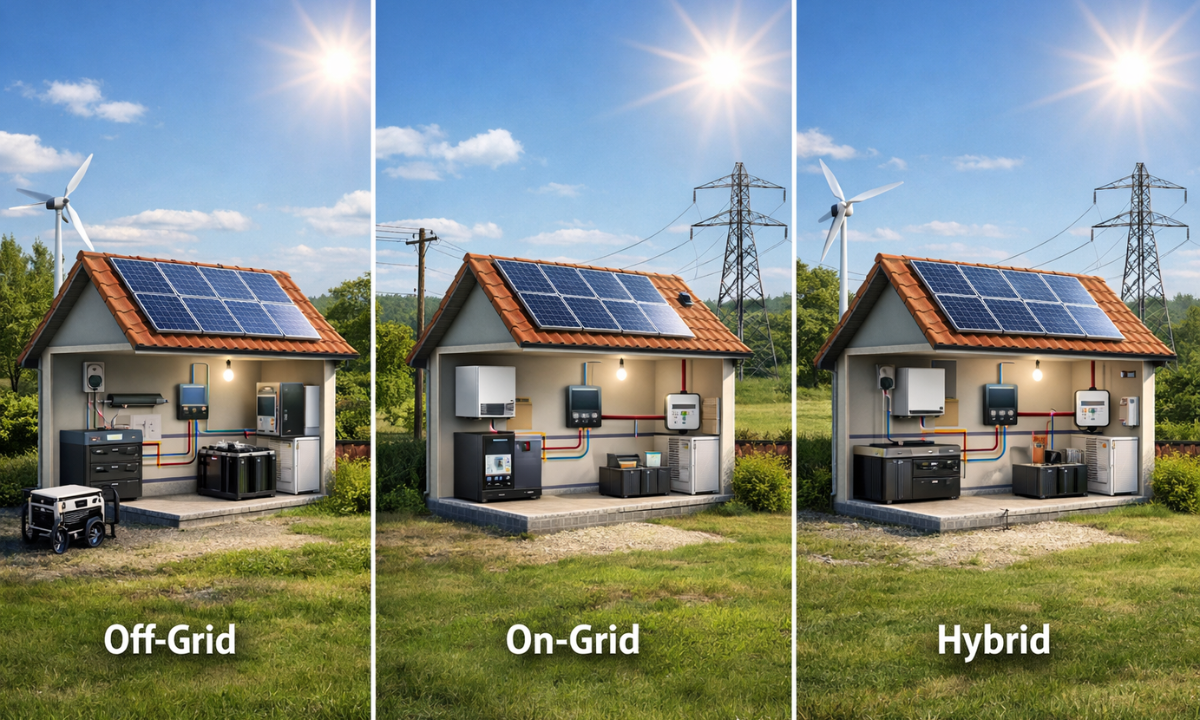
Modern homeowners are shifting toward renewable integration.
Solar Inverters
Solar inverters convert DC electricity from panels into usable AC power.
They are ideal if:
- You want reduced electricity bills
- You aim for long-term sustainability
- Your rooftop receives adequate sunlight
On-Grid Inverters
On-grid inverters are connected directly to the utility grid.
They:
- Feed excess solar power back to the grid
- Reduce electricity bills
- Do not provide backup during outages
Hybrid Inverters
Hybrid inverters combine battery backup with grid connectivity.
They:
- Store excess solar energy
- Provide backup during outages
- Optimize energy efficiency
Future-Proofing Your Purchase
In 2026, homes increasingly rely on:
- Work-from-home setups
- Smart appliances
- Security systems
- Electric vehicle charging
When planning your inverter size, consider potential upgrades over the next 3–5 years.
Under-sizing leads to system replacement sooner than expected.
Common Mistakes to Avoid
- Ignoring the starting surge load of refrigerators and pumps
- Choosing a battery without a runtime calculation
- Overlooking ventilation requirements
- Buying purely based on price
- Not considering solar compatibility
A balanced approach ensures longevity and ROI.
Maintenance Considerations
- Check battery water levels (for lead-acid systems)
- Keep terminals clean
- Ensure proper earthing
- Schedule annual inspections
Modern lithium systems require less maintenance but cost more upfront.
When Should You Upgrade Your Existing Inverter?
Consider upgrading if:
- Your inverter trips frequently
- Backup duration has reduced significantly
- You’ve added high-power appliances
- Your battery is older than 4–5 years
An energy audit can help determine if resizing is necessary.
Why Choose Sun AP Ecopower?
Sun AP Ecopower provides:
- Load-based customized inverter sizing
- Solar integration expertise
- Installation support
- Transparent pricing
- After-sales service
Browse our complete range of solar products online:
Frequently Asked Questions
1. What is the ideal inverter size for a 2BHK home?
A 1000–1500 VA system is typically suitable depending on appliance load and backup duration requirements.
2. How do I calculate the size of an inverter battery?
Use a basic inverter battery size calculator formula:
(Load × Backup Hours) ÷ (Voltage × Efficiency)
3. Is a hybrid system better than a normal inverter?
Hybrid systems provide battery backup and solar integration, making them more future-ready.
4. How long does an inverter battery last?
Lead-acid batteries typically last 3–5 years. Lithium batteries can last 7–10 years.
Final Thoughts
Choosing the correct inverter size for a home is a structured process, not a guess. It requires:
- Accurate load calculation
- Backup duration planning
- Battery capacity assessment
- Consideration of future expansion
- Solar compatibility evaluation
For homeowners in Andhra Pradesh and beyond, consulting with Sun AP Ecopower ensures a reliable, energy-efficient, and future-ready solution.
If you are planning an installation or an upgrade, explore our expert resources or contact our team for personalized recommendations.
Reliable power begins with informed decisions.