Let’s start with a scenario that far too many Indian homeowners know intimately.
It’s 11 PM. Your city is in the middle of an unannounced power cut — the third this week. Your WiFi router is dead. Your ceiling fans have stopped. Your refrigerator is warming up. And the inverter you bought five years ago just ran out of battery backup after forty-five minutes.
Sound familiar?
Here’s the harder truth beneath that frustrating scenario. That old inverter-battery setup you’re relying on for backup power was never designed for the energy demands of a modern home. It wasn’t designed for homes with high-wattage appliances, work-from-home setups, EV chargers, and the expectation of uninterrupted power through an eight-hour outage. And it certainly wasn’t designed to recharge itself from the sun, so you’re never dependent on grid availability to restore your backup capacity.
That’s exactly what a properly planned off-grid or hybrid solar backup system delivers. And in 2026 with solar technology more advanced, more affordable, and more capable than it has ever been there has never been a better time to replace your dependence on the grid with a genuinely resilient, self-sustaining backup power architecture for your home.
This guide walks you through everything you need to know to plan that system correctly — from calculating your backup power needs to choosing the right components — with trusted, certified products from Sun-AP Ecopower, Bangalore’s officially authorized distributor of the world’s leading solar brands.
Understanding Off-Grid vs. Hybrid Backup Systems
Before diving into planning specifics, let’s clarify the two primary backup system architectures — because choosing the right one for your situation is the first and most consequential planning decision you’ll make.
Pure Off-Grid Systems
A pure off-grid solar system operates completely independently of the utility grid. Solar panels generate power during the day, a battery bank stores surplus energy, and the entire home runs on stored solar power when panels aren’t generating — at night, during cloudy weather, or during extended outages.
Pure off-grid systems are ideal for:
- Homes in areas with frequent, prolonged power outages
- Rural properties where grid connection is expensive or unavailable
- Homeowners who want complete energy independence from the utility
- Remote farmhouses, vacation homes, and agricultural properties
The primary planning challenge with pure off-grid systems is sizing — you must have enough panel capacity and battery storage to sustain your home through multiple consecutive low-sunlight days without grid backup.
Hybrid Solar Systems — The Smart Choice for Most Urban Homes
A hybrid system combines the best of both worlds: solar generation, battery storage, and grid connectivity — all managed intelligently by a hybrid inverter that optimizes how your home uses each energy source.
During the day, your panels generate power for immediate consumption and battery charging. When batteries are full, surplus power exports to the grid (earning you net metering credits). During outages, the system seamlessly switches to battery power — with no interruption to your home’s electricity supply. And when solar generation and batteries are both insufficient (during extended cloudy periods), the grid provides backup.
Hybrid systems are ideal for:
- Urban and suburban homes with generally reliable but imperfect grid supply
- Homeowners wanting maximum energy cost savings alongside backup capability
- Homes with EV charging requirements
- Any installation where complete grid independence isn’t necessary but resilience is
Sun-AP Ecopower’s distribution of the Sunpower Renewables Australian-Engineered Hybrid Inverter-Battery Set System — BIS approved and launched exclusively in India through Sun-AP Ecopower at The Chancery Pavilion, Bengaluru in December 2025 — represents the most advanced hybrid backup architecture available to Indian homeowners today.
Step 1: Calculate Your Backup Power Requirements
This is the foundation of every good off-grid backup plan — and the step most homeowners either skip or dramatically underestimate.
Identify Your Critical Loads
Start by categorizing your home’s electrical loads into two groups:
Essential loads — appliances and devices you absolutely cannot lose power to during an outage:
- Ceiling fans and lighting
- WiFi router and modem
- Medical equipment (if applicable)
- Refrigerator
- Phone and laptop charging
Comfort loads — appliances that significantly impact quality of life during extended outages:
- Air conditioner (the highest-wattage load in most Indian homes)
- Water pump/borewell motor
- Washing machine
- Television and entertainment systems
- EV charger
Calculate Your Daily Energy Consumption
For each load, multiply its wattage by the hours per day you use it to get watt-hours (Wh):
Formula:
Watts × Hours per day = Watt-hours per day (Wh/day)
Example Calculation for a Typical Bangalore Home:
| Appliance | Watts | Hours/Day | Wh/Day |
| 4 Ceiling Fans | 240W | 8 hrs | 1,920 Wh |
| LED Lighting | 100W | 6 hrs | 600 Wh |
| Refrigerator | 150W | 24 hrs | 3,600 Wh |
| WiFi Router | 15W | 24 hrs | 360 Wh |
| 2 Laptops | 130W | 8 hrs | 1,040 Wh |
| Television | 120W | 4 hrs | 480 Wh |
| 1.5 Ton AC | 1,500W | 6 hrs | 9,000 Wh |
| Water Pump | 750W | 1 hr | 750 Wh |
| Total | ~17,750 Wh/day |
A home running these loads needs approximately 17.75 kWh per day — a figure that immediately defines the minimum solar panel capacity and battery storage your system requires.
For a backup-only system (excluding AC), daily energy need drops to approximately 8.75 kWh — a significantly more manageable system size.
Step 2: Size Your Solar Panel Array
With your daily energy consumption established, sizing your solar panel array follows a straightforward calculation.
Peak Sun Hours in Bangalore
Bangalore receives approximately 5.5 peak sun hours per day on average — one of the most favorable solar resources of any major Indian city, making off-grid planning here particularly effective.
Panel Sizing Formula
Daily energy requirement ÷ Peak sun hours ÷ System efficiency = Required panel capacity (kW)
Using our example (full home, 17.75 kWh/day):
17,750 Wh ÷ 5.5 hours ÷ 0.80 efficiency = ~4,030W (≈ 4 kW)
For backup-only (8.75 kWh/day):
8,750 Wh ÷ 5.5 hours ÷ 0.80 efficiency = ~1,990W (≈ 2 kW)
Sun-AP Ecopower’s Premium Panel Options
Sun-AP Ecopower distributes India’s most certified, highest-efficiency solar panels — each ideal for off-grid and hybrid backup system sizing:
REC Singapore Alpha Pure R (HJT Technology)
- Industry-leading efficiency with lowest degradation rate of just 0.25% per year
- 25-year product and performance warranty
- Exceptional performance in low-light and high-temperature conditions — critical for Indian climate
- IEC certified, built for extreme weather durability
- Perfect for maximizing generation from limited rooftop space
Panasonic 540Wp DCR (Heterojunction Technology)
- Fire Class A rated — the highest fire safety classification
- Outstanding performance coefficient in Bangalore’s warm climate
- 25-year warranty with proven long-term reliability
- Ideal for premium residential off-grid and hybrid installations
Vikram Solar 545Wp NDCR Monocrystalline
- BIS approved — meets India’s mandatory quality standards
- Rigorous quality testing for Indian climate conditions
- Excellent value-to-performance ratio for larger off-grid arrays
- Trusted by commercial and residential installers across India
General Recommendation: For a 4 kW off-grid system using Vikram Solar 545Wp panels, you need approximately 8 panels — occupying roughly 14–16 square metres of rooftop space.
Step 3: Size Your Battery Storage
Battery storage is the heart of any off-grid backup power system — and sizing it correctly is where most DIY plans fail.
Battery Sizing Principles
Backup duration — How many hours (or days) of autonomy do you need without solar generation? For urban homes with occasional outages, 8–12 hours is typically sufficient. For rural off-grid homes, 48–72 hours of autonomy may be required.
Depth of Discharge (DoD) — Lithium-ion batteries (the modern standard) safely discharge to 80–90% of their capacity. Lead-acid batteries should not be discharged below 50%. Always factor DoD into your sizing.
Battery Sizing Formula:
Daily energy need × Backup days ÷ DoD = Required battery capacity (kWh)
Example (8.75 kWh/day, 1 day backup, 80% DoD lithium):
8,750 Wh × 1 day ÷ 0.80 = ~10.9 kWh battery capacity required
The Sunpower Renewables Hybrid Inverter-Battery System
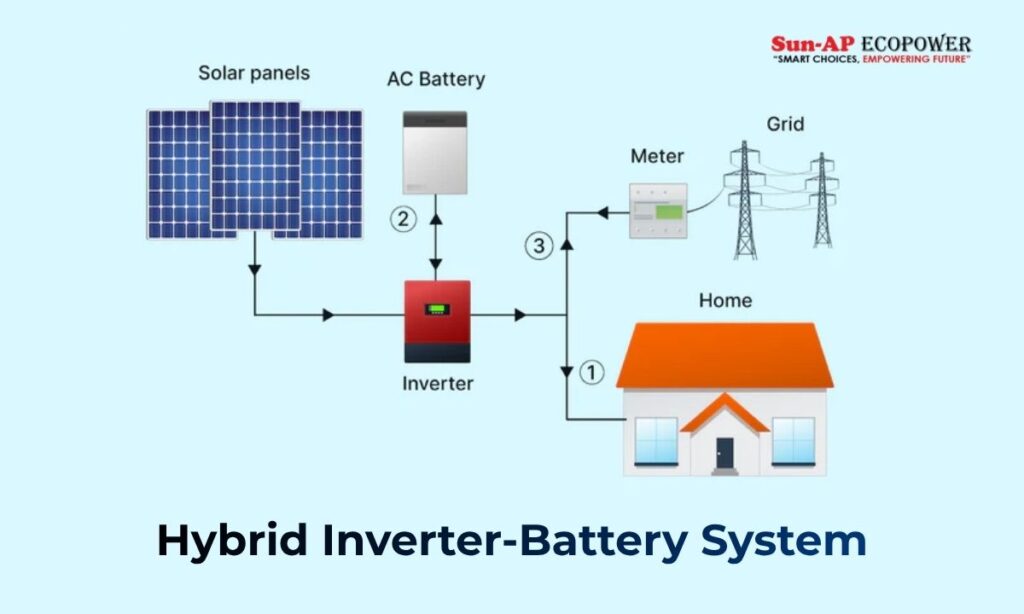
For Indian homeowners seeking a complete, integrated, professionally engineered solution — Sun-AP Ecopower’s exclusive distribution of the Sunpower Renewables Australian-Engineered Hybrid System delivers a ready-to-install battery backup architecture with no compromise on safety or performance.
Key features of this system that make it India’s most compelling battery backup solution:
- BIS (Bureau of Indian Standards) certified — mandatory Indian safety approval
- Smart Battery Management System (BMS) — real-time cell monitoring prevents overcharge, deep discharge, and thermal runaway
- Time-of-Day (ToD) charge/discharge optimization — maximizes battery lifespan and backup availability
- On-grid, off-grid, UPS, and hybrid operating modes — adapts to India’s variable power supply conditions
- Plug-and-play installation design — reduces installation errors and commissioning time
- Solar and EV charging compatible — future-proof energy architecture
- PAN-India stocking and service support through Sun-AP Ecopower’s nationwide network
As Mr. Srinivas Kumar, Managing Director of Sun-AP Ecopower, stated at the system’s Indian launch: “With local support, stocking, and nationwide service readiness, we aim to make advanced storage accessible and dependable for Indian customers — from urban rooftops to remote, high-need applications.”
Step 4: Choose Your Inverter Architecture
Your inverter is the brain of your off-grid or hybrid backup system — managing power flow between panels, batteries, grid, and home loads. Choosing the right inverter architecture is critical to both safety and performance.
String Inverters (Basic On-Grid/Off-Grid)
Traditional string inverters centralize DC-to-AC conversion at a single unit. They are cost-effective for straightforward installations but create high-voltage DC wiring across the rooftop — a safety consideration in off-grid designs.
Sun-AP Ecopower distributes:
- Sungrow On-Grid Inverters — with built-in anti-islanding, overcurrent, temperature, and grid monitoring protection
- Feston On-Grid Inverters — reliable, certified performance for standard residential installations
Enphase Micro-Inverters — The Safest Architecture for Off-Grid Ready Systems
For homeowners who prioritize both safety and maximum system performance, Enphase Micro-Inverters — distributed by Sun-AP Ecopower as an authorized partner — represent the gold standard in residential solar architecture.
Each Enphase microinverter converts DC to AC at the individual panel level, completely eliminating high-voltage DC wiring across the rooftop. The benefits for off-grid and backup planning are substantial:
- No single point of failure — one panel or microinverter issue doesn’t shut down the whole system
- Panel-level monitoring — real-time performance data for every individual panel
- Seamless compatibility with Enphase IQ Battery storage for complete home backup
- Eligible for India’s Suryaghar Scheme government subsidy — reducing your upfront system cost
- Rapid shutdown compliant by design — no additional RSS device required
For a complete off-grid backup solution: Enphase microinverters paired with Enphase IQ Batteries and premium REC or Panasonic panels from Sun-AP Ecopower deliver the most reliable, most monitorable, and most future-proof home backup system available in India today.
Step 5: Design Your System for Indian Climate Conditions
Bangalore’s climate presents specific considerations for off-grid backup system design that distinguish a well-planned system from a poorly conceived one.
Summer (March–May): Peak solar generation, highest AC loads. Your battery cycling will be most intensive during this period — reinforcing the need for a BMS-protected lithium system with proper thermal management.
Monsoon (June–September): Reduced solar generation due to cloud cover — the most challenging period for pure off-grid systems. Hybrid systems with grid connectivity handle this automatically. Pure off-grid systems need 30–40% additional panel capacity and 2–3 days of battery autonomy to maintain backup capability through consecutive cloudy days.
Winter (November–February): Excellent solar generation, reduced AC loads. Battery backup is typically most comfortable during this season.
Design Rule for Bangalore Off-Grid Systems: Size your panels for monsoon generation, not peak summer generation. A system sized for ideal conditions will underperform when you need it most — during extended cloud cover. Add a 25–30% generation buffer to your calculated panel capacity for robust year-round off-grid performance.
Step 6: Safety, Wiring, and Installation Requirements
A correctly planned off-grid system that is incorrectly installed is still a dangerous system. Here are the non-negotiable installation safety requirements for every off-grid backup installation:
Rapid Shutdown Compliance — Every off-grid and hybrid system must include rapid shutdown capability to reduce panel voltage to safe levels during emergencies. Enphase microinverters achieve this by architecture. String inverter systems require a dedicated RSS device.
Earthing and Surge Protection — All metallic components must be properly bonded to earth. Surge Protection Devices (SPDs) must be installed on both DC and AC sides to protect the battery and inverter from lightning-induced voltage spikes.
Battery Enclosure Safety — Lithium-ion batteries must be housed in ventilated, non-combustible enclosures away from heat sources. The Sunpower Renewables system from Sun-AP Ecopower is engineered with appropriate thermal management built in.
CEA Regulation Compliance — All solar installations in India must comply with Central Electricity Authority (CEA) regulations. Use a licensed electrical contractor familiar with CEA solar installation standards.
Net Metering Registration — For hybrid systems, register for net metering with your local DISCOM (BESCOM in Bangalore) to legally export surplus solar power and earn grid credits. Sun-AP Ecopower’s energy meters and net metering solutions are configured for seamless BESCOM compatibility.
Off-Grid System Sizing Summary
| Home Type | Daily Load | Panel Size | Battery Size | Recommended System |
| Essential backup only | ~4 kWh | 1–1.5 kW | 6–8 kWh | Enphase + IQ Battery |
| Medium home (no AC) | ~8.75 kWh | 2–2.5 kW | 10–12 kWh | Sunpower Hybrid System |
| Full home with 1 AC | ~17.75 kWh | 4–5 kW | 20–24 kWh | REC/Panasonic + Sunpower Hybrid |
| Full home with 2 ACs | ~26 kWh | 6–7 kW | 30–36 kWh | Custom design via Sun-AP Ecopower |
Sun-AP Ecopower: Your Complete Off-Grid Backup Power Partner
Planning a reliable off-grid or hybrid backup system requires three things: correct calculations, premium certified components, and an experienced supply partner who stands behind every product they recommend. Sun-AP Ecopower delivers all three.
- India’s most trusted solar products distributor — established 2016, PAN-India reach
- Official authorized distributor of REC, Panasonic, Enphase, Sungrow, Feston, Vikram Solar, and Sunpower Renewables
- Enphase microinverter specialist — authorized promoter, eligible for Suryaghar government subsidy
- Exclusive PAN-India launch partner for Sunpower Renewables hybrid inverter-battery systems
- Complete off-grid solutions — panels, hybrid inverters, battery storage, energy meters, net metering, surge protection, and all BOS (Balance of System) components
- Expanding dealer and sub-dealer network across Karnataka and all of India
Backup Power Planning Checklist
- Daily energy consumption calculated for essential and comfort loads
- Backup duration requirement defined (8 hours / 24 hours / 48 hours)
- Panel array sized for Bangalore’s peak sun hours with monsoon buffer
- Battery capacity sized with correct DoD factoring for lithium chemistry
- Hybrid or pure off-grid architecture selected based on grid reliability needs
- Inverter type selected — Enphase microinverter (safest) or string hybrid inverter
- Surge protection devices specified for DC and AC sides
- Proper earthing and rapid shutdown provisions confirmed
- CEA-compliant installation by licensed electrician confirmed
- Net metering BESCOM registration planned for hybrid systems
- All components carry BIS, IEC, and brand certifications
- Annual maintenance schedule established from day one
Key Insights Worth Saving
- Bangalore’s 5.5 peak sun hours per day make it one of India’s most favorable locations for off-grid solar backup planning — requiring fewer panels to generate a given daily energy output than most other Indian cities
- The Sunpower Renewables hybrid system — exclusively distributed in India by Sun-AP Ecopower — is the only Australian-engineered, BIS-approved hybrid inverter-battery solution in the Indian market, combining international engineering standards with Indian certification compliance
- Enphase microinverters from Sun-AP Ecopower are eligible for India’s Suryaghar Scheme government subsidy — reducing the upfront cost of the safest available inverter architecture
- Sizing panels for monsoon performance rather than peak summer performance is the single most important design decision for reliable year-round off-grid backup in Bangalore’s climate
- REC Alpha Pure R panels distributed by Sun-AP Ecopower carry a 0.25% annual degradation rate — the lowest in the industry — ensuring your backup system maintains near-original generating capacity 20+ years into operation