Solar panels get most of the attention in a solar project, but the inverter decides how well that energy is actually used. When you add a battery, the inverter takes on an even bigger role: it converts power, charges and discharges the battery, manages grid interaction and keeps critical loads running during outages.
For homeowners, businesses and developers across India, a solar inverter with a battery has become a practical answer to unreliable grid supply, rising tariffs and the desire for energy independence.
This guide covers how these systems work, the main types of solar inverters, the benefits, the key factors to consider before buying, and how to choose a reliable supplier, whether you are comparing options in a showroom or searching for a solar inverter online.
What Is a Solar Inverter with a Battery?
A solar inverter with a battery is a system in which the inverter is connected to both your solar panels and a battery bank. Panels produce direct current (DC) electricity. Household and commercial appliances run on alternating current (AC). The inverter performs the conversion, and in a battery-based setup it also decides where each unit of energy goes:
- To your appliances first
- To the battery for storage when there is surplus
- To the grid (where export is permitted) once the battery is full
- From the battery or grid when solar generation is low
This intelligent routing is what separates a modern battery-ready inverter from a basic grid-tied unit.
How the System Works
During the day, solar panels generate power and feed the inverter. The inverter supplies your loads and directs extra energy into the battery. In the evening or during a power cut, the inverter draws from the battery to keep selected loads running. If the battery is depleted and solar is unavailable, the system can draw from the grid, or from a generator in some setups.
A charge controller, either built into the inverter or installed separately, protects the battery from overcharging and deep discharge. Most modern inverters use Maximum Power Point Tracking (MPPT) to extract the highest possible output from the panels under changing sunlight conditions.
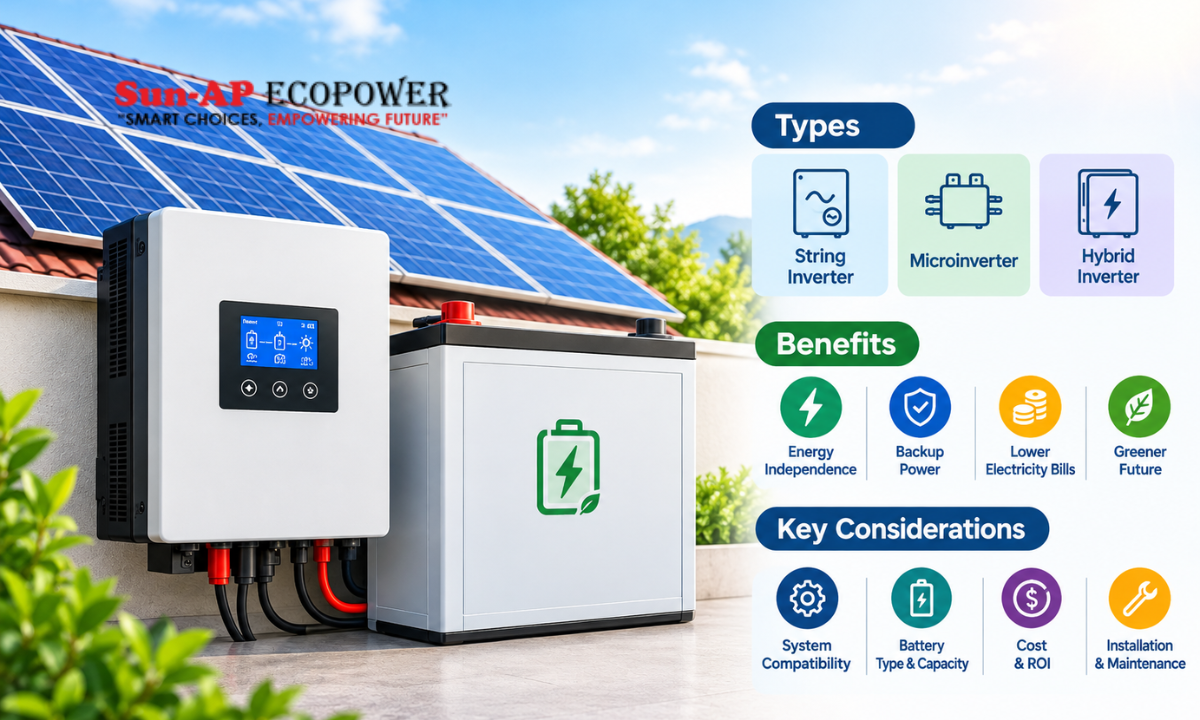
Types of Solar Inverters with Battery Support
Not all solar inverters are designed to work with batteries. The right choice depends on your grid reliability, goals and budget.
1. Off-Grid Solar Inverters
Off-grid inverters operate independently of the utility network. They are used in remote locations, farms, telecom sites and homes without reliable grid access. The system relies entirely on solar panels, batteries and sometimes a backup generator.
- Best for: locations with no grid or very poor grid supply
- Key point: battery capacity must be sized carefully to cover nights and cloudy days
2. Hybrid Solar Inverters
A hybrid inverter combines the functions of a grid-tied and an off-grid inverter. It connects to panels, batteries and the grid at the same time, and can switch between sources automatically. Hybrid solar inverters are among the most popular choices for homes and small businesses that face frequent outages but still want grid connectivity.
- Best for: users who want backup power, bill savings and flexibility
- Key point: some models allow you to add a battery later, which makes phased investment possible
3. Battery-Ready (Grid-Tied) Inverters
Some on-grid inverters are designed so that a compatible battery can be added later. They offer lower upfront cost than a full hybrid system, though features and backup capability depend on the model.
4. Microinverters and Battery-Coupled Systems
Microinverters sit behind individual panels. In some designs, AC-coupled batteries are added alongside them. These suit roofs with partial shading or complex layouts, though the overall system cost and design considerations differ from string-based solutions.
5. Solar Inverters by Phase
- Single-phase: suitable for most homes and small shops
- Three-phase: suited to larger homes, commercial establishments and industrial loads
Check your electricity connection type before selecting a model, since a mismatch can limit performance.
Understanding Battery Types
The battery you pair with your inverter affects cost, lifespan and maintenance.
Lead-acid batteries (tubular, flooded or VRLA/gel):
Lower upfront cost and widely available. They need periodic maintenance (in flooded types), have a shorter cycle life, and are usually discharged to a limited depth to preserve life.
Lithium-ion and lithium iron phosphate (LiFePO4) batteries:
Higher upfront cost but deeper usable capacity, longer cycle life, higher efficiency, lighter weight and low maintenance. Many buyers find the total cost of ownership favorable over time.
Always verify that the inverter supports the battery chemistry and voltage you plan to use. Compatibility with the battery management system (BMS) is particularly important for lithium batteries.
Key Benefits of a Solar Inverter with Battery
Backup During Power Cuts
The most immediate benefit is continuity. Lights, fans, refrigerators, routers, and in larger systems, air conditioners or machinery, can keep running when the grid fails.
Higher Self-Consumption of Solar Energy
Without storage, surplus solar power is exported or wasted. With a battery, you store daytime generation and use it after sunset, increasing the share of solar energy you consume directly.
Reduced Electricity Bills
By using stored solar energy in the evening, when household demand is often high, you reduce grid purchases. In regions with time-of-day tariffs, shifting consumption away from peak-rate periods can add further savings.
Energy Independence
Battery systems reduce your dependence on grid stability and give you more control over how and when you use power.
Protection for Sensitive Equipment
Voltage fluctuations and sudden outages can damage electronics. A battery-backed system offers smoother power delivery for computers, medical devices and networking equipment.
Support for Future Expansion
Many hybrid platforms can scale by adding panels or battery capacity later, including support for electric vehicle charging as your needs grow.
Key Considerations Before Buying
1. Load Assessment
List the appliances you want to run on backup, their wattage and expected hours of use. This determines inverter capacity and battery size. Account for starting surge, since motors, pumps and air conditioners draw much higher current when they start.
2. Inverter Capacity and Panel Compatibility
Choose an inverter that matches your panel array’s voltage and current range. A wider MPPT voltage window and multiple MPPT inputs offer flexibility for different roof orientations.
3. Efficiency
Higher conversion efficiency means less energy lost as heat. Look at both peak and weighted efficiency figures on the datasheet.
4. Battery Capacity and Depth of Discharge
Battery capacity (in kWh or Ah) and usable depth of discharge decide how long you can run backup loads. A bigger battery gives longer autonomy but raises cost.
5. Protection Features
Look for overload, short-circuit, over-temperature, reverse polarity, surge and anti-islanding protection where grid-connected. These safeguard both equipment and people.
6. Monitoring and Connectivity
Wi-Fi or app-based monitoring lets you track generation, battery state of charge, consumption and faults. Remote visibility helps you detect problems early.
7. Grid and Net Metering Compatibility
Regulations vary by state and DISCOM. If you plan to export power, confirm that the inverter meets local technical requirements and that net metering is available for battery-integrated systems in your area.
8. Warranty and Service
Check the warranty on both the inverter and the battery. Ask about service coverage, response time and spare parts. A strong warranty is only useful if the support network behind it is dependable.
9. Installation Environment
Inverters and batteries perform best in ventilated, dry, temperature-controlled spaces. Heat shortens battery life, so placement matters.
10. Total Cost of Ownership
Compare not only the purchase price but also battery replacement cycles, maintenance and efficiency over the system’s life.
What to Check Before Buying Solar Inverters Online
Many buyers now prefer to buy a solar inverter online because of easy comparison, transparent specifications and convenient delivery. To buy confidently:
- Verify authenticity: Buy only from sellers that clearly state brand authorization and provide warranty documentation.
- Review the datasheet: Match the listed model number, capacity and specifications with the manufacturer’s documentation.
- Check compatibility: Confirm voltage, battery type and phase requirements before ordering.
- Understand delivery and installation: Ask whether installation support is available or whether you need a separate installer.
- Confirm after-sales support: Know who handles warranty claims and how to reach them.
- Compare total value: Factor in shipping, installation and support, not just the listed price.
A reliable online platform should offer clear product information and responsive pre-sales guidance, since inverter selection often needs technical input.
How to Choose Reliable Solar Product Dealers in India
The market includes manufacturers, distributors and a wide range of resellers, so supplier quality varies. When shortlisting solar product dealers in India, consider:
- Authorization: Authorized dealers provide genuine products and valid manufacturer warranty.
- Technical expertise: They should assess your load, roof and goals before recommending a solar inverter.
- Product range: Access to solar inverters, batteries, panels, metering and protection devices from compatible sources simplifies procurement.
- Transparent pricing: Itemized quotations with clearly stated inclusions help you compare offers fairly.
- Installation and service support: Trained installers and accessible service teams reduce downtime.
- Experience and references: Past projects and customer feedback offer practical proof of reliability.
Common Mistakes to Avoid
- Buying an undersized inverter that trips under load
- Overlooking surge requirements for motor-driven appliances
- Choosing batteries without checking compatibility with the inverter
- Focusing only on the lowest price
- Ignoring warranty terms and service availability
- Installing batteries in hot or poorly ventilated spaces
- Skipping local approval requirements for grid-connected systems
Maintenance Tips
- Keep inverter vents and surroundings clean and unobstructed
- Check connections and cabling periodically
- Monitor battery health and state of charge through the app or display
- Clean solar panels regularly to maintain generation
- Schedule professional inspection at regular intervals
Good maintenance extends system life and helps you get the performance you paid for.
Final Thoughts
A solar inverter with a battery turns a solar installation into a dependable, flexible power system. By understanding the types of solar inverters available, such as off-grid, hybrid and battery-ready models, and matching them with the right battery technology, you can build a setup that fits your consumption pattern, budget and backup needs.
The decision does not end with choosing a model. Careful load assessment, attention to specifications, awareness of local regulations and a trustworthy supplier all shape the long-term outcome of your solar project.
If you are ready to explore solar inverters online or want guidance from dependable solar product dealers in India, visit Sun-AP Eco Power to browse solar solutions suited to your home, business or project.