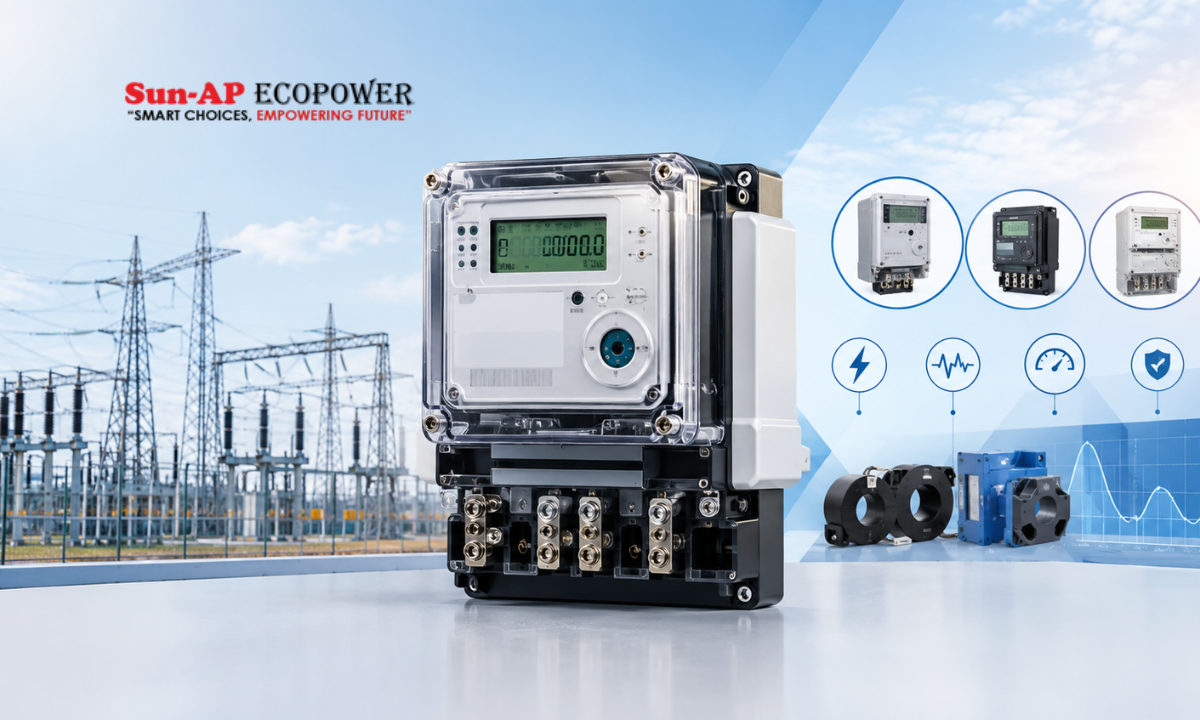
Industrial plants, large commercial complexes, solar power projects and institutional campuses all draw or generate power at high voltage. Measuring that energy accurately is a technical and financial necessity, because the reading on the meter decides your electricity bill, your export credits and your compliance status. This is where HT (High Tension) meters come in.
This guide explains what HT meters are, how the main types differ, where each is used, and which features to evaluate before buying. It also covers how to choose a supplier, whether you are a buyer, an EPC contractor or a business looking at HT meters distributors in India.
What Is an HT Meter?
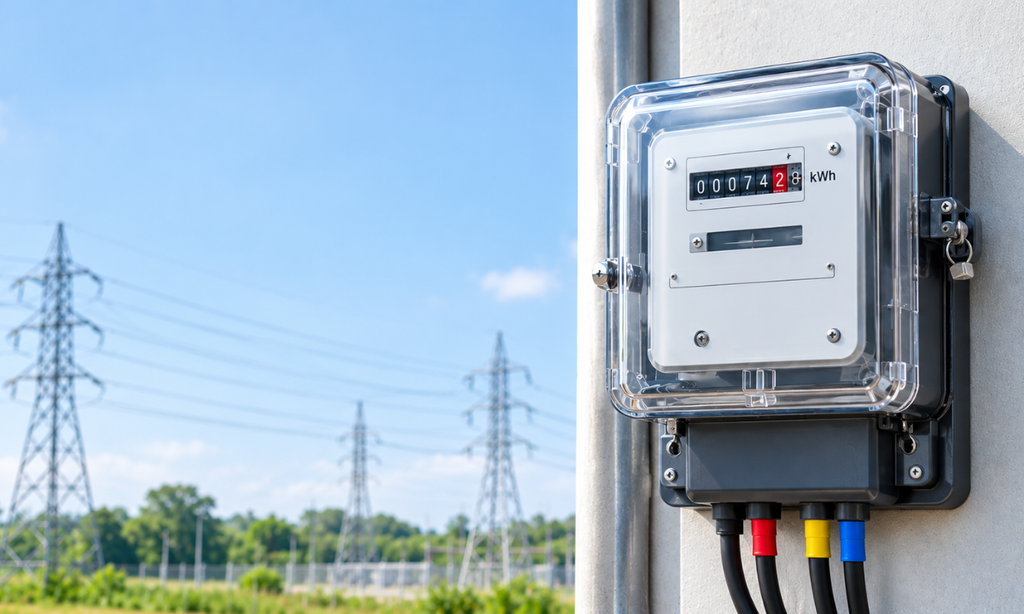
An HT meter is an energy meter designed for high-voltage electricity connections, typically 11 kV, 22 kV, 33 kV and above. Connections at these voltages carry large loads, so the meter cannot be wired directly to the line. Instead, it works with two instrument transformers:
- Current Transformer (CT): steps down high line current to a low, standard value (commonly 1 A or 5 A) that the meter can read.
- Potential Transformer (PT) or Voltage Transformer (VT): steps down high line voltage to a safe, measurable level, commonly 110 V.
The meter applies the programmed CT and PT ratios to calculate actual consumption. Because of these multipliers, even a small measurement error is magnified in the billed energy, so accuracy and reliability matter far more than they do for a household meter.
Why HT Metering Needs Special Attention
HT consumers usually have high monthly bills, so billing disputes can involve large sums. Many HT tariffs are also based on more than units consumed. They can include maximum demand charges, power factor incentives or penalties, and time-of-day pricing. An HT meter must therefore record several parameters at once, not just kilowatt-hours.
For solar and captive power projects, HT meters are also used for import-export measurement, which determines how much energy is supplied to the grid and how much is drawn from it. For these reasons, buyers increasingly look for secure HT meters that resist tampering, protect recorded data and comply with national standards.
Main Types of HT Meters
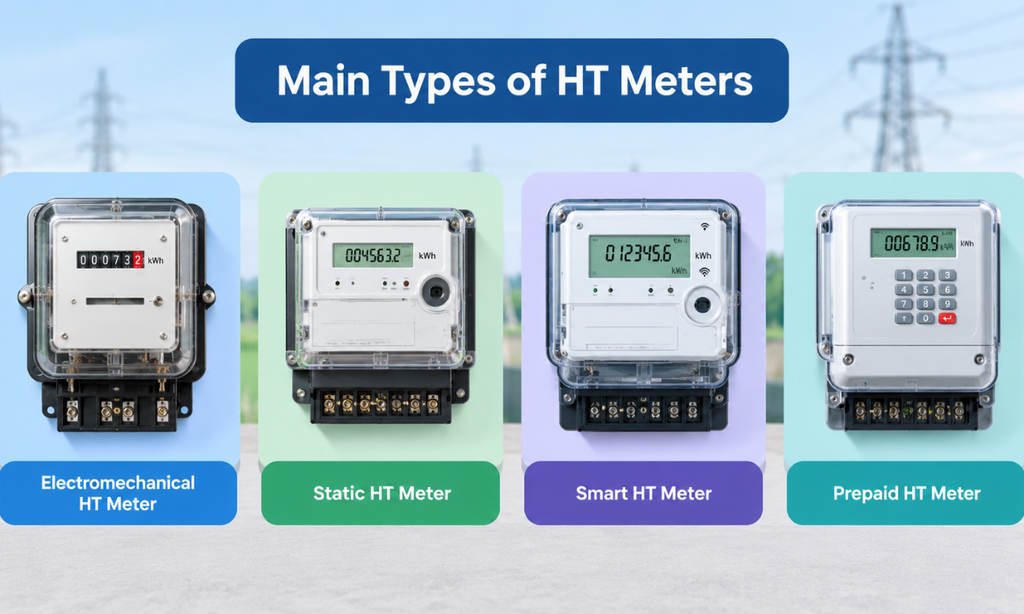
HT meters can be classified by technology, function and communication ability.
1. Electromechanical HT Meters
These older meters use a rotating aluminum disc driven by electromagnetic force. They are largely obsolete for new HT connections because they offer limited accuracy, cannot record advanced parameters and are easier to tamper with. You may still encounter them in legacy installations, but most utilities have moved to electronic alternatives.
2. Static (Electronic) HT Meters
Static meters use solid-state electronics and a digital processor to measure energy. They have no moving parts, which improves accuracy and long-term stability. Most modern HT meters fall in this category. They usually record multiple parameters such as active energy (kWh), apparent energy (kVAh), reactive energy (kVArh), demand and power factor.
3. Trivector Meters
A trivector meter measures three quantities simultaneously: active, reactive and apparent energy. It also records maximum demand, which is why it has long been used for HT industrial and commercial billing. Many utilities still specify trivector functionality as a baseline for HT consumers.
4. Special Energy Meters (SEM) and ABT-Compliant Meters
These are used where precise, time-block-based measurement is needed, such as at generating stations, inter-utility boundary points and large open-access consumers. They record energy in short intervals, commonly 15-minute blocks, and support scheduling and settlement mechanisms such as Availability Based Tariff (ABT).
5. Bidirectional (Import-Export) HT Meters
Solar plants, captive generators and industries with on-site generation need meters that measure energy flowing in both directions. A bidirectional meter records import and export separately, so net energy and billing can be settled accurately. This is a key requirement for HT consumers adopting rooftop or ground-mounted solar systems.
6. Smart and AMR-Enabled HT Meters
Smart HT meters include communication modules that let utilities and consumers read data remotely. Automatic Meter Reading (AMR) reduces manual reading errors, supports faster billing and enables real-time monitoring of load patterns. Communication options typically include GSM/GPRS, RF, Ethernet or RS-485, along with an optical port for local data download.
7. Prepaid and Advanced Metering Variants
Some utilities and large campuses use prepaid or advanced metering infrastructure (AMI) arrangements for HT connections. These allow consumption control, balance monitoring and integration with energy management systems.
Classification by Accuracy Class
Accuracy class defines how closely the meter reading matches true consumption. For HT applications, two classes are most common:
- Class 0.5S: widely used for HT consumer metering.
- Class 0.2S: a higher accuracy class used for large consumers, generation points and boundary metering where even minor errors carry significant financial value.
The “S” indicates accuracy performance across a wide range of loads, including low-load conditions, which is important for solar and variable-load installations. Always confirm the required class with your DISCOM or utility before purchase, since requirements vary by consumer category and connection level.
Classification by Connection Type
- 3-phase 3-wire (3P3W): generally used where the neutral is not available, often in 11 kV and higher HT systems.
- 3-phase 4-wire (3P4W): used where a neutral is present, offering measurement of all three phases independently.
Selecting the wrong connection configuration can lead to incorrect readings, so this should be confirmed during planning.
Key Applications of HT Meters
Industrial consumers:
Manufacturing units, steel plants, textile mills and process industries use HT meters for energy billing, demand management and power factor monitoring.
Commercial and institutional complexes:
Malls, hospitals, data centers, universities and large office parks use HT supply to meet high loads and rely on accurate metering for cost allocation.
Solar power plants and captive generation:
Ground-mounted solar projects, open-access and captive systems use HT meters to measure generated, exported and imported energy at the grid interface point.
Utility boundary and feeder metering:
Distribution companies use HT meters for feeder monitoring, energy accounting and loss analysis at substations.
Open access and group captive consumers:
Time-block recording and data logging support scheduling, settlement and regulatory reporting.
Key Features to Consider Before Buying
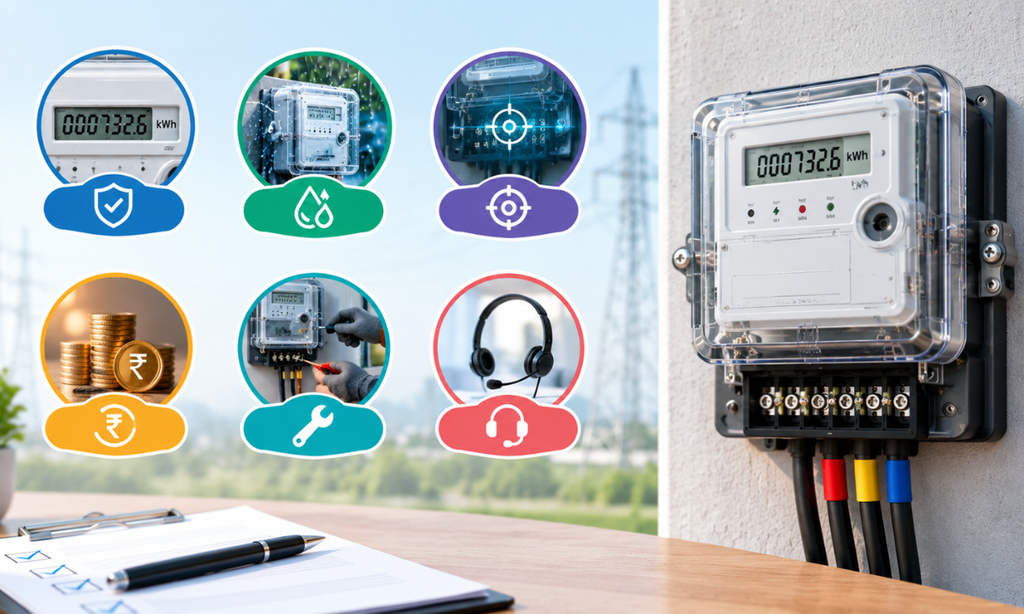
Evaluating HT meters on price alone is risky. These factors deserve closer attention.
Accuracy and Standards Compliance
Check that the meter conforms to relevant Indian and international standards, such as IS 14697 for static transformer-operated meters and applicable IEC standards, along with CEA metering regulations. Ask for type test reports from recognized laboratories. DISCOM approval for specific models may also be required.
Multi-Parameter Measurement
Look for a meter that measures kWh, kVAh, kVArh, kW and kVA demand, power factor, voltage, current and frequency. The ability to record import and export separately is essential for solar installations.
Tamper Detection and Security
Secure HT meters protect against energy theft and data manipulation. Useful security features include:
- Detection and logging of CT/PT open or short circuits, phase failure and reversal
- Magnetic and external field tamper detection
- Cover-open and terminal-cover event recording
- Secure sealing provisions and password-protected configuration
- Encrypted or authenticated data communication
Event logs with date and time stamps give both consumers and utilities a reliable audit trail.
Load Profile and Data Storage
Meters should store load profile data at configurable intervals, and retain billing history across several months. Adequate memory and non-volatile storage ensure data is not lost during power interruptions.
Time-of-Day (ToD) Capability
Many tariffs vary by time slot. A meter with multiple programmable ToD registers lets you track consumption in peak and off-peak periods and optimize operations accordingly.
Communication and Interoperability
Check available communication ports and protocols. Support for open protocols such as DLMS/COSEM makes integration with utility billing and energy management systems easier. Remote reading capability can significantly reduce manual intervention and billing delays.
Display and Usability
A clear display that cycles through billing parameters, along with push-button access to instantaneous values, simplifies on-site verification.
Build Quality and Environmental Protection
HT meters often operate in demanding environments. Look for robust enclosures, suitable ingress protection (IP) ratings, wide operating temperature range and good electromagnetic compatibility. A long service life with minimal drift reduces recalibration costs.
Battery Backup and Real-Time Clock
A reliable internal real-time clock with backup ensures timestamps and ToD calculations stay accurate through outages.
How to Choose a Reliable Supplier

The meter is only part of the equation. The supplier influences product authenticity, technical support and delivery timelines. When evaluating HT meters distributors in India, consider the following:
- Authorization: Confirm the distributor is authorized by the manufacturer and can provide genuine products with valid warranty.
- Documentation: Ask for test certificates, calibration reports, datasheets and compliance documents.
- Technical support: A good distributor helps with CT/PT ratio selection, programming, commissioning guidance and troubleshooting.
- Utility approval knowledge: Familiarity with DISCOM specifications and approval processes saves time and avoids rejected installations.
- Availability and logistics: Stock availability and reliable delivery matter, especially for project timelines.
- After-sales service: Check warranty terms, repair turnaround and software or communication support.
For buyers sourcing across categories, working with experienced solar product dealers in India can simplify procurement, since solar installations often require inverters, panels, protection devices and metering from compatible and verified sources.
Common Mistakes to Avoid
- Choosing a meter without confirming DISCOM-approved make and specification
- Ignoring the required accuracy class for your connection category
- Overlooking CT/PT ratio compatibility, which can cause billing errors
- Selecting unbranded meters without test certification
- Neglecting communication needs, leading to manual data collection later
- Skipping tamper and data security features to save cost
Final Thoughts
HT meters sit at the point where electricity is measured, billed and settled, so choosing the right one has direct financial and operational consequences. Understanding the differences between static, trivector, bidirectional and smart meters, along with accuracy classes, connection types and security features, helps you match the meter to your application.
Equally important is the supplier. A knowledgeable partner who provides certified products, technical guidance and dependable support can make the difference between a smooth installation and costly delays.
If you are looking for a reliable distributor in India or exploring options from trusted solar product dealers in India, visit Sun-AP Eco Power to explore solar and power solutions suited to your project needs.