Selecting the appropriate solar module is the single most critical engineering decision determining the 25-year energy yield, financial return, and structural safety of a photovoltaic installation.
Across commercial, industrial, and residential projects, treating solar procurement as a generic, one-size-fits-all transaction frequently leads to premature degradation, severe thermal clipping, and structural mismatch. Leading Solar panel distributors in India emphasize that a module’s real-world power generation depends on how its semiconductor architecture, encapsulation materials, and mechanical ratings interact with local climatic stressors and specific roof substrates.
India’s geographic and architectural diversity presents a wide spectrum of operating environments.
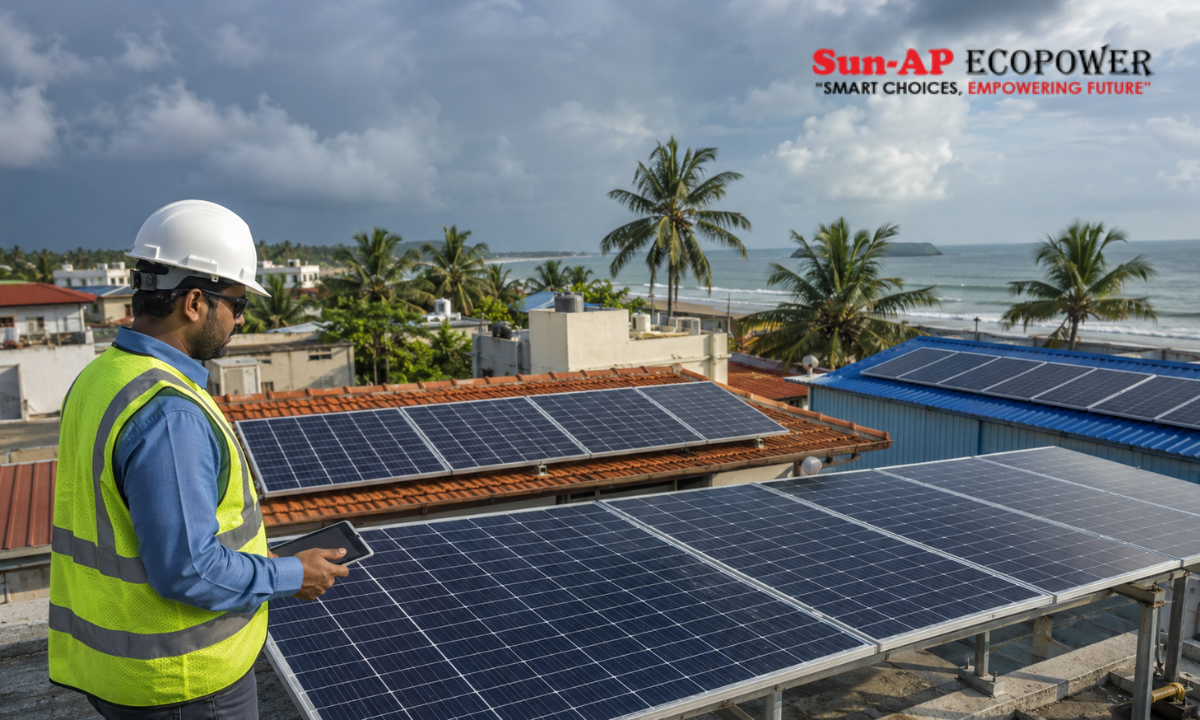
A rooftop installation on a coastal chemical facility in Gujarat faces extreme ambient heat, airborne salinity, and corrosive gases, whereas a manufacturing plant in Bengaluru or Pune contends with seasonal cloud cover, moderate temperatures, and standing-seam metal roofs.
SITE-SPECIFIC SELECTION CRITERIA
Climatic Stressors ➜ Ambient heat, humidity, salinity, albedo
Roof Topologies ➜ RCC slabs, trapezoidal/metal, clay tiles
Cell Architectures ➜ Mono PERC, N-Type TOPCon, HJT, Bifacial
Lifecycle Objective ➜ Lowest Levelized Cost of Energy (LCOE)
Failing to match the module type to these localized parameters creates several performance risks:
- Thermal Yield Mismatch: Installing high-temperature-coefficient panels in arid, high-heat zones causes severe midday voltage drops, reducing energy yield when power tariffs are highest.
- Corrosive Degradation & Delamination: Standard backsheet modules installed in coastal or chemical belts often suffer accelerated moisture ingress and Potential-Induced Degradation (PID).
- Structural & Mechanical Overloading: Deploying heavy, large-format commercial modules on older structural metal trusses without checking wind uplift ratings risks mechanical racking failure.
- Albedo Loss on Concrete Surfaces: Overlooking rear-side irradiance on white concrete flat roofs forfeits significant generation gains available from advanced cell designs.
A systematic site-assessment framework ensures that every solar installation generates optimal kilowatt-hours per square meter while withstanding localized environmental stresses over its operational lifecycle.
Decoding Solar Cell Technologies: Monocrystalline vs. Next-Gen Architectures
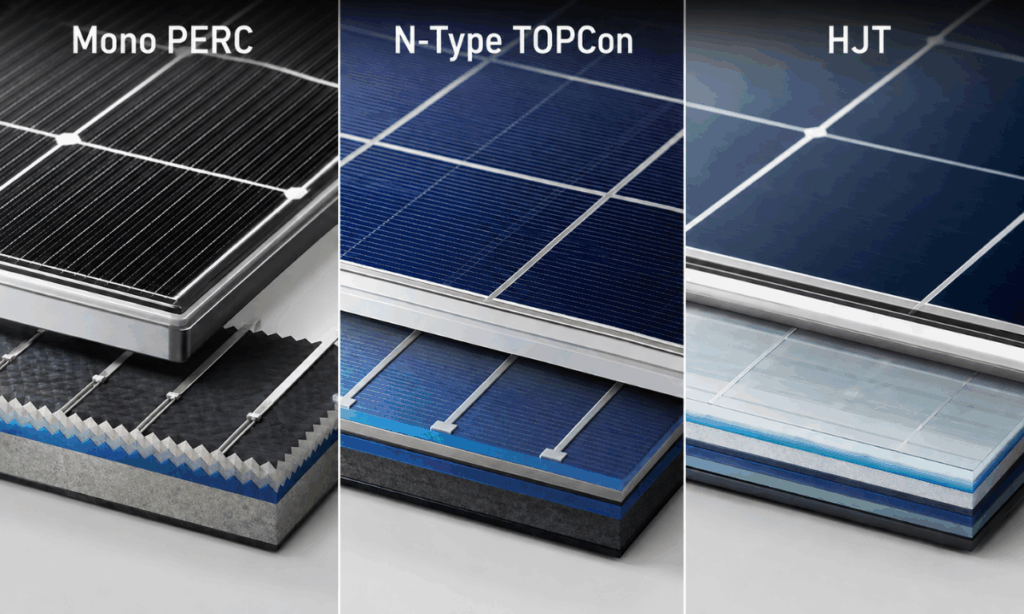
Understanding the underlying silicon chemistry and cell design is the foundation of effective hardware selection.
Modern crystalline solar modules are categorized by wafer doping (P-type vs. N-type), manufacturing crystal structures, and internal surface passivation layers. Sifting through the various types of solar modules and types of solar panels allows system designers to balance initial capital outlay against long-term conversion efficiency and degradation rates.
Silicon cell development is defined by three primary commercial technologies:
1. P-Type Monocrystalline Modules (Mono PERC)
Passivated Emitter and Rear Cell (PERC) technology utilizes single-crystal silicon ingots doped with boron. Modern monocrystalline solar modules incorporate a dielectric passivation film on the cell’s rear surface, which reflects unabsorbed photons back through the active silicon wafer for a secondary absorption opportunity.
- Efficiency & Rating: Mainstream commercial efficiencies range from 20.5% to 21.6%, with module capacities spanning 450Wp to 550Wp.
- Cost-to-Performance Value: As a mature technology with fully amortized manufacturing lines, Mono PERC offers a low initial capital cost per watt.
- Operational Drawbacks: Boron-doped wafers remain susceptible to initial Light-Induced Degradation (LID) and carry higher negative temperature coefficients (-0.35% to -0.38%/°C).
While Mono PERC remains a dependable option for budget-conscious projects with ample roof space, its efficiency ceiling has led leading developers to adopt N-type alternatives.
2. N-Type TOPCon (Tunnel Oxide Passivated Contact)
TOPCon technology replaces boron doping with phosphorus-doped N-type silicon wafers. The architecture incorporates an ultra-thin tunnel oxide layer paired with a doped polycrystalline silicon layer on the rear surface, virtually eliminating surface electron recombination.
- Commercial Conversion Efficiency: Achieves 22.0% to 23.2%+, with power outputs reaching 580Wp to 620Wp+ in standard 144-half-cut formats.
- Negligible LID & Slower Degradation: Phosphorus doping prevents boron-oxygen defects, keeping Year 1 degradation below 1.0% and annual linear decay at approximately 0.40%.
- Superior Temperature Stability: Lower negative temperature coefficients (-0.29% to -0.30%/°C) minimize power drop-offs during hot summer operating windows.
By delivering 3% to 6% higher lifetime energy yield per installed kilowatt-peak than legacy PERC systems, N-Type TOPCon has become the standard for space-constrained commercial and industrial rooftops.
3. Heterojunction Technology (HJT)
Heterojunction modules combine monocrystalline N-type silicon wafers with ultra-thin amorphous silicon (a-Si) thin-film layers deposited on both front and rear surfaces. This hybrid architecture creates a seamless passivating heterojunction that achieves high open-circuit voltages (Voc).
- Maximum Power Density: Delivers commercial efficiencies of 22.5% to 24.0%, making it the highest-density silicon technology available.
- Lowest Thermal Coefficient: Features an industry-leading temperature coefficient of -0.24% to -0.26%/°C, maintaining superior output under high ambient temperatures.
- Symmetrical Bifaciality: Produces >85% to 92% rear-side generation, capturing maximum reflected albedo light.
For high-tariff facilities operating in extreme ambient heat with strictly limited rooftop space, HJT delivers the highest specific energy density available in commercial solar technology.
Cell Technology Comparison
| Engineering Parameter | P-Type Mono PERC | N-Type TOPCon | N-Type Heterojunction (HJT) |
|---|---|---|---|
| Wafer Base / Doping | P-Type (Boron-doped) | N-Type (Phosphorus-doped) | N-Type (Phosphorus) + a-Si |
| Commercial Module Efficiency | 20.0% – 21.6% | 22.0% – 23.2% | 22.5% – 24.0% |
| Temperature Coefficient (Pmax) | -0.35% to -0.38%/°C | -0.29% to -0.30%/°C | -0.24% to -0.26%/°C |
| Bifaciality Factor | 65% – 70% | 80% – 85% | 85% – 92% |
| Year 1 Degradation | ~ 2.0% | ≤ 1.0% | ≤ 1.0% |
| Annual Linear Degradation | ~ 0.55% / year | ~ 0.40% / year | ~ 0.25% – 0.30% / year |
| Optimal Application Fit | Unconstrained Ground Mounts | C&I Rooftops & Metal Sheds | High-Heat Zones & Finite Space |
Selecting the optimal cell platform requires analyzing available surface area, regional temperatures, and surface reflectivity to maximize generation economics over the installation’s 30-year operational life.
Matching Solar Modules to Regional Climates & Environmental Stressors

India spans multiple distinct microclimates from the arid heat of Rajasthan to the humid coastal corridors of Tamil Nadu, Maharashtra, and Kerala. Selecting modules based purely on Standard Test Conditions (25°C cell temperature) causes significant forecasting errors because real-world cell temperatures routinely reach 50°C to 65°C.
REGIONAL CLIMATIC DEPLOYMENT GUIDE
Arid / High-Heat Zones ➜ N-Type TOPCon/HJT + Low Temp Coeff
Coastal / Marine Belts ➜ Dual-Glass + IEC 61701 Salt Mist Cert
Industrial Corridors ➜ POE Encapsulation + IEC 62716 Ammonia
Monsoon / High Cloud ➜ High Low-Light Irradiance Sensitivity
Engineering teams must design for four primary environmental operating environments:
1. High-Heat and Arid Operating Environments (Western & Central India)
In regions such as Rajasthan, Gujarat, and interior Maharashtra, summer ambient temperatures frequently exceed 42°C, pushing rooftop module temperatures above 65°C.
- Temperature Coefficient Impact: Standard P-type modules losing -0.38%/°C shed over 15.2% of their rated capacity at 65°C. Switching to N-type modules (-0.29%/°C) reduces thermal loss to 11.6%, preserving valuable peak generation.
- Thermal Dissipation Design: Systems in high-heat zones require elevated mounting clearances (150mm to 200mm) above the roof surface to promote convection airflow and passive cooling.
Deploying N-type semiconductor architectures with lower temperature coefficients preserves daytime generation when industrial air conditioning and manufacturing loads peak.
2. Coastal and High-Humidity Corridors (Marine Belts)
Installations located within 20 kilometers of the coastline (e.g., Chennai, Kochi, Mumbai, Visakhapatnam) face continuous exposure to airborne salinity, morning moisture, and cyclical maritime winds.
- Dual-Glass Packaging: Dual-glass modules replace porous polymer backsheets with semi-tempered glass on both sides, providing a barrier against moisture ingress and electrochemical corrosion.
- Corrosion Certification: Specify modules certified under IEC 61701 (Salt Mist Corrosion Testing, Severity Level 6), paired with anodized aluminium frames possessing a minimum coating thickness of 15 microns.
Specifying dual-glass encapsulation and marine-grade anodized frames prevents moisture ingress and eliminates structural corrosion in coastal installations.
3. Industrial and Chemical Zones (Manufacturing Hubs)
Manufacturing clusters with on-site chemical processing, textile dyeing, or agricultural fertilizer units release ammonia, sulfur dioxide, and airborne particulates that accelerate material decay.
- Chemical Resistance Standards: Modules must hold IEC 62716 (Ammonia Corrosion Testing) certification to ensure junction boxes, bypass diodes, and edge seals resist chemical degradation.
- PID Resistance with POE Encapsulation: High-voltage strings (1500V) in humid industrial air risk Potential-Induced Degradation. Modules utilizing Polyolefin Elastomer (POE) encapsulants offer superior volume resistivity compared to standard EVA films, preventing leakage currents.
Utilizing chemical-resistant POE encapsulation protects high-voltage strings against leakage currents and insulation breakdown in contaminated industrial atmospheres.
4. High-Rainfall and Diffused-Light Belts (Monsoon Corridors)
Regions experiencing extended monsoon seasons or heavy seasonal cloud cover require modules capable of converting low-intensity and scattered light.
- Low-Irradiance Performance: N-type cells maintain linear electron flow at weak irradiance levels (down to 200 W/m²), generating usable power during overcast mornings and rainy afternoons.
- Anti-Reflective Hydrophobic Glass: High-transmittance glass treated with anti-reflective and hydrophobic coatings facilitates natural self-cleaning during rain showers, minimizing particulate accumulation.
Selecting modules with advanced low-light spectral response ensures consistent power generation during monsoon seasons and hazy winter mornings.
Roof Substrates & Structural Dynamics: Concrete RCC, Metal Sheds & Tiles
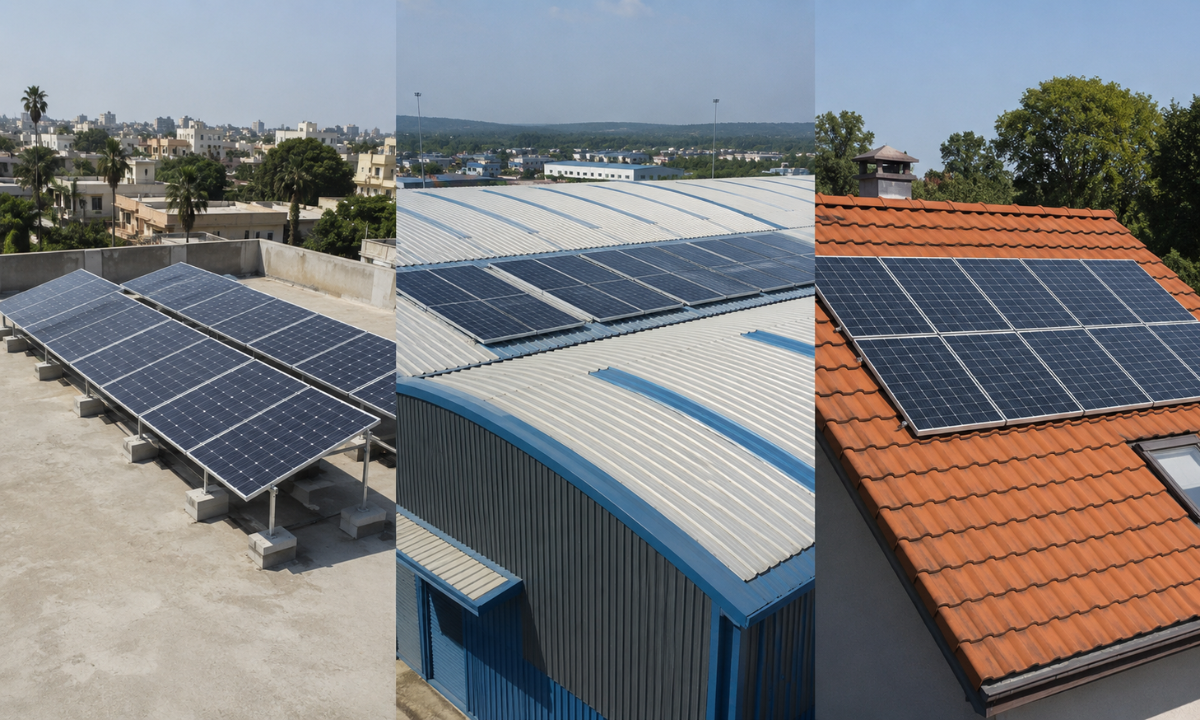
A solar module’s mechanical design must match the physical characteristics, load-bearing capacity, and optical properties of the roof substrate. Mismatched mechanical attachments or improper weight distributions can cause roof leaks, frame warping, or structural failures during storm events.
Selecting hardware across three common commercial and residential roof substrates requires specific structural configurations:
1. Flat Concrete RCC Roofs: Maximizing Bifacial Light Harvesting
Reinforced Cement Concrete (RCC) roofs are standard across commercial office parks, institutional facilities, and residential multi-dwellings in India.
- Unlocking Bifacial Performance: Flat concrete roofs provide an ideal surface for bifacial solar modules. Painting the concrete slab white or applying a high-albedo cool-roof coating (>60% solar reflectance) allows the rear side of bifacial modules to capture reflected irradiance, increasing total energy yield by 10% to 25%.
- Mounting Geometry: To optimize rear-side light harvesting, install modules with an elevated clearance (0.5m to 1.0m above the roof) at a fixed tilt angle of 10° to 15°.
- Ballasted vs. Anchored Racking: Concrete roofs allow for precast concrete ballasted foundations, avoiding roof perforations and preserving structural waterproofing membranes.
Elevating bifacial modules over reflective concrete surfaces significantly boosts specific generation per kilowatt-peak without requiring mechanical roof penetrations.
2. Industrial Metal Sheet Sheds (Trapezoidal & Standing Seam)
Manufacturing plants and logistics warehouses typically feature large-span metal roofs constructed from corrugated or standing-seam sheet profiles.
- Weight Distribution & Module Form Factor: Large commercial modules (580Wp+) weigh between 28 kg and 33 kg. Structural assessments must verify that the existing purlins and roof trusses can support the combined dead load of panels, mounting rails, and potential wind uplift (2400 Pa).
- Non-Penetrating Clamp Solutions: For standing-seam profiles, use certified non-penetrating aluminium standing-seam clamps to preserve roof integrity and prevent water leakage during monsoons.
- Thermal Clearance on Metal Decks: Metal sheets reach high surface temperatures under direct sunlight. Ensure a minimum ventilation gap of 100mm between the sheet and module frame to prevent heat buildup.
Using engineered non-penetrating clamps and maintaining proper ventilation gaps preserves shed waterproofing while preventing thermal heat traps beneath the array.
3. Sloped Clay Tiled and Residential Roofs
Sloped tiled roofs found on residential villas and heritage commercial properties require hardware engineered for ergonomics and structural care.
- Compact Form Factors: Smaller 108-half-cut or 120-half-cut modules (400W–450Wp, weighing ~21 kg) are easier to handle manually on steep slopes and distribute point loads evenly across wooden or light-steel rafters.
- Specialized Tile Hook Fasteners: Stainless steel tile hooks (SUS304) slip underneath overlapping tiles to anchor into structural rafters, preventing tile cracking.
Deploying compact, lightweight modules with rafter-anchored brackets prevents tile breakage and maintains structural balance across sloped residential roofs.
Tier-1 Hardware Reliability: The Panasonic Engineering Standard
For multi-kilowatt commercial arrays and high-reliability residential systems, component bankability and manufacturing consistency are as crucial as nameplate efficiency. Tier-1 manufacturers undergo rigorous third-party audits, maintain automated cell-sorting lines, and provide fully backed warranties supported by decades of field operations.
Sourcing authentic Panasonic solar panels through authorized distribution channels ensures long-term operational reliability, advanced dual-glass protection, and high-yield N-type TOPCon bifacial cell architecture.
Panasonic’s high-efficiency commercial and residential modules integrate advanced semiconductor materials with industrial-grade mechanical design:
1. N-Type TOPCon Dual-Glass Bifacial Architecture
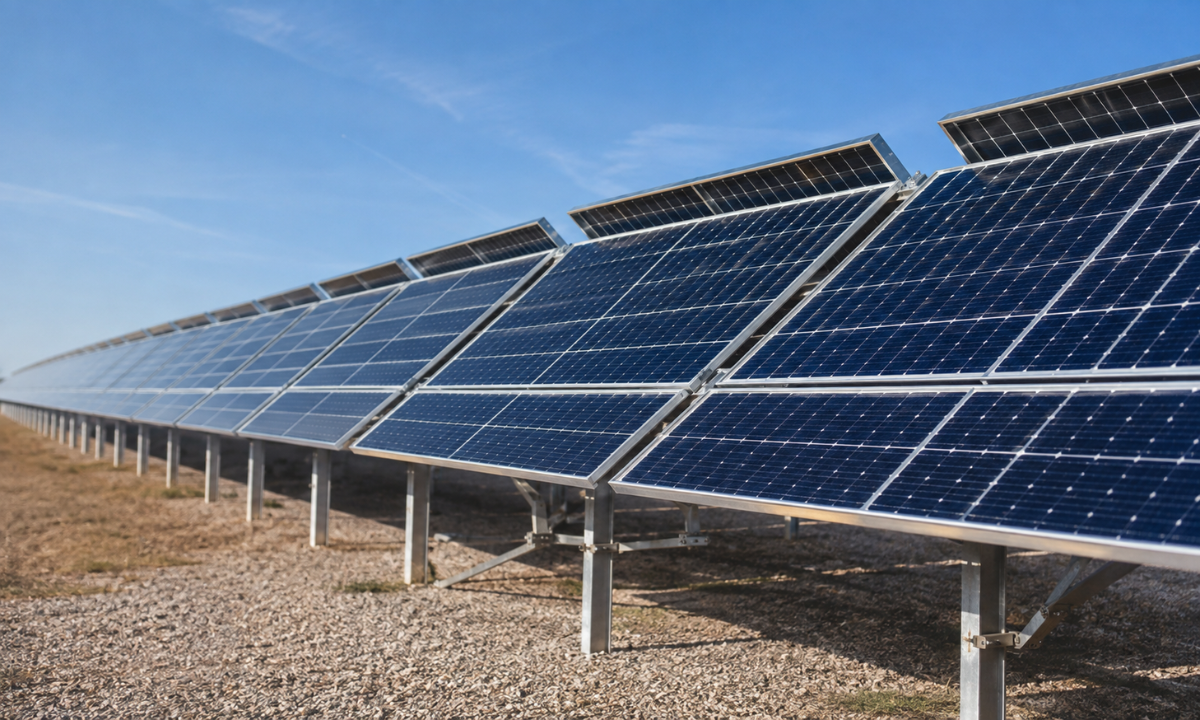
Engineered for both commercial rooftops and premium residential installations, Panasonic modules deliver high energy density across limited roof spaces:
- High-Density Power Ratings (570Wp to 585Wp+): Incorporates 144 half-cut N-type cells, achieving module conversion efficiencies up to 22.66% to maximize power generation per square meter.
- Bifacial Light Harvesting: Semi-tempered rear glass captures diffused and reflected albedo light, generating up to 10% to 25% additional energy on reflective commercial rooftops and white RCC slabs.
- Low-Temperature Loss (-0.29%/°C): The phosphorus-doped N-type substrate maintains stable output during hot summer afternoons, mitigating peak midday thermal losses.
- DCR & Non-DCR Options: Available in Domestic Content Requirement (DCR) compliant configurations to support public sector tenders and commercial net-metering programs.
Deploying high-efficiency bifacial modules allows commercial facilities to generate substantially more total megawatt-hours across annual production cycles without expanding their physical rooftop footprint.
2. Bill-of-Materials (BOM) Rigor & Durability Standards
Modules deployed in harsh operating environments require high-grade encapsulation and structural materials:
PANASONIC MODULE BUILD QUALITY METRICS
- Encapsulation: Dual-Glass / POE Packaging for Complete PID Immunity
- Enclosure: Split IP68 Junction Box with Integrated Bypass Diodes
- Front & Rear Glass: Dual 2.0mm Semi-Tempered Anti-Reflective Glass
- Mechanical Load: 5400 Pa (Snow/Static) / 2400 Pa (Wind Uplift)
- Certifications: IEC 61215, IEC 61730, IEC 61701 (Salt Mist)
- Complete PID & Zero-LID Immunity: Advanced POE encapsulation paired with N-type chemistry eliminates initial Light-Induced Degradation and prevents Potential-Induced Degradation in high-voltage DC strings.
- Automated Quality Inspection: Multi-stage optical and Electroluminescence (EL) testing before framing prevents internal micro-cracks and hot-spot risks during transport and operation.
- Industrial Environment Compliance: Certified under IEC 61701 (Salt Mist) and IEC 62716 (Ammonia Resistance) for long-term deployment in coastal corridors and industrial manufacturing zones.
Strict adherence to international bill-of-materials standards protects the physical module from premature delamination, cell degradation, and moisture ingress throughout its multi-decade operating lifecycle.
3. Lifecycle Warranties & Bankability
Tier-1 equipment backed by transparent warranties simplifies project financing and third-party Power Purchase Agreements (PPAs):
- Comprehensive Workmanship Warranty: Covers structural materials, anodized frames, and junction box components against manufacturing defects for 12 to 15 years.
- 30-Year Linear Performance Guarantee: Guarantees a minimum output retention of >87.4% at Year 30, with first-year degradation capped at ≤ 1.0% and annual linear decay limited to 0.40%.
- Institutional Bankability: Recognized by commercial lenders and financial institutions, facilitating smooth debt financing approvals for commercial projects.
Supported by more than a century of electrical manufacturing heritage, these long-term guarantees protect capital investments, maintain predictable project cash flows, and ensure high residual asset valuation for decades.
Site-Specific Selection Matrix & Pre-Purchase Checklist

Selecting the right module requires balancing regional climatic conditions with roof structural characteristics. Solar EPCs, developers, and facility managers can consult this engineering matrix and pre-purchase checklist to confirm hardware compatibility before placing procurement orders.
Site-Specific Solar Module Selection Matrix
| Roof Substrate | Regional Climate Zone | Recommended Module Architecture | Key Engineering Justification |
|---|---|---|---|
| Flat Concrete (RCC) | Arid / High Heat (e.g., RJ, GJ) | N-Type TOPCon/HJT Bifacial (Dual Glass) | High albedo reflection (+15–20% yield) combined with low thermal coefficient (-0.29%/°C). |
| Flat Concrete (RCC) | Coastal / Humid (e.g., TN, KL, MH) | Dual-Glass N-Type TOPCon (Bifacial) | Dual-glass moisture barrier; certified IEC 61701 salt-mist corrosion resistance. |
| Metal Shed (Standing Seam) | High-Heat Industrial (e.g., KA, MH) | Monofacial N-Type TOPCon (580Wp+) | High power density per purlin; low thermal degradation; non-penetrating seam clamps. |
| Metal Shed (Corrugated) | High Rainfall / Monsoon | Half-Cut Mono PERC / TOPCon Monofacial | Excellent low-light response; hydrophobic self-cleaning ARC front glass. |
| Sloped Clay Tile | Residential / Coastal | Compact 108-Cell Monofacial (400W–450W) | Lightweight ergonomic handling; rafter-anchored tile hooks; reduced structural point-loading. |
The 10-Point Pre-Purchase Technical Verification Checklist
1. Technical Datasheets & Factory Verification
1. Factory Flash-Test Serialization: Confirm that delivered modules include serialized flash-test data showing positive power tolerances (0 to +5W) with zero negative deviation.
2. Electroluminescence (EL) Defect Reports: Verify double-EL testing records to ensure zero micro-cracks, soldering faults, or dead cell areas across the shipment.
3. Temperature Coefficient Verification: Check that the Temperature Coefficient (Pmax) is ≤ -0.30%/°C for high-temperature deployment zones.
4. Bill-of-Materials (BOM) & Encapsulant Check: Ensure module encapsulation uses high-grade POE or UV-stabilized EVA layers alongside anti-reflective coated front glass.
5. Environmental Certifications: Confirm valid certificates for IEC 61215 (Design), IEC 61730 (Safety), IEC 61701 (Salt Mist), and IEC 62716 (Ammonia Resistance).
Verifying serialized factory flash-test reports and EL imaging prior to consignment dispatch ensures that only high-integrity, positively sorted modules reach the installation site.
2. Electrical & Balance-of-System (BOS) Compatibility
6. Maximum String Voltage Check: Model string open-circuit voltage (Voc) at minimum winter temperatures to keep total voltage below inverter limits (<1000V / 1500V DC).
7. Inverter MPPT Current Matching: Ensure module operating current (Imp) and short-circuit current (Isc) do not exceed the inverter’s maximum input current.
8. Structural Racking Load Ratings: Check that module frame profiles (30mm–35mm) match mounting clamp specifications and regional wind-uplift ratings.
9. Verified Supply Chain Sourcing: Procure exclusively through authorized Tier-1 distributors to maintain valid OEM warranties and direct technical support channels.
10. Transit Packaging & Insurance: Requires heavy-duty vertical pallet packaging with corner protectors to prevent frame warping during transit, backed by transit insurance.
Conducting thorough electrical and mechanical compatibility checks prior to order placement eliminates on-site delays, prevents current clipping, and ensures that the physical installation operates safely across its full design life.
Partnering with Sun-AP Ecopower: Turnkey BOS Supply & B2B Distribution
Scaling a solar installation business requires a supply chain partner who pairs Tier-1 hardware distribution with technical engineering support. Sourcing components across fragmented, unauthorized suppliers introduces risks of component mismatches, unverified flash data, and delayed warranty processing.
Sun-AP Ecopower addresses these challenges by serving as a centralized, authorized clean energy distribution partner connecting global Tier-1 manufacturers with EPCs, system integrators, and commercial developers across India, the Middle East, and Africa.
Solar EPC contractors and commercial project developers partner with Sun-AP Ecopower for four foundational operational advantages:
- Authorized Multi-Brand Tier-1 Portfolio: Authorized distributor for leading PV module manufacturers including Panasonic, REC (Singapore), Adani Solar, Goldi Solar, and Novasys, alongside inverter systems from Enphase (USA), FIMER / ABB, DEIF, and Livguard.
- Turnkey Balance-of-System (BOS) Kits: Supply complete solar kits combining PV modules, inverters, ACDB/DCDB protection boxes, DC disconnect switches, solar DC cables, and structural mounting hardware, eliminating multi-vendor coordination issues.
- Centralized Logistics & Warehousing: Extensively stocked distribution hubs in JP Nagar, Bengaluru, facilitate prompt dispatches across Karnataka, Tamil Nadu, Andhra Pradesh, Telangana, Maharashtra, and export corridors in the GCC and Africa.
- Full Regulatory & Post-Sales Support: Provides 100% GST-compliant e-invoicing, serial-number-tracked warranty documentation, and dedicated assistance for Return Merchandise Authorization (RMA) claims and engineering sizing.
Consolidating module procurement, inverter synchronization, and balance-of-system logistics under a single verified distribution channel accelerates project execution schedules and guarantees bankable system performance.
Conclusion
Choosing the right solar module requires matching semiconductor chemistry to regional climate conditions and roof structures. By pairing high-efficiency cell technology with Tier-1 build quality, solar developers can build high-yield arrays that generate maximum clean energy over a 30-year operational life.
Contact our technical distribution team for site-specific module selection, flash-test validation, and bulk bill-of-quantities (BOQ) quotations:
- Headquarters & Distribution Hub: Sun-AP Ecopower Private Limited, #393, 2nd Cross, Dollars Colony, JP Nagar 4th Phase, Bengaluru, Karnataka 560078
- Official Website: sunapecopower.com
- B2B Procurement Helplines: +91 88844 66393 / +91 88844 11530 / +91 88844 90100
- Direct Commercial Inquiries: marketing@sunapecopower.com
Partnering with Sun-AP Ecopower provides your solar projects with verified Tier-1 hardware, complete balance-of-system integration, and dependable long-term energy yields.