When evaluating residential energy infrastructure, the conversation has permanently shifted from environmental consciousness to hard financial mathematics.
The PM Surya Ghar Muft Bijli Yojana has catalyzed this transition across India, turning standard domestic rooftops into high-yield, subsidized financial assets. For modern homeowners and property developers, understanding the core on-grid solar system benefits is no longer optional; it is the baseline for smart real estate engineering.
However, securing these guaranteed government returns requires a rigorous approach to architectural compliance, starting with the integration of authorized, Tier-1 On-grid solar inverters capable of synchronized utility communication.
Let’s strip away the marketing noise and examine the exact financial architecture of the 2026 PM Surya Ghar scheme, detailing how premium hardware compliance translates directly into a secured, multi-decade return on investment.
Decoding the 2026 PM Surya Ghar Subsidy Math
The government solar scheme, officially the PM Surya Ghar Muft Bijli Yojana, is structured not as a tax write-off, but as a Direct Benefit Transfer (DBT). Once the system is installed, inspected by your local DISCOM, and the net meter is commissioned, the capital is transferred directly into your Aadhaar-linked bank account.
However, a common misconception in the market is that the subsidy scales linearly with the size of your installation. This is incorrect.
The 2026 framework is heavily front-loaded to incentivize the first three kilowatts of generation, which covers the baseline load of a standard Indian household. Any capacity built beyond 3 kW is driven entirely by your personal consumption needs, not by increasing government payouts.
To accurately calculate your upfront capital requirement for a residential solar system, you must understand the current national baseline tiers.
The 2026 Residential Subsidy Matrix (Central Guidelines)
| System Capacity | Subsidy Calculation Metric | Total Central Subsidy (DBT) | Estimated Annual Bill Savings |
|---|---|---|---|
| 1 kW | ₹30,000 per kW | ₹30,000 | ₹9,000 – ₹11,000 |
| 2 kW | ₹30,000 per kW | ₹60,000 | ₹18,000 – ₹22,000 |
| 3 kW | ₹60,000 (for first 2 kW) + ₹18,000 (for 3rd kW) | ₹78,000 | ₹28,000 – ₹35,000 |
| 5 kW+ | Subsidy permanently capped after 3 kW | ₹78,000 | ₹45,000 – ₹60,000 |
*> Annual savings depend heavily on localized DISCOM tariffs and the specific generation index of the region.
While several state governments (like Uttar Pradesh, Delhi, and Gujarat) offer localized top-ups that stack on top of this central baseline, the ₹78,000 cap remains the universal anchor for the solar subsidy scheme in India. Your return on investment accelerates rapidly within the first 3 kW, resulting in a typical capital payback period of just 3.5 to 5 years.
Understanding Net Metering
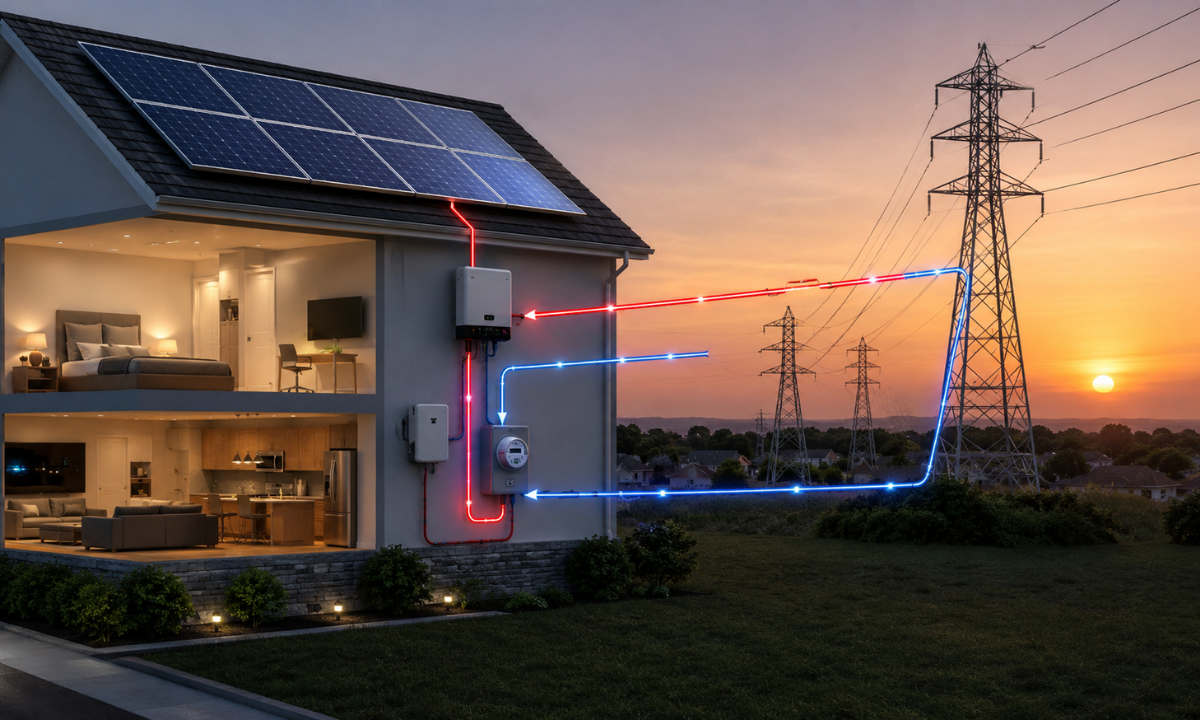
An on-grid solar system does not rely on expensive, chemical-heavy battery banks to store power for nighttime use. Instead, it treats the local electrical grid as a massive, frictionless “virtual battery.”
This elegant architecture is powered entirely by a bi-directional net meter, which serves as the core operational mechanism for unlocking true solar energy for homes.
During peak daylight hours, your rooftop system will frequently generate more electricity than your household currently consumes. Instead of letting this surplus power go to waste, an on-grid system automatically channels the excess energy backwards through your net meter and directly into the utility grid.
The Bi-Directional Energy Cycle
When the sun sets, your system stops generating, and your home seamlessly draws power from the utility grid exactly as it did before. At the end of the monthly billing cycle, your local DISCOM reads the net tally:
Net Units Billed = Total Imported Units – Total Exported Units
Quantifying Net Metering Benefits
To understand how this mechanism directly impacts your operational costs, it helps to examine how units are balanced across different time periods.
| Operating Condition | Energy Flow Dynamics | Billing & Credit Impact |
|---|---|---|
| Peak Generation (10:00 AM – 3:00 PM) | Solar generation exceeds home load. Surplus electricity flows into the utility grid. | Your net meter runs backbackwardsnking generation credits with the DISCOM. |
| Off-Peak / Evening (6:00 PM – 5:00 AM) | Solar generation is zero. Home load is powered entirely by the grid. | You consume the energy credits accumulated during the day. |
| Monsoon / Heavy Overcast Days | Solar generation drops below home load. Grid automatically supplements the deficit. | Minimal credits are exported, but home power remains completely uninterrupted. |
| End of Billing Cycle (Monthly) | Grid automatically calculates the net balance between total imports and exports. | If exports exceed imports, credits roll over to the next month, cutting bills down to fixed minimum charges. |
This continuous balancing act is where the financial power of net metering benefits becomes obvious. By eliminating the need for localized battery storage, you avoid the heavy capital expenses associated with battery replacements every seven to ten years.
The utility grid absorbs your daytime peaks and covers your nighttime valleys, ensuring that every single kilowatt-hour your roof produces is either utilized immediately or monetized as a direct credit on your monthly electricity bill.
The ALMM Mandate & Hardware Compliance
While the financial returns of the PM Surya Ghar scheme are highly attractive, the government does not simply hand out capital for any hardware you decide to place on your roof. To protect the integrity of the national grid and promote indigenous manufacturing, the Ministry of New and Renewable Energy (MNRE) has implemented strict regulatory guardrails.
If you execute a home solar installation using non-compliant, imported, or gray-market hardware, your subsidy application will be immediately and permanently rejected.
The DCR and ALMM Checkpoints
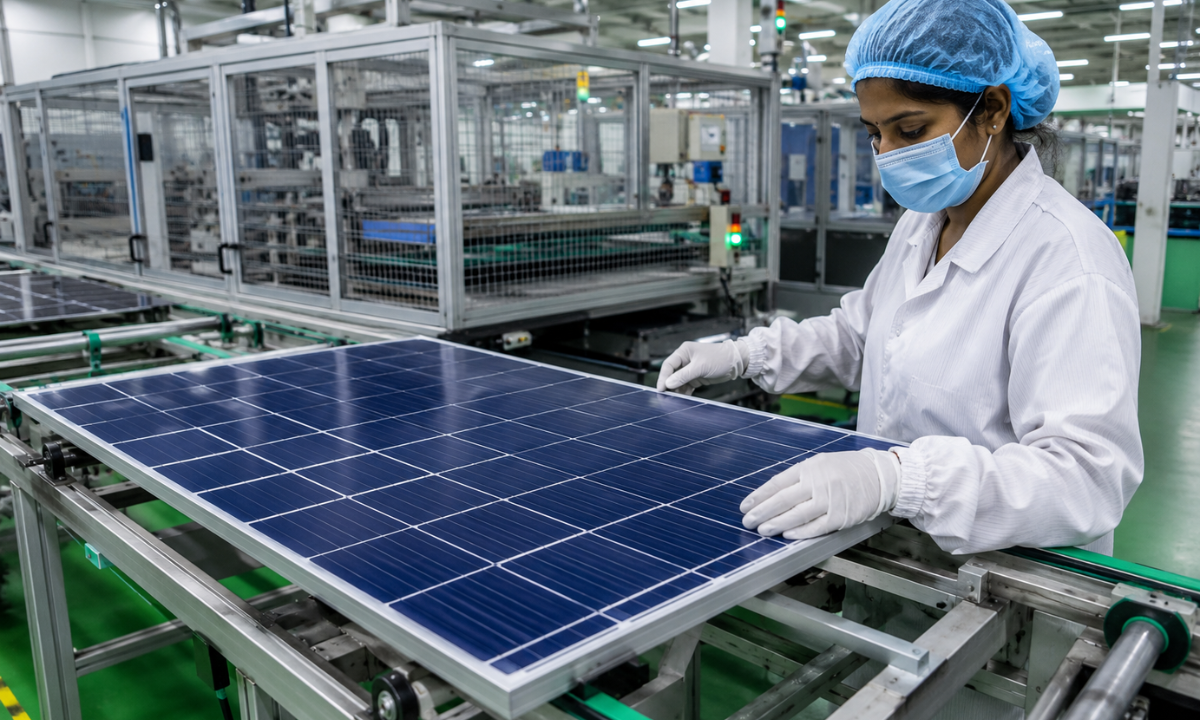
To qualify for the Direct Benefit Transfer, every single solar module on your roof must pass two critical certifications:
- Approved List of Models and Manufacturers (ALMM): The government maintains a strict, frequently updated registry of approved solar equipment. If the specific make and model of your panel is not on the ALMM list, it is disqualified from the subsidy.
- Domestic Content Requirement (DCR): To claim the government payout, the panels must be manufactured in India using domestically produced solar cells. You cannot use imported cells wrapped in an Indian-assembled module.
Navigating Tier-1 Quality within Compliance
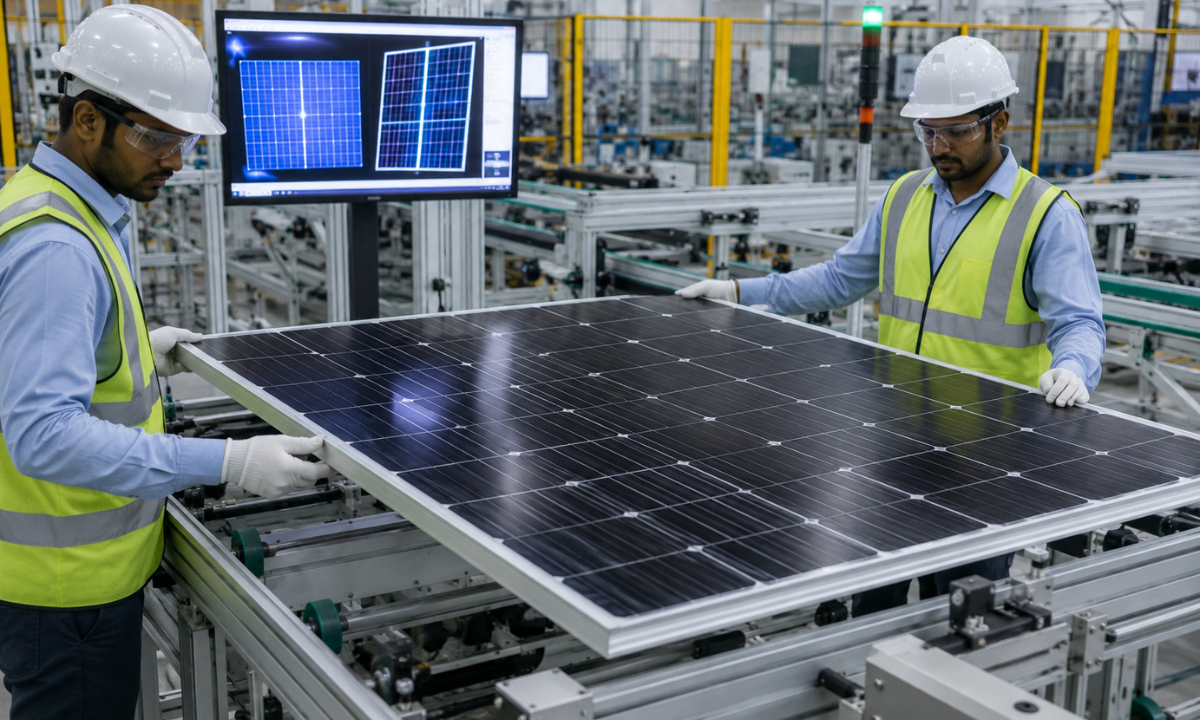
The challenge for premium property owners is finding hardware that meets these strict domestic government mandates without sacrificing global, Tier-1 engineering standards.
Many budget vendors push cheap, localized panels simply to check the DCR box, but these modules often suffer from rapid thermal degradation.
This is where working with authorized distributors becomes critical. We ensure that your system utilizes high-efficiency, Tier-1 modules such as ALMM-compliant variants from top global ecosystems like Panasonic Solar Panels (often deployed through their localized Anchor by Panasonic division) or other premier DCR-approved manufacturers.
Meticulously matching global-grade engineering with strict local DCR compliance, we guarantee that your subsidy is approved without compromising the 25-year structural integrity of your system.
Premium vs. Budget Components
Securing the PM Surya Ghar subsidy is only the first step in maximizing your solar investment. The true financial test of a solar array is its ability to consistently generate power over a 25-year lifecycle. While DCR and ALMM certifications ensure basic regulatory compliance, they do not guarantee long-term engineering excellence.
Many installers will attempt to maximize their own profit margins by quoting the absolute lowest-grade DCR panels and budget inverters that legally qualify for the subsidy. While this reduces your initial capital outlay, the math over two decades is devastating.
Saving ₹20,000 upfront on unverified, gray-market components can easily cost you ₹3,00,000 in lost generation, recurring maintenance, and complete inverter replacements over the system’s lifespan.
When you treat your rooftop solar as a long-term financial asset, investing in Tier-1, globally recognized components even within the domestic manufacturing constraints is the only way to protect your return on investment.
Hardware Impact on Subsidy ROI
| Engineering Metric | Tier-1 Authorized Equipment (e.g., Panasonic, Enphase, Deye) | Unverified Budget / Gray-Market Hardware | Financial Impact Over 25 Years |
|---|---|---|---|
| Thermal Degradation | Built with high-purity silicon. Degrades at an ultra-low rate of 0.45% annually, even under intense 50°C Indian summers. | Poor quality encapsulation and cell micro-cracks lead to rapid degradation rates of 1.5% to 2.0% annually. | Budget panels can lose up to 35% of their generating capacity by year 15, directly destroying your monthly bill savings. |
| Smart Inverter Uptime | Heavy-duty capacitors and advanced cooling heat-sinks ensure 99.8% uptime with seamless utility grid synchronization. | Uses cheap internal components highly susceptible to voltage spikes. Frequent shutdowns during minor grid fluctuations. | Every hour the inverter is offline, your home pulls expensive power from the grid, entirely negating your net-metering benefits. |
| Warranty Enforceability | Backed by billion-dollar corporate entities with localized Indian service networks. Claims are honored swiftly. | “White-labeled” brands that frequently go bankrupt or rebrand within 3–5 years, leaving you with zero support. | When a budget inverter fails in year 6, you will bear the complete cost of buying and installing a brand-new unit out of pocket. |
| Grid Communication | Advanced internal gateways provide micro-level telemetry to cloud platforms, isolating specific panel faults instantly. | Basic Wi-Fi dongles provide delayed, inaccurate data. Cannot detect localized shading or bypass diode failures. | Undetected string faults in budget systems can drain your generation by 20% for months before you notice it on your utility bill. |
The fundamental truth of solar engineering is that the cheapest system is never the most profitable. By anchoring your installation with Tier-1 modules and smart inverters, you ensure that the high-yield generation curves established in year one are fiercely protected all the way through year twenty-five.
Why Choose Sun AP- Ecopower? Securing Your Energy Asset with Sun-AP Ecopower
The PM Surya Ghar Muft Bijli Yojana represents a rare, highly lucrative opportunity to have the government underwrite a significant portion of your transition to energy independence. However, the bureaucratic and engineering friction involved in actually securing that direct bank transfer from strict DCR hardware verification to navigating local DISCOM net-metering approvals is substantial. This is not a process that should be entrusted to unverified, fly-by-night local installers.
As one of the most technically authorized Solar Product dealers in India, Sun-AP Ecopower bridges the critical gap between premium global engineering and strict domestic regulatory compliance. We operate as a fully MNRE-empanelled partner, meaning our commitment extends far beyond simply supplying hardware; we architect the entire lifecycle of your energy asset.
- End-to-End Subsidy Management: We completely eliminate the administrative burden. Our in-house regulatory team manages the entire PM Surya Ghar portal workflow on your behalf from initial feasibility approvals and DISCOM liaison to the final commissioning and DBT subsidy realization.
- Uncompromised Tier-1 Hardware: We guarantee that every panel and smart inverter installed on your property is 100% ALMM and DCR compliant, securing your subsidy without forcing you to settle for sub-par, rapid-degrading gray-market components.
- Precision Engineering: We do not believe in “one-size-fits-all” solar kits. Our engineers design bespoke on-grid architectures tailored precisely to your property’s localized irradiance footprint, shadow profile, and base electrical load, ensuring maximum grid-export profitability.
To capitalize on this scheme without jeopardizing your long-term ROI, you must partner with an engineering firm that intimately understands both the regulatory landscape and the physics of high-yield solar generation.
Conclusion
Modern real estate is only as valuable as the infrastructure that powers it. Every day your roof sits empty, you are passively absorbing the rising costs of utility grid power and missing out on a rapidly closing window of government financial assistance.
By leveraging the PM Surya Ghar scheme through an authorized, premium integration partner, you permanently insulate your home from volatile electricity tariffs and build a structural asset designed to generate wealth for the next twenty-five years.
Do not leave your subsidy to chance. Connect with the engineering team at Sun-AP Ecopower today to schedule your site feasibility analysis, select your Tier-1 DCR hardware, and initiate your official PM Surya Ghar application.