Frequent power outages, voltage fluctuations, and the rising cost of electricity have made backup power systems a necessity in modern homes and businesses. When people start exploring solutions, the first question that arises is: What is the difference between UPS and an inverter?
Although both devices provide power during grid failures, they serve different purposes, operate differently, and are suited to distinct use cases. Choosing the right system can significantly impact appliance performance, energy costs, and long-term reliability.
In this detailed guide, we’ll explain everything from what inverter technology is, how a UPS works, to a direct comparison of UPS vs inverter — including real-world applications and where advanced solutions like those offered by Sun-AP Ecopower can play a role in power backup strategy.
What Is an Inverter?
An inverter is an electrical device that converts direct current (DC) from batteries into alternating current (AC) — the standard form of power used by most household and industrial appliances.
When there’s a power outage, an inverter begins supplying backup electricity by drawing energy stored in connected batteries. It’s a backup power system designed primarily for longer runtime and higher load capacity.
How an Inverter Works
Inverters operate on a simple principle:
- The mains electricity charges the battery during normal operation.
- When power fails, the inverter detects the loss and switches to battery mode.
- It converts the stored DC to AC for connected appliances.
- Once grid power returns, it switches back and recharges the battery.
Although the switching time — typically 10 to 20 milliseconds — is small, it is not fast enough for sensitive electronics like computers without data loss. However, this is usually negligible for fans, lights, refrigerators, and similar appliances.
Types of Inverters
Inverters come in different designs based on waveform output:
Pure Sine Wave Inverters
These provide high-quality AC power nearly identical to grid electricity and are ideal for sensitive electronics, modern appliances, and high-efficiency equipment.
Modified Sine Wave Inverters
Occasionally produces distortion that may cause humming in certain devices — generally more suitable for basic loads.
Square Wave Inverters
Basic output type is rarely used today due to poor power quality.
Overall, Sun-AP Ecopower provides reliable inverter systems, including solar-compatible units that integrate smoothly with renewable setups like solar panels and storage systems for sustainable energy performance.
What is UPS?
UPS stands for Uninterruptible Power Supply — a system designed to provide immediate and uninterrupted power during outages, particularly for sensitive electronics.
Unlike inverters, UPS systems are constantly active and switch power delivery seamlessly when grid power drops — typically within 0 to 5 milliseconds — which is critical for computers, servers, networking equipment, and medical systems.
How Does a UPS Work?
A UPS continuously monitors incoming power from the main supply. When electricity flows normally, it conditions and regulates the power while simultaneously charging its internal battery.
The moment a power interruption or voltage fluctuation occurs, the UPS instantly switches to battery mode without noticeable delay. This ensures connected devices continue running without shutdowns, data loss, or hardware damage. Once the main power supply is restored, the UPS switches back and recharges its battery automatically.
Types of UPS
UPS systems are broadly categorized into:
1. Offline/Standby UPS
This system provides a buffer against minor outages and surges and is cost-effective for small equipment.
2. Line-Interactive UPS
Offers improved voltage regulation, beneficial where minor voltage fluctuations are common.
3. Online UPS
Delivers continuous, clean, and stable power, ideal for mission-critical equipment.
UPS vs Inverter, Key Differences Explained
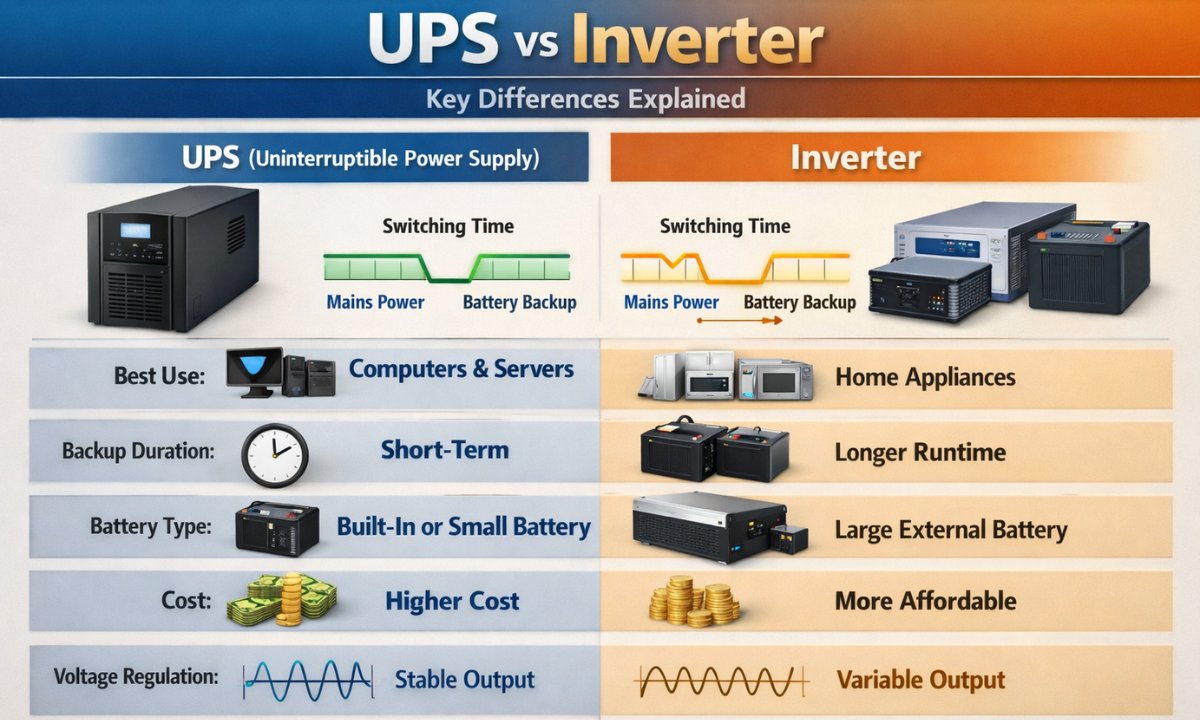
To properly address the difference between UPS and inverters, it’s best to compare them across key criteria:
| Feature | UPS | Inverter |
|---|---|---|
| Switching Time | Near-instant (0–5 ms) | Slight delay (10–20 ms) |
| Best Use | Computers, servers, sensitive hardware | Entire household or heavy appliances |
| Backup Duration | Short-term | Longer runtime with larger batteries |
| Battery Type | Usually built-in or small external | Larger external batteries |
| Cost | Higher per watt | More economical |
| Voltage Regulation | Stronger (especially online UPS) | Varies based on model |
1. Switching Time
The difference between UPS and an inverter begins with switching time. UPS systems switch almost instantly to the battery without interruption, while inverters take a fraction longer. This makes UPS superior for devices where even a blink in power can cause data loss or damage.
2. Load Capacity and Backup Duration
Inverters generally support larger appliances — lights, fans, refrigerators, washing machines — and can run longer using larger battery banks. UPS systems are often designed for short bursts of power, just long enough to save work and shut down safely on computers or servers.
3. Cost and Application
Inverters are widely chosen for households because they are cost-effective for whole-home backup, whereas UPS systems — though more expensive — are essential where power continuity is critical.
4. Voltage Regulation & Safety
Many UPS systems — especially high-end online models — offer better surge protection and voltage regulation. Inverters with poor regulation may allow voltage spikes or dips that can affect sensitive electronics. Premium models available through Sun-AP Ecopower include enhanced protection features for safer power backup solutions.
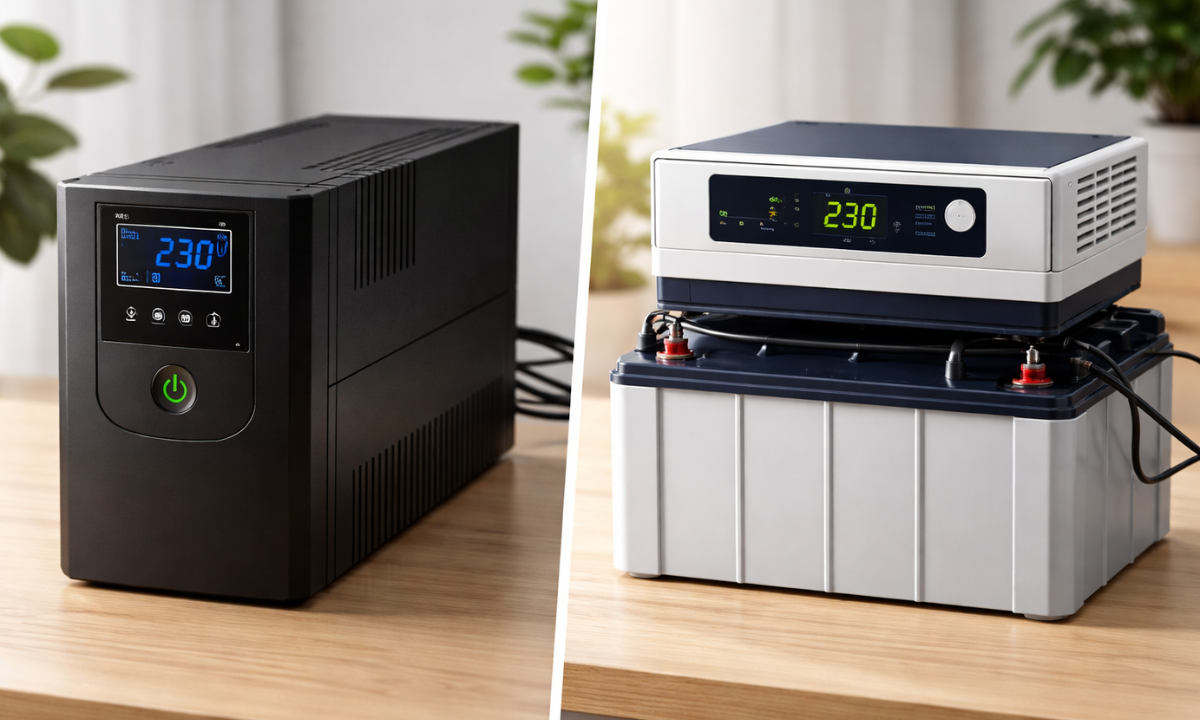
UPS Inverter With Battery — What You Should Know
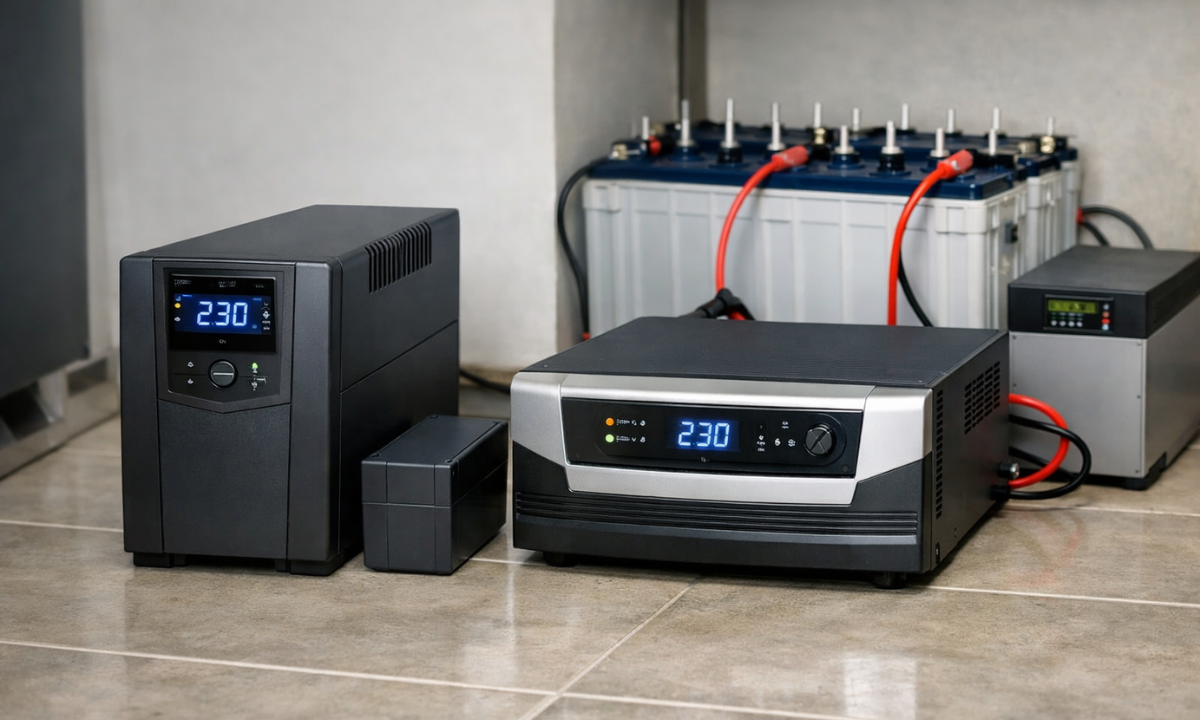
There’s often confusion around the term “UPS inverter with battery”. Here’s the fact:
- A UPS typically includes an internal battery or is designed to connect to a small external battery.
- A standalone inverter requires separate external batteries, such as tubular or lithium storage systems.
Larger batteries in an inverter setup mean longer backup duration, whereas UPS batteries are usually sized for short transitions and protection of critical equipment.
Battery Types & Long-Term Performance
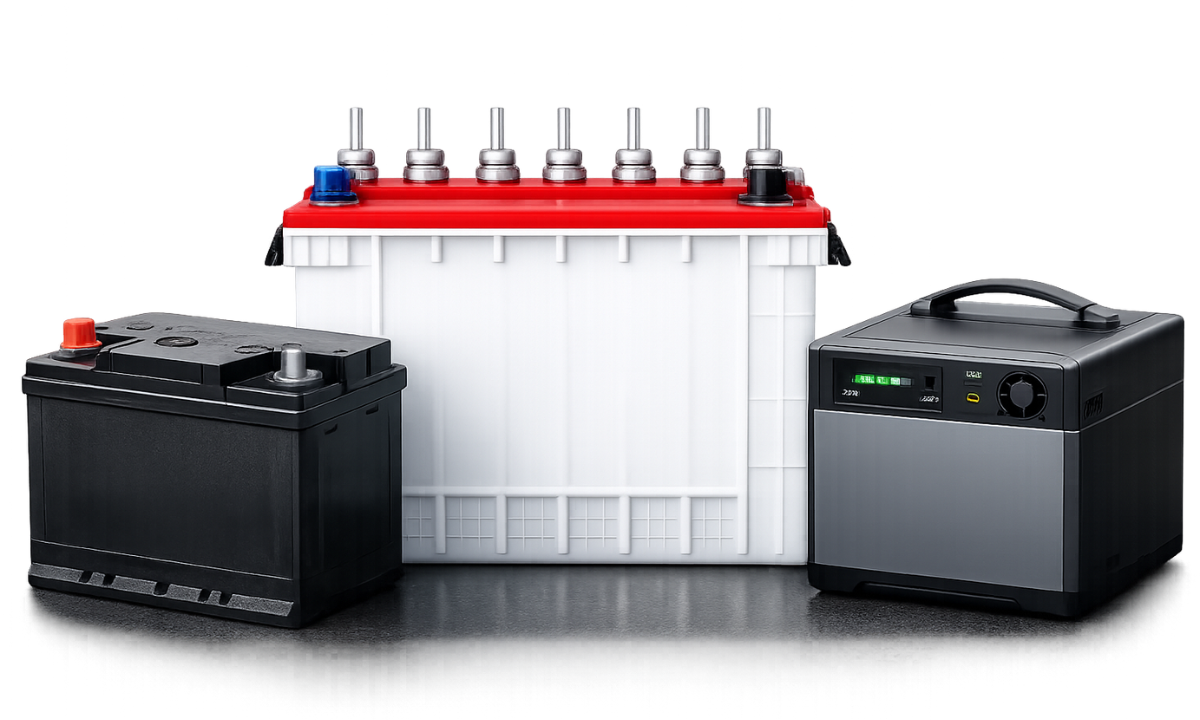
Your backup system’s effectiveness depends on battery type and capacity.
Lead-Acid Batteries
Affordable but requires maintenance.
Tubular Batteries
Common in inverter setups and known for deep discharge capabilities.
Lithium-Ion Batteries
Newer technology — longer lifespan, faster recharge, compact design, and increasingly popular in advanced systems like hybrid solar inverters and portable UPS models available on Sun-AP Ecopower’s shop.
These batteries make the system future-ready and ideal if you’re considering long-term energy independence.
Integration with Solar & Renewable Energy
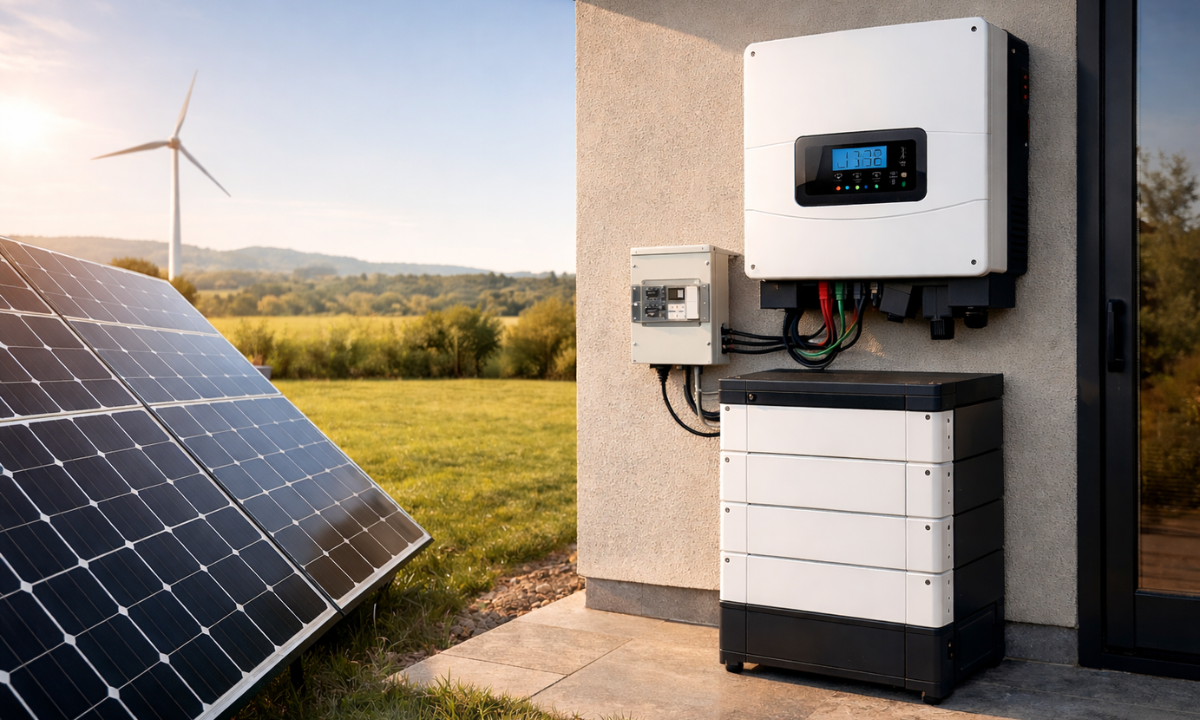
Modern inverters, including hybrid and solar variants, can integrate with solar panels to store clean energy and reduce dependence on grid power. Systems from Sun-AP Ecopower not only support standard inverter functions but can also be part of an off-grid or hybrid solar setup for energy independence.
This hybrid ability means your power backup system isn’t just a temporary solution — it becomes part of a long-term energy strategy.
Safety, Protection & Smart Features
Both UPS and inverter systems should incorporate key safety features:
- Overload protection
- Short-circuit protection
- Thermal management
- Battery health monitoring
Higher-end systems, like those distributed by Sun-AP Ecopower, often include integrated monitoring features that allow users to view performance, battery status, and energy production data — giving you peace of mind and operational clarity.
Browse verified solar products online
Real-World Scenarios
Here’s a simple way to decide your best option:
Scenario 1: Home User
If your priority includes lights, fans, televisions, or an entire household backup, an inverter — possibly solar-integrated — is usually the best choice.
Scenario 2: Office or Small Business
If you run computers, networking gear, or servers that can’t tolerate even a brief interruption, a UPS is indispensable.
Scenario 3: Renewable Hybrid Setup
For properties interested in solar with backup and possible grid interaction, hybrid inverters — such as those available from Sun-AP Ecopower — deliver both energy independence and resilience.
Frequently Asked Questions
1. What is inverter technology?
An inverter converts stored DC battery power into AC electricity for use by your appliances and systems.
2. What is the main difference between UPS and an inverter?
The key difference is switching time and purpose — UPS systems switch immediately and prioritize sensitive equipment, while inverters provide broader backup power with longer runtime.
3. Can I use a UPS inverter with a battery for my entire home?
Standard UPS systems are not designed for whole-home backup unless they are high-capacity units paired with appropriate battery systems.
4. Which backup lasts longer during outages?
Generally, inverters paired with large battery banks provide longer runtime than standard UPS systems.
5. Are systems from Sun-AP Ecopower reliable?
Yes. Sun-AP Ecopower, one of India’s trusted solar and electrical technology distributors, offers high-quality solar inverters, hybrid systems, and UPS products with lifecycle support and warranty assurances.
Final Thoughts
Understanding the difference between UPS and inverters empowers you to choose the most suitable backup power solution for your home or business.
If you prioritise uninterrupted switching and protection for sensitive devices, a UPS is essential. If you’re looking for longer power runtime, integration with renewable systems, and whole-home backup, a modern inverter, especially one that can integrate with solar systems, is often a better choice.
To explore high-quality options, expert guidance, and advanced systems that can meet your exact energy and backup requirements, consider browsing the products and solutions at Sun-AP Ecopower India’s trusted partner in solar, inverter, battery, and backup energy solutions.